Logo

Need help 1976 351winsor

Angler4reel

New member
I have a 1976 Clean Machine Trojan, with twin 351 merc, I just finish installing all the parts on a long block for the RR engine, and it will not fire. The one question I have is my crank and distributor both turn cw, I have tried the manual firing order and I get nothing. I was told ford did make a motor that turn and ran backwards during this time period but no one seems to no were to get spec for this app. Is it possible to get the firing order for the way it is or do I have a problem... Tranny is a brog warner.
 
here a pic of 351 firing order,but you need to know what direction the motor turns, ford did have a reverse rotation.
 

Attachments

  • 351 Firing order.jpg
    351 Firing order.jpg
    90.2 KB · Views: 94,200
See if the firing order is stamped on the intake manifold or on the valve cover. Do you have a manual?
 
LH/RH rotation is determined when viewed from the flywheel end only.

Yes, that is a good example.
The 5.8L standard LH Rotation firing order is as shown below....... likewise with the RH Reverse Rotation firing order below.
5.8L distributors and oil pumps both rotate standard and in the CCW direction.


attachment.php


The RH Reverse Rotation engine starter motor must be correct.
Crank her over, and verify the cranking rotation.

This link will let you see which way each starter motor needs to rotate.
http://www.ebasicpower.com/faq/rotate.htm


I believe that any raised firing order numbers (on the intake manifold), are going to be for Std LH Rotation engines.


.
 
I do have a manual and the firing order mention hear did not work. My RR engine may have a gear driven camshaft which is why my dizzy is turning cw. Trying to find information on this type of application. Thank u for your input
 
Angler4reel, I did not quote this in my first response, but perhaps this may help you.
............ I just finish installing all the parts on a long block for the RR engine, and it will not fire. The one question I have is my crank and distributor both turn cw, I have tried the manual firing order and I get nothing.
** Is is safe to assume that you are viewing the distributor from an above prospective... IOW, looking down upon it....... Yes/No?
** Is it also safe to assume that you are viewing the crankshaft from the FRONT of the Engine....... Yes/No?


Angler4reel, a couple of things here that may help you:

The LH (Std) and RH (Rev) Rotation Ford 5.0L and 5.8L use different firing orders.
Are you certain that these are 5.8s?


The Std LH rotation Ford 302 (5.0L) V8 Engines 1-5-4-2-6-3-7-8
The Std LH rotation Ford 351 (5.8L) V8 Engines 1-3-7-2-6-5-4-8
The Std LH rotation Ford 351 (5.8L), 400 and 5.0L/302-HO V8 Engines 1-3-7-2-6-5-4-8
For either of these engines (in a RH Reverse orientation)......, we simply read the firing order in a reverse direction, and place #1 in front of the "8".
#1 cylinder will always be our referrence cylinder for both camshaft indexing and Ignition indexing.

NOTE: #1 TDC occurs twice. Once during the Compression Stroke.... and once during the Exhaust Stroke.
When we begin with Ignition timing, #1 must be TDC on C/S ONLY! (this is very important)
If not on C/S, the crankshaft/distributor phasing/indexing will be 180* off @ the distributor.... or, 360* off @ the crankshaft.

All oil pumps rotate in the OEM direction, so therefor the distributor must also rotate OEM correct... (i.e., CCW when looking down upon it)


Whether chain drive, 2 gear drive or 4 gear drive camshaft, the correction for the distributor/oil pump direction is made within the gear camshaft and distributor design.
Furthermore, a RH Reverse Rotation engine that would be using a 2 gear camshaft drive system, simply brings the camshaft back to a standard LH Rotation Engine orientation.
IOW, the distributor and oil pump (in this RH Reverse Rotation engine) would not know that they are being installed in a RH Reverse Rotation engine, unless you told them! :D


So..... I'd make sure that:

  • you are fully understanding Std and Rev rotation Ford 5.8L engines, and how to tell which is which.
  • these are indeed 5.8s.... and not 5.0s.
  • you are setting up your ignition distributor by beginning with #1 TDC C/S.
  • you are using the correct firing order beginning from #1 cylinder TDC C/S only.
  • your starter motors are turning the crankshaft in the correct direction.
Remember that Industry Standards tell us that we view engine rotation from the flywheel end....
NOT THE FRONT END!
However....... if/when viewing your engines from the front end.... (I.E., the Circ Pump/V-belt/Harmonic Balancer end):

  • a Std LH Rotation Engine will turn the crankshaft CW.
  • a Non-Std RH Reverse Rotation Engine will turn the crankshaft CCW.
*******************
It's got to be something very simple. I'm sure that you'll find it! :)
 
Last edited:
1 what was the direction of the old motor
2 what was the new block
3 do you have the correct rotation starter

look at the props, if there both the same you have standard rotation engines.1 left and 1 right you have a reverse rotation motor. only the crankshaft turns reversed in most cases.sometimes the trans is setup for reverse rotation.
 
Boat Doc makes a good point.
Not all Stbd engines are required to be reverse rotation.... this may be acheived via the transmission.... so prop hand alone may not tell us much!

However, in 1976 it's very likely that a Stbd side engine would require Rev Rotation.
 
(this topic was also discussed in another thread. I suggested that we keep it here.)

OK.... if we stick to this one thread, I think that we can get to the bottom of this for you.

Suggestions:
Re-read Bt Doctur's firing order posted in #2, and my suggestions in posts #4 and # 6.

Verify your starter motor rotation for the RH Rev Rotation engine..... (of which should be the Starboard Engine).

Verify that the ignition distributor is indeed turning CCW.

Bring this engine's #1 piston up to TDC and on the Compression Stroke ONLY.
(remember that TDC occurs twice.... once on the Exhaust stroke and once on the Compression stroke)

Make certain that the rotor is indexed to the #1 cylinder tower in the distributor cap.
(typically we index the distributor so that the rotor is aiming towards the physical location of #1 cylinder while at TDC C/S....... although not a deal breaker as long as the firing order is maintained.)

After verifying the above, and while at TDC C/S, loosen distributor clamping unit.
Place a spark plug wire directly into the ignition coil.
Place a known-to-be-good spark plug into the wire boot.
Lay this spark plug onto a metal surface where Negative contact is ensured.

Watch for any fuel vapors that could pose an explosion issue.

Move the distributor CW as to place the spark triggering event in a "retarded" position.
(this step is key to what we're about to do next)

With the ignition key switch ON, rotate the distributor CW until you get one crisp, sharp, crackling, white in color, triggering event.... I.E. a spark.
(the distributor must be moved quickly for this)
Do this several times as to get a feel for it.

Once you are comfortable that you can stop rotating (the moment of a triggering event), tighten the clamping unit a tad bit so that the distributor will not move on it's own.

This generally places the spark event close enough to fire an engine on (baring that all else is A-OK).
This is also generally a bit on the retarded side..... so you may need to advance it as soon as it fires up.

Follow this by setting your BASE advance with your strobe light.

NOTE:
Always follow setting BASE advance by checking/setting the progressive advance, and the full-in TA (total advance).
BASE is BASE, and that's all that BASE is.
We fire up on BASE advance, and we idle on BASE advance....... that's it!
The important numbers are the Progressive and TA.
For this, see your OEM service manual.
 
Last edited:
Hmmm, what does "Eeeee" mean? :D

Angler4reel, I've been using that procedure for more than 40+ years. I can tell you that it does work, and that it works well.

Just go about this methodically and systematically.
Use the P of E (process of elimination) one item, and one item at a time ONLY, as you go down a list of things to check.

Begin with starter motor rotation for each engine.
Don't waist your money on a Bendix drive Ford starter motor (shown below).
images

I'd suggest one of the HTGR/PMGR starter motors.
These will kick a$$ over that of the OEM Non-gear reduction motors, plus no more Bendix drive.

a20792912f0d54fddcb5ca_m.JPG


Next, see if the distributor is rotating correctly.
Then find #1 TDC on the C/S (compression stroke) for each engine.
Next, align #1 spark plug wire with the rotor and corresponding tower on the distributor cap.
Then follow the correct firing order for the engine being set up.
#1 location in the distributor cap will be same for either engine.
Port engine should be your LH Std Rotation engine...... 1-3-7-2-6-5-4-8
Stbd engine should be your RH Rev Rotation engine..... 1-8-4-5-6-2-7-3

If you get the engines cranking over in the correct direction as they should....., and if the above does not get you going, then it's likely that the camshaft is incorrect.... either that, or the way that the cam is being driven.

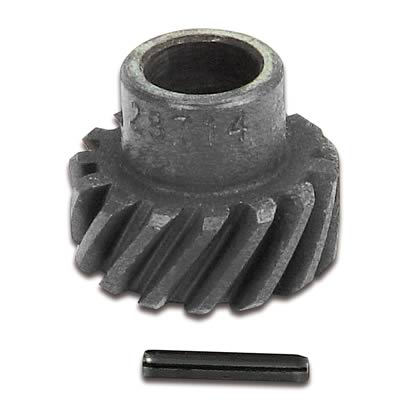
Here is a Reverse Rotation Windsor...... FORD 75-87 8 cyl 351/5.8 W engine.
Note that they are using a chain drive.
This means that the camshaft is also rotating CW (with the crankshaft) when viewed from the flywheel end.
The also means that the camshaft "drive" gear and the distributor "driven" gear are a special cut for the RH Rev engine (in order to maintain CCW rotation of the distributor).
for-302lb.jpg


Note the difference in the gear cut between the LH and RH distributor "driven" gears.
With the correct cam gear and distributor gear......, the distributor and oil pump will rotate CCW.
(STD LH Rotation gear on left....................................................... REV RH Rotation gear on the right)

maa-29421_w.jpg
maa-28714a_w.jpg

Next
Image


http://www.ebasicpower.com/presto/index.php?ID=526 for more info.
 
Last edited:
Thank Rick, you were right , keeping this discussion on one forum, help me get results. I like to thank everyone for all your help and advise. Took sometime to go over everything, went back reconnect everything just to make sure, not thinking it would start or even run, after hooking everything up,l thought to myself let me just try to start it , first touch of the switch VAROOM, scared the s$&t out of me. All n all thank you guys, l appreciate it.....
 
One question, I didn't have any gauges during the break in process, toward the last few min, the riser got fairly warm to touch, ls that normal. I read on one of the forum were they drill the hole in the spacer a little bit bigger for more water flow. Is that something anyone would recommend doing.
F
 
...the riser got fairly warm to touch...
Just as long as you can lay your hand on the top of it w/out getting burned. Use a laser temp. gun to check operating temps. all around the engine. If I remember right the riser runs around 140 deg. F.
 
I would connect your instruments before going any further.
You'll be on the water for proper break-in, and you really want to have all instruments working.

Do not forget to set your timing up for TA, especially during this break-in procedure.

Like guyjg said, you should be able to touch a riser without being burned, when the correct water flow is present.
 
.............. toward the last few min, the riser got fairly warm to touch, ls that normal. I read on one of the forum were they drill the hole in the spacer a little bit bigger for more water flow. Is that something anyone would recommend doing.
I'd first clean this port out to the OEM diameter, and give it another test. It may be restricted via rust scale, etc.
Once renewed, temps may return to normal.

If you were to open a port up that may be part of the OEM cooling flow design, you may upset the balance.
I'm not suggesting that you DO NOT do this, just give it some thought first.
Maybe look at several other areas also.

I am not familiar with your system (without seeing a schematic), but perhaps you can find something in a Merc Service Bulletin that addresses this.


.
 
I will definitely check the ports out, make sure everything is clean, l also went and purchase some gauges to hookup as well. I didn't get a Chances to set the timing or adjust the carburetor while it was running, l let it run for about 15 min or so, l will run it again this weekend and make all the adjustment. Any advise or suggestion on setting the timing etc......
 
If newer than 10 yrs. for fresh water use and 5 yrs. for saltwater use I would have the exhaust components cleaned by a radiator shop and pressure tested just as part of the rebuild as Rick noted. Over 9 years for fresh and 4 yrs for salt they would all get replaced...cheap insurance for a new engine. If you acid dip them yourself you'll need a deep pale of muriatic acid w/a lid, face mask, rubber apron, boots and gloves. Dipping the riser and elbow is not hard it's the manifolds that are difficult.
 
Idle in gear ~ 650 rpms
Out of gear or neutral ~ 700-750 rpms

Base Timing for almost any V8 these days with the gas available is 6-8 degree BTDC

As far as your exhaust manifolds go, Like said if they have been fresh water only then age is your enemy. If salt water use then get new ones and be done with the hole experiment...........

Those square log type manifolds suck to be honest with you.......Unfortunatly the only way around this would be to change to a center riser style from a OMC I/O of a newer year. This would be a much beter system with lots less to worry about.
I believe a 90's vintage may work and that is if they were using small block fords. I know they were using big block fords but dont remember the transition to small block chevys.....I did work on some OMC's with 302's.......


Of course my recomendation is only valid if you need to replace the manifolds. You could find the parts here on this site for reference or purchase.
 
The riser and spacers are all new, l did keep the manifolds, l was told they were still good, so l clean them in muriatic acid, they have been sitting in my garage until now. Before installing them, l took them them to the car wash and flush them out. The engines are stored in my garage, and it will be awhile before l installed them back into the boat. So when that times comes, l might just invest in some new manifold as suggested. Thank you again for all the good advise, this is my first boat project and l need all the help l can get....lol.. How long do muffler last, and how do you know when they are bad.
 
I will definitely check the ports out, make sure everything is clean, l also went and purchase some gauges to hookup as well. I didn't get a Chances to set the timing or adjust the carburetor while it was running, l let it run for about 15 min or so, l will run it again this weekend and make all the adjustment. Any advise or suggestion on setting the timing etc......
Best advice that I can offer, is to not make the mistake of setting BASE advance ONLY, and not taking it any further.
I see well seasoned marine mechanics make this very mistake.......... They set BASE, and look no further. :mad:

I'd suggest that you see your OEM ignition timing specs, and then physically check your progressive spark advance up to the full-in RPM, and make a comparison.
Your harmonic balancer will need to be marked off.
If you know the balancer diameter, you can purchase a Mr. Gasket decal that installs directly onto the outer ring.
Now you can strobe your timing marks at idle, and up to the limit RPM and compare to the OEM specs.

If you want to take it a bit further, you can jot these numbers down in approximate increments of 300-400 RPM, and then plot this out in graph form.
This can be compared to the OEM curve.

At the risk of redundancy, BASE advance is BASE advance, and all day long.
We fire up on, and idle on BASE advance..... that's all we do on BASE advance.

The important numbers will be the progressive advance, and the RPM at which the system if full-in!
Not enough advance will seldom cause anything but poor performance, and poor fuel economy.
Conversely, too much progressive advance, and/or excessive TA (total advance) may cause detonation, of which can be very destructive.

This is of particular importance for the Marine Engine where loads are more constant, and are maintained for much longer durations.


NOTE: Checking the progressive and TA can also be done with the digitally advancing type timing lights, of which I will not use for Marine Ignition timing.
By doing the above method....., we get to view this in real time/real degress, and with less risk of an error, IMO.

I know that the guys who use the digitally advancing timing lights love them. I mean no offense, it's just not my preferred procedure.

 
Last edited:
If his ignitions are still the stock ones then he would have mechanical weights and springs and points,rotor, condensor.

If he is going as far as new/rebiult motors then it would be advisable to get a good all in one MARINE electronic replacement distributor where he need only a matching coil. This would allow a full 12 volts to the coil and a much more dependable system and do away with the points once and for all......

JMHO
 
Would any of the electronic distributor conversion kits Be adequate.
I not one to recommend the conversion kits. Conversions do ZERO for any worn 30+ year old distributor components.
I go with complete new units.

Do you know which systems are installed now?
In 1976, it could have been Prestolite, Mallory and I believe that there was a Marine Motocraft ignition as well.
Plus, these could be mechanical triggering (points) or any early electronic triggering system.

I'm rather bias on this because I like the VR that Mallory offers. (VR= variable reluctor... or magnet ignition)
productimage_4791.gif


So my initial suggestion would be the Mallory YLM554CV for the Std LH rotation engine, and the YLM554DV for the Rev RH rotation engine.
If you like the photo eye system, this becomes the Mallory YLU554CV and the YLU554DV.

If you like the idea of EST and/or HEI (in mechnical advance or EST) then there are some choices in these also.

.
 
Back
Top