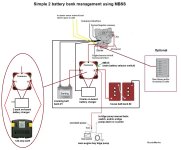
Regarding the two battery installation:
This is what we call a "two bank" system.
"Bank" being the repository of energy stored in the battery.
Incorrect!
A battery bank is what is described in your next sentence.
A bank can be a single or multiple batteries all grouped to form one bank.
Usually these are divided into "Start" bank, and "House" bank, but you can have more banks depending on need (your 19 footer probably won't need more).
The important concept of separate banks is that you want your start battery bank to be fully charged and ready to start the engine at all times and never use it to run anything but the starter,
Yes, we refer to this as being held in "reserve".
while the house battery bank runs everything else...lights, pumps, electronics, etc.
When the house bank has been selected..... that is correct!
Another important factor is isolation. You don't want to be in a situation where the start bank is bleeding voltage into the house bank. Big no on that.
In the old days, a thing called a Battery Selector Switch was used. It's a big ol rotary switch that lets you select 1, 2, ALL or none. Totally steampunk. Its main drawbacks are; possible drainage of start bank
when left in the ALL position.
No one should be selecting the ALL/BOTH mode.
That is to be used in an emergency scenario ONLY.
Possible destruction of the alternator if moved when engine is running (altho there is a type that's known as make-before-break that is supposed to minimize that risk),
You would be hard-pressed to find an MBSS today that was not "Make-before-Break".
What you DO NOT want to do, is to pass through the OFF position while the engine is running.
fire hazard, and shock risk if installed incorrectly. Nice, huh? At least they are shielded so they won't throw a spark and blow you and your boat to atoms if there's fuel vapor in the area.
Yes, these are Ignition Source Protected.
Even while they are, they should NEVER be mounted within an engine bay!
They should be in a location that offers easy and quick access.
On the other hand it's a pretty simple setup that works if you understand it.
The modern way is with something known as a voltage sensing relay (VSR). These are solid state electronic devices that do several jobs. First they maintain the full charge on the start bank. They isolate the start battery from the house battery. They maintain the house battery when the start battery has been filled.
They allow for emergency parallel of the house and start bank in case the batteries get too low.
The only style that will provide that feature, will be the Bluesea 7622ML ACR or one similar.
A standard VSR or ACR will not.
They eliminate human intervention.
There are many brands out there and they all offer this basic set of services along with other features such as optional manual switching (with a remote switch on the dash) interface with the electronics, blah blah blah.
Such as the Bluesea 500 amp 7622 ML with the remote switch.