Logo

Mercruiser 5.7 overheating, raw water cooled Alpha 1 Gen 1 sterndrive

Cliffs

Member
Hello,
I'm new here and have never posted on a forum. I need some ideas and really hope somebody can help. I just bought a 1990 Sea Ray, raw water cooled, Alpha 1 Gen sterndrive, carburetor, and in very nice shape but it does run hot. The engine was replaced in 2010 with a Mercruiser remanufactured engine which starts and runs perfectly. I've only had it on muffs, not on the water. The temp gauge did not work but I have since replaced it and the sending unit. I have been using an IR temp gun and the manifold risers got up to about 300 degrees and the engine over 200!! Launch water is over an hour away so I'm trying to make sure to eliminate an overheating problem without putting it in the water. I have read some old threads on this same subject and made some changes.

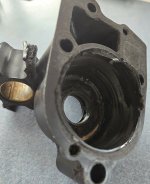
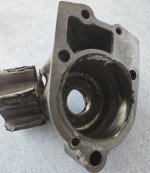
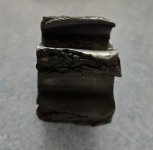
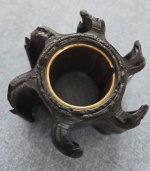
I have changed the raw water lift pump in the lower unit, only the top half and impeller and not the base. The impeller was incredibly bad and the case was melted. The alignment tube was badly distorted. The gasket mating surface between the two halfs of the pump was a bit messed up from the top half melting so much. Now I'm wondering if I should have also replaced the bottom half of the pump......

I changed the 160 thermostat, it worked fine in boiling water, to a 140 thermostat.

I removed and inspected the exhaust risers and they looked very clean like they had never been in salt water, cleaned off what little corrosion there was, no cracks, reinstalled with open gaskets which is what came off of them. The exhaust flappers are intact and there is exhaust coming out the middle of the prop - no water though.

Replaced the engine water circulating pump. Old one seemed okay on visual inspection so no obvious issues. I was also hoping that replacing the circulating pump would solve the high pitch whining but it didn't. I can't seem to narrow down where that whining is coming from even with my stethoscope??

Any suggestions and/or ideas would be very much appreciated. I'm happy to send any pictures or additional information.

Thanks!
Cliff
 
Because of the pump damage, I suspect you may have old impeller pieces blocking the water passages. When the pump fails & before the operator is aware, hot exhaust will have melted everything. That is what you initially found. Probably should have replaced the entire pump. New base would have come with gaskets & seals.

Disconnect the seawater "in" hose at the 1st connection inside the boat. Essentially this is at the transom plate. Connect your garden hose to the outdrive & start it briefly. Don't run it too long because you will have no exhaust cooling. (Although from the sound of it, you have already ran it without cooling water.) Does water flow into boat? If not, you have obstacles from the pump up to & thru the bell housing, 3/4" hose & thru hull fitting.

If you have a steady flow of water, it's time to reconnect hose & disconnect further downstream, right after the power steer cooler & try again.

I'd bet if there is an obstruction it will be before it enters boat simply because of the twists & turns thru the upper gearcase & bell housing.

If you know how to remove the drive, you can pull it off then hook your garden hose inside the boat to the 1st hose I told you to disconnect. Now your engine is being fed cooling water directly & if it runs cool with water flow out exhaust you know your problem is outside. Don't try this test without removing drive or you will fry the impeller.

Because you have run it on several occasions & got it hot each time, you may have melted your new pump housing. Risers should be cool enough to almost keep your hands on them. Certainly not 300 deg.
 
I would look first at this, Follow link and note item 3 and item 2.

You need to confirm item 3 (rubber insert) is properly in place and the copper tube is not pinching it and closing off water flow.
Item 2 is plastic, the water flow follows a S path through it and if any impeller pieces made its way up the copper tube, it could clog in this area.


Also there is a power steering cooler inline with the incoming water hose. This may have a screen and any impeller pieces could be clogging it.

See item 22 in link (power steering cooler)

 
May I also humbly suggest that while you are at it, replace all the belts, hoses, do a complete tune up to include plugs wires cap rotor (and points condenser if equipped) change the oil with new filter, inspect every single hose clamp, check all the mounting bolts and nuts, and clean off the contact points on the starter and ground strap along with the battery terminals then grease the f outta those.
Any new-to-you boat should be highly suspect regarding maintenance, so getting a baseline for your records is important. Unless the PO hands you a log book with dates and receipts, assume the boat needs everything.
 
Wow, some good ideas! I will order a new lift pump with base. I have to do all online ordering because there isn't a marine store nearby, about 2.5 hrs. away. I never thought to check above the pump or the power steering cooler. I don't think "item #3" in the diagram was installed when I took it apart to replace the lift pump. Does it slide over the copper tube or go over the end of it? Does it look like a cap or an o-ring? Does the copper tube pull out?

Belts and hoses and ignition parts are absolutely like new as is the alternator. Everything looks OEM and right off the shelf. I always do everything possible to bring maintenance items up to date when I purchase anything new. I have changed the oil and fuel filter, tightened and inspected all connections but I want to wait to get into the ignition items until after this overheating problem is resolved. It starts instantly and runs great, no leaks.

The lower unit was replaced at one point. I was surprised there wasn't a groove in the top of the shaft for an o-ring, does that sound correct?

Any ideas on narrowing down where the the whining is coming from?

Thanks!
Cliff
 
Did you look at item 3 in the parts list?
Its not an oring.

It is a keyed rubber cup, tapered on the inside to seal to copper tube both at the impeller housing and Item 2 the plastic part with the S path way thdough it.
They are the same part used in both locations.....

If you have Zero background or expeience , either get someone who does or watch a lot of Youtube videos to understand what and how.....and why....
 
Just wondering what the rubber cup looked like. Thanks for the description. The diagram isn't clear and the part was missing when I took it apart. I've had other outdrives apart and removed the full outdrive to replace the Gimbal bearing and bellows and removed the lower unit a few times on other boats but yes, I'm just a DIY guy that can't afford to pay shop rates. Mechanic all my life and over 30 years owning I/O boats, doing DIY (see my profile) but I have never messed with item 2 or had an overheating problem like this. Appreciate your help. I'll check out some YouTube videos.
 
If you replaced the impeller housing with new, the rubber cup is typically already installed.
Its the plastic part attached to the upper gear case that need to be checked out.
 
Yes, there was a rubber cup in the new housing but not in the old.... The copper tube presses into it, correct?
The copper tube was intact and seemed rigid and attached to the upper case. I'm thinking I was okay putting it together. I'll install a new pump with base and check under the plastic part #2 for rubber pieces from the old impeller. Since the lower unit was replaced could it be an updated model and take another pump or would it not match the upper unit if that was so? Shopping for another pump online, I want to make sure I'm getting the right pump.
 
What you should do is,

1. Pull drive off. Remove incomming hose at engine water pump, get garden hose and stick it into hose and secure the best you can. Turn on water and back flush system to bellhousing and see if anything comes out.

Yes the copper tube is commonly stuck in upper and appears to be ok.
Your problem is something is NOT ok.

You said impeller was in bad shape, not the best descriprion when asking for help.

Be more descriptive, a lot more!

Was the impeller 100% intact or were there pieces missing?

Also, severe over heating causing plastic to melt at impeller housing means lack of water so EVERYTHING in the cavity between the upper and lower where the water impeller lives is suspect.
 
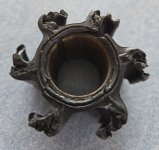
I will attach pictures of the impeller and impeller housing. Part of the impeller housing was melted through. Pieces of the impeller were melted onto the inside of the impeller housing. The impeller itself has pieces missing and is jagged but the pieces might have come off and melted to the inside of the impeller housing so MAYBE all pieces were contained in the housing.

20240908_111748.jpg20240908_111701.jpg20240908_111538.jpg20240908_111515.jpg20240908_111504.jpg20240829_104556.jpg20240829_104138.jpg
 
Can a bad seal between the upper and lower halves of the lift pump cause my over heating? I cleaned up the lower half sealing surface when I replaced the upper half but it was kind of rough. I put it back together hoping the gasket would fix it.
 
Its not called a lift pump.

It is called the stern drive IMPELLER.

I would pull the base out of drive, use two large flat head screw drivers on opposite sides and pry it up.

Get a flash light and look down and make sure pathway from intake ports to impeller housing is clear of debrie and possibly impeller chunks. They can fall down into passage and cause problems.

Once you have it all apart clean real good, if you have to scrape gasket surfaces for flat and clean for gaskets. If you want, you can paint it.

Note the oring on the base, dont throw anything away until you match gaskets and oring. Kits come with several gaskets and orings for multi models.

Also when reassembling base install correct gakset first before oring is installed. Also all orings get coated with perfect seal or equivalant. Seal lips with 2-4-C or good grease. Also be carefull of splines when installing base (seals preinstalled in base)
 
Thanks. Do you have a diagram for the orings and other seals near the sterndrive impeller for this model? The tag on the lower unit says Alpha 1 REMAN 5010147R1 if that helps or do you just need to know Alpha 1 Gen 1 ?

What do you think of the impeller pictures? Is this exceptional or pretty typical? I've never seen one so bad but I haven't seen very many.
 
Above is the link to lower unit. Click gear housing (driveshaft) - MR. Sorry I'm not good at linking. The Alpha Gen1 is considered a "MR" drive.

Note item #42, rubber ring also called "slinger". It gets slid down the driveshaft to the top of the housing. It causes any escaping water to be slung outward so it doesn’t climb the shaft & wash grease out of the splines.


Regarding the o-ring groove, later units didn't have one.
 
Thanks. Do you have a diagram for the orings and other seals near the sterndrive impeller for this model? The tag on the lower unit says Alpha 1 REMAN 5010147R1 if that helps or do you just need to know Alpha 1 Gen 1 ?

What do you think of the impeller pictures? Is this exceptional or pretty typical? I've never seen one so bad but I haven't seen very many.

MR and Alpha are 100% transferable of all parts. The only difference when new was the vertical drive shaft for the MR (First release) had an oring and groove just below the splines. The Alpha (final release) did not have the oring or groove.

Both lower gear cases have, (MR/Alpha)
One oring at impeller base.
One oring at shift shaft bushing
One very large oring at prop shaft carrier
If vertical drive shaft has a groove at splines, one oring goes there.(this oring gets greased) All other orings mentiined get perfect seal or quality gasket goop.

That "slinger" refered to is to keep exhaust gases from getting into the impeller housing. For Gen 1's It is a thick square edged oring. It gets pushed down and sits on the impeller housing. (I add a small amount of grease to impeller housing top where this will spin for a little lubrication)

Thats all there
 
Thanks. Do you have a diagram for the orings and other seals near the sterndrive impeller for this model? The tag on the lower unit says Alpha 1 REMAN 5010147R1 if that helps or do you just need to know Alpha 1 Gen 1 ?

What do you think of the impeller pictures? Is this exceptional or pretty typical? I've never seen one so bad but I haven't seen very many.

Yes the Impeller looks horrible but for those of us who have worked in the business, we have seen worse, much worse.
 
Is the tag on the lower unit that says REMAN 5010147R1 the serial number for it? Or is that the part number or casting number. Where would I find the serial number?

What does "MR" stand for? Online searching was coming up with "MR" and "R".

I was comparing the base and gaskets online and it looks like there are two different types used and I don't have a good example to follow now since the one I have in there might be totally wrong because of the overheating. Once I know the serial number for sure I will be able to do an accurate search.

I'm not familiar with "Perfect Seal", what is it? I use a marine grease or a silicone grease for orings, will that work?

Thanks for the info on the "slinger" and the oring groove question. I really like to know the "why" when I'm doing anything, especially when I'm doing the sterndrive impeller over again. This time with a new base to make sure it's all good.
 
Is the tag on the lower unit that says REMAN 5010147R1 the serial number for it? Or is that the part number or casting number. Where would I find the serial number?

What does "MR" stand for? Online searching was coming up with "MR" and "R".

I was comparing the base and gaskets online and it looks like there are two different types used and I don't have a good example to follow now since the one I have in there might be totally wrong because of the overheating. Once I know the serial number for sure I will be able to do an accurate search.

I'm not familiar with "Perfect Seal", what is it? I use a marine grease or a silicone grease for orings, will that work?

Thanks for the info on the "slinger" and the oring groove question. I really like to know the "why" when I'm doing anything, especially when I'm doing the sterndrive impeller over again. This time with a new base to make sure it's all good.


Check your email/messages here
 
Update:
After several long phone conversations.

1. Back flushed incoming water hose- no issues. Some very minor debris.

2. Plastic "s" part with 4 screws that copper water tube fits into in upper gear case, part of gasket was missing and the 4 bokts were not tight- gasket replaced and bolts properly tightened.

3. Exhaust manifold to Elbow gaskets were the wrong ones based on Raw water cooling system design. Gaskets were 4 open passages. - Replaced with correct 2 open and 2 restricted passages per parts diagram. 4 open paasages are for a Riser if used, which it is not.
4. 2nd New waterpump impeller, housing and a new base.

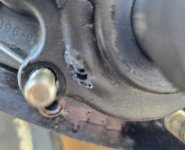
5. Most important, while Cliff was trying to located a dropped nut or bolt in bildge he noticed that the exhaust manifold water inlet elbow was missing its drain plug. Bingo! He fabricated a new one and added a rubber washer and installed.


Now he will reassemble drive and test on the trailer and follow up with results.

Note: He had already replaced impeller housing once and retested and the housing/cavity got hot enough it melted the white plastic guide tube and caused the newly installed impeller to take a shape of one that had been in service for years. He has replaced all with new parts again.

So the missing plug at manifold was the biggest contributor to this over heat issue but when you add wrong manifold to elbow gaskets and the incomming "s" plastic piece being loose and missing a piece of the gasket, it all added up to high temps of the exhaust, manifolds elbows and impeller cavity.
 
Jack is a true wealth of knowledge. Many thanks to Jack for his tireless determination to solve my overheating problem! I learned many tips and tricks for working on a Mercruiser and marine applications in general. I've always worked on jet engines, cars, trucks and tractors but I only have a little experience with marine engines and sterndrives. There are so many parts and procedures that are particular to marine. Working with Jack we solved several problems and potential problems. Also, I changed the thermostat from a 160 to a 140 and replaced the temperature sending unit and gauge. This boat is new to me and I have zero history on it. I had to figure out with Jack's help that it had the wrong elbow gaskets and the impeller housing needed the base replaced as well. Several other issues, as Jack mentioned, were resolved. I'll finish up and install the lower unit and report the results.
 
Back
Top