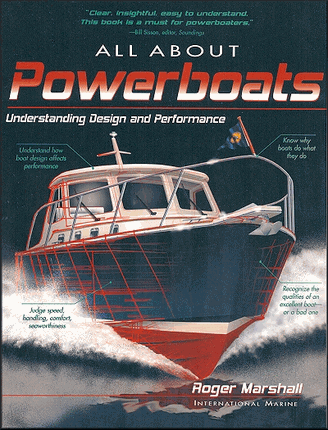
| Whats
the difference between a deep-vee hull and a modified vee? A planing
hull and a displacement hull? Find the answers to these and scores
of other frequently asked questions in All About Powerboats. Writing
for any boater seeking a better understanding of modern powerboat
design and handling, author Roger Marshall provides a well-illustrated,
clear introduction to small powerboats (18 to 30 feet long) from
the perspective of use. His practical advice on hull shape, engines,
construction methods, steering systems, comfort, and safety gives
todays boaters a thorough grounding in powerboat selection, use,
and lore.
Clear,
insightful, easy to understand. This book is a must for powerboaters.--Bill
Sisson, editor, Soundings
Roger
Marshall shares three decades of accumulated boating knowledge
so you can cut years off your learning curve!--Dean
Clarke, executive editor, Sport Fishing
Your plain-language
guide to powerboat design and performance
Whats the
difference between a modified-V and a deep-V hull? Or a planing
hull and a displacement hull?
Why does
boat A have flared topsides and not boat B?
How can I
tell if a boat is adequately powered?
How do I
judge a boats seaworthiness just by looking at it?
What are
the advantages or disadvantages of twin engines or a stern drive?
Get answers
to these and all your questions about powerboat design and performance
in All about Powerboats.
If you want
to know what makes a boat fast, slow, stable, unstable, seaworthy,
comfortable, or ideal for the things you want it to do, heres
a perfect place to start. Longtime boat designer Roger Marshall
tells you what you need to know about hull design, engines, drive
trains, steering systems, comfort factors, safety features, and
construction methods. He translates the jargon, explains the key
concepts, and offers a wealth of insights into what makes powerboats
tick.
Acknowledgments
Chapter 1. FACTORS IN POWERBOAT DESIGN
Powerboat Speed
Other Design Factors
Seaworthiness / Range / Comfort / Cost
Chapter 2. THE LANGUAGE OF HULL SHAPES
Reading the Lines
Profile View / Plan View / Sectional View
Features of Hull Design
Chines / Deadrise / Freeboard / Flare / Keels and Bilge Keels
/
Running Strakes / Trim Angle and Trim Tabs
Chapter 3. HULL SHAPES
Displacement Hulls
Trawler Yachts / Skinny Boats / Catamarans
Planing Hulls
High-Speed Deep-V Hulls / Stepped Hulls
Fishing Hull Shapes
Saltwater Flats Boats / Bass Boats / Offshore Sportfishing
Boats
Semiplaning or Transitional Hull Shapes
Bow / Midbody / Stern
Summary
Common Questions
A Rounded Hull or a Chined Hull: Which Is Best? / How Fast Will
It Go? / How Many People Can I Get Aboard? / What Kind of
Range Can I Expect?
Chapter 4. TOOLS TO HELP EVALUATE BOATS
Speed - Length Ratio / Displacement - Length Ratio /
Length-to-Beam Ratio / Power-to-Weight Ratio / Cubic Number /
Prismatic Coefficient
Chapter 5. Powerboat Styling
Hull Styling
Developing the Sheerline / Developing the Bow and Stern
Adding the Superstructure
Avoiding Clutter
Chapter 6. UNDERSTANDING STABILITY
Factors Affecting Transverse Stability
Form Stability / Center of Gravity / Chines and Chine Flats
Longitudinal Stability
Tender and Stiff Boats
Stability at Large Angles of Heel
Effects of Flooding on Stability
Chapter 7. SEAWORTHINESS
The Skill of the Skipper and Crew
A Seaworthy Hull
Seaworthiness Belowdecks
Engine Room
Seaworthiness on Deck
Chapter 8. COMFORT
A Comfortable Hull Shape
Onboard Location Counts
Stabilizers
Passive Stabilizers / Active Stabilizers / Paravanes / Dynamic
Stabilization
Comfort on Deck
Easy and Safe to Go Forward / Easy-to-Climb Ladders and Stairwells
/ Easy to Work in the Cockpit or to Enjoy the Fantail /
Fewer Steps between Deck Levels
Lighting for Comfort
Deck Lighting / Lighting in the Engine Room
Interior Comfort
Doors, Passageways, and Walkways / Bridge Layout / Sleeping Quarters
/ Bunk Dimensions / Bathrooms and Toilets
Designing for Good Maintenance
Storage
Electronics Storage / Galley Storage / Lockers / Refrigerator
/ Under the Cabin Sole / Overhead Storage / Engine Room Storage
/ Anchor Storage
Chapter 9. POWERING YOUR BOAT
Early Engines
Basic Engine Types
Two-Stroke Cycles or Two-Cycle Engines (Gasoline) / Four-Stroke
Cycles or Four-Cycle Engines (Gasoline) / Diesel
Engines (Inboards)
Outboard Engines
Recent Outboard Engine Developments / Choosing an Outboard
Inboard Engines
The Latest Gasoline Inboard Engines / Diesel Inboard Engines
/ Gas or Diesel Inboard: Which One Is for You? / Single or Twin
Engines?
Sterndrive Engines
Inboard, Outboard, or Sterndrive?
Jet Drive
Drive Train Components
Transmission / Propeller Shaft / Shaft Logs
Chapter 10. PROPELLERS
Propeller Terminology
Increasing Your Propellers Efficiency
Common Engine Solutions
Vibration / Noise
Chapter 11. STEERING SYSTEMS
Wheel Steering
Hydraulic / Cable / Wire
Other Types of Steering Systems
Steering with a Whipstaff / Tiller Steering / Rack-and-Pinion
Steering
Rudders
Steering with Twin Engines
Backing Down
Chapter 12. How a Boat Is Built
The Mold
Making the Plug / Making the Mold
Laying Up a Hull
The Laminate / Interior Moldings / Vacuum-Assisted Resin Transfer
Molding (VARTM)
Evolution of Hull Materials
Core Materials
Resins
Putting the Hull Together
Production Boat Construction / Custom Boat Construction /
Semicustom Boats / Safety
Appendix. INFLATABLES
Puncture Resistance
Rigid-Bottom versus Soft-Bottom
What to Look For: Features and Construction
Index
Author Biography
Roger Marshall
is the technical editor for Soundings. After designing for the
renowned firm of Sparkman & Stephens, he founded his own design
company, where he has designed boats
from 15 to 165 feet. He has written extensively for the boating
press and is the recipient of numerous writing awards, including
recent first-place awards at the annual Boating Writing International
marine journalism contest. He is the author of ten boating books.
|