Logo

Winterizing

Bigblock427

New member
After reading a lot on the subject of winterization I find myself on the fence in regards to using those drain plugs or just plain flushing with the pink stuff. If I ear muff the pink stuff would it be useful to drain engine of water first then close drains and run the pink through ? Also I would rather circulate it then pour it in the hoses unless someone can make me understand how pouring it in serves me better and if so pour it where? I imagine this has been beaten into the ground over time.
 
There is a series of postings for this in the last few days. I'm a believer in draining and puring in thru the hoses...very easy and simple process. A well drained block, manifolds and circ. pump hose won't freeze. Antifreeze is just a bandaid unless it is a closed system.
 
Look at it this way,

Why did they put the drain plugs in there locations to begin with?

Answer: To drain the water when winterizing.

The mythical method of running the motor and using the muffs so suck in the coolant is just that, A myth......many use it including friends of mine.
Got in a real sticky argument about it last year.....

I myself have been wintizing boats for 23 years, and not just my own.........at least a thousand over that time span.
I pull all plugs, poke the residue free untill water flows easily, remove hoses, when water is done draining put plugs back in.
Add RV antifreeze to manifolds, into incoming water hose until pink comes out of outdrive, rest into motor. conect hoses. disconnect batteries, done.

If onboard water pump impeller housing remove output hose and pour antifreeze into incoming water hose at thermo housing to flush water out of hose, while hose is off crank motor over (coil wire out) to get any water out of housing.

It is your boat, if the effort to pull plugs and drain is too great. take your chances........

I know my method works...........just sayin.........
 
Look at it this way,

Why did they put the drain plugs in there locations to begin with?

Answer: To drain the water when winterizing.

The mythical method of running the motor and using the muffs so suck in the coolant is just that, A myth......many use it including friends of mine.
Got in a real sticky argument about it last year.....

I myself have been wintizing boats for 23 years, and not just my own.........at least a thousand over that time span.
I pull all plugs, poke the residue free untill water flows easily, remove hoses, when water is done draining put plugs back in.
Add RV antifreeze to manifolds, into incoming water hose until pink comes out of outdrive, rest into motor. conect hoses. disconnect batteries, done.

If onboard water pump impeller housing remove output hose and pour antifreeze into incoming water hose at thermo housing to flush water out of hose, while hose is off crank motor over (coil wire out) to get any water out of housing.

It is your boat, if the effort to pull plugs and drain is too great. take your chances........

I know my method works...........just sayin


I think the muff route is a pain really. I've Stabilized,flushed,fogged,oil changed,drained manifold, block, forward drain, and changed outdrive lube. Only thing left is antifreeze. Mcm 4.3l v6 merc. I'm a tad confused.

When you stated " rest into motor " were you saying to pour it into the outgoing hose of water pump? Or is there another way . And how much? When I add to manifolds am I supposed to remove hose that leads to thermostat housing and pour in there, and again how much?

This boat is super easy to drain and I'm all for using this method. I do find it strange that all the boat dealers around me want to circulate antifreeze though and mercury suggests using it for anti corrosion measures.

Thanks for the reply. It makes more sense than any thing else I've came across.
 
If we say a V6 or V8

We will say a Alpha drive first with the impeller in the outdrive.

Remove 4 hoses from the thermostat housing. typically but not always the same four based on design.

one hose if the incoming from out drive
one is a large 2 incher from tstat to engine water pump.
the other two go to elbows or bottom of manifolds. (there are other but they are older so we will stick with 80's to 2000's ish)

once block and manifolds are drained. put plugs back in, snug, not to tight.

Outdrive down and level

pour some rv antifreeze into incomming water hose, it will fill up quick but it will also drain down. As it drains down it is forcing water out thru the outdrive.
Do this a couple times in a row and you will use ~ 1/4 of a gallon. you should see pink dripping out the outdrive intake.

now pour 1/4 into each manifold.

pour the rest into the large hose and this will go into block.

attach all hoses.

raise drive

done.

if you have a bravo or inboard you have a on motor water pump impeller driven by a belt either a V belt or serpintine.

with this you must remove the incoming hose at the T stat and at the back of the pump/impeller housing (typically soft hose, the suction side hose is typically very hard due to spring wire stiffining the ose for strength. Pour antifreeze at the t stat side of soft incoming hose and flush all water out with rv antifreeze.

While the hose is off crank engine over with coil wire out of distributor a few times to get any water out of pump. If you want you can pull pickup/suction side hose at thru hull location or in the case of a bravo typical the hose that feeds the pump and add some RV antifreeze and then crank motor over to flush water out of impeller pump housing. when both are done reconnect hoses.

And follow the rest of my previuos description
 
If you want to be sure antifreeze gets to where it's supposed to go, leave the plugs out until antifreeze comes out, then replace the plugs as you go.
 
After reading a lot on the subject of winterization I find myself on the fence in regards to using those drain plugs or just plain flushing with the pink stuff. If I ear muff the pink stuff would it be useful to drain engine of water first then close drains and run the pink through ? Also I would rather circulate it then pour it in the hoses unless someone can make me understand how pouring it in serves me better and if so pour it where? I imagine this has been beaten into the ground over time.
That is an understatement. :cool:

If you care to, give this a read.

I'll say that adding antifreeze to a Raw Water Cooled engine for the primary purpose of rust/corrosion protection, should be the least of our worries.
The amount of rust/corrosion that could occur during the layup period is paled by comparison to that which occurs during the normal season, IMO.
I think that I can safely say, that doing this gives us that "Feel Good" feeling only.

Your call!


.
 
Just to wrap up the issue..... If you try to suck antifreeze into the motor from the outside there is no garentee that all the water will be displaced. Even if you have been told that when you see it come out the exhaust.

I for one have seen enough improperly winterized cracked motors....not not winterized but improperly.

I said once before I should make a video for most engines..4 v6 and v8 standard cooling/ raw water cooled systems including inboard impeller systems.....then maybe sell it...haha
 
Interesting read here. It's funny to me at how many differing opinions there are on this issue of filling with anti-freeze. I have a closed cooled 496 in my boat so the block itself is protected. However I still need to drain and protect the raw water cooling loop, including the heat exchanger. In my 20 yrs. of winterizing my boats, I have done both ways---with the muffs and by pouring the A/F into the hoses. I always pressurize the loop beforehand to drain the water, regardless of which method I use. However, because my Bravo III is such a PITA to run on the muffs, this year I did it the manual way of pouring the A/F into each Exhaust manifold and the outlet hose of the seawater pump until the pink was pouring out of the lower unit. This was after I pulled the blue drain plugs to make sure all of the water was out. If you read other forums, you'll see that many people swear by using the muffs. Either way, I think it's more important to pull the drain plugs and be sure all of the water is out first. Then introduce the A/F either way until it comes back out. I have also read that some people will simply run the anti-freeze through the engine, then drain it back out. Their philosophy is: it flushes out all the water and leaves a anti-corrosion film inside the engine. Sounds like a bad idea to me!
 
A well drained engine will not freeze, however, that said, a $5 gallon of antifreeze is cheap insurance just in case a puddle of water got stuck some where in the system.

one is a large 2 incher from tstat to engine water pump.
When disconnected at the T'stat this hose should be lowered until all of the water drains out of the trap.
 
Thanks everyone for the clarity. Learned way more here than any you tube video on winterization. Someone should make a video walk through that leaves those muffs on the shelf.
 
I am going to purchase and install a Perko Flush Pro valve this winter. It is a T with one way valve that allows you to hook the hose up right in front of the seawater pump. Then you can flush the engine much easier without dealing with the @#$*%$ muffs!! It also has a removable part that allows you to pour the anti-freeze in as well. I'm so sick of trying to get muffs to work!!
 
Problem with the T fitting is you need pressure to open the T valve........so just trying to pour antifreeze into the T wont work.....


At least the ones I have seen....

May want to look into that first before you buy...
 
.........................

Forgive me if this sounds like preaching.... but this is too dang important to NOT get right....., unless you are wealthy, and replacing an engine is a non-issue! :eek:


Just to wrap up the issue..... If you try to suck antifreeze into the motor from the outside there is no garentee that all the water will be displaced. Even if you have been told that when you see it come out the exhaust.
I for one have seen enough improperly winterized cracked motors....not not winterized but improperly.
Kghost just made mention of this huge misnomer!
Average Joe sees antifreeze exit the exhaust..... and he cracks open a beer in celebration of a job well completed!
Come spring time.... Joe learns just how well he actually did! :eek:

........
  1. It's funny to me at how many differing opinions there are on this issue of filling with anti-freeze.

  2. I have also read that some people will simply run the anti-freeze through the engine, then drain it back out. Their philosophy is: it flushes out all the water and leaves a anti-corrosion film inside the engine. Sounds like a bad idea to me!
  1. This like saying that there's more than one way to skin a cat.... and for the most part, there's some truth to that.
    However, the Furier Dealer will tell you that some Cat Skinners will sell them a better pelt!

  2. If after the anti-corrosion value only........ sure, it makes sense.

Thanks everyone for the clarity. Learned way more here than any you tube video on winterization. Someone should make a video walk through that leaves those muffs on the shelf.
I often cringe when I watch some of these home brew You Tube videos.
Use caution!

I am going to purchase and install a Perko Flush Pro valve this winter. It is a T with one way valve that allows you to hook the hose up right in front of the seawater pump. Then you can flush the engine much easier without dealing with the @#$*%$ muffs!! It also has a removable part that allows you to pour the anti-freeze in as well. I'm so sick of trying to get muffs to work!!
You can do this with an engine located sea water pump (Volvo Penta or Merc B drives).... but you cannot do this with a Cobra or Merc A drive.
However, you're still up against the issues as described in the Amazon write up.
 
Speaking of the Amazon write up.........
Here's my new Can'tGo Goof-Proof winterizing kit.
My kits include enough antifreeze to thwart off any risks of dilution during the time that the thermostat hasn't fully opened.

You can purchase this kit directly from my web site Goofy-products.com.... or right here through MarineEngines.com. :)

Optional drum support stick $1.25 + shipping.
Please include length, or you'll need to cut it yourself.
 

Attachments

  • Winterizing kit new improved version w treeco.jpg
    Winterizing kit new improved version w treeco.jpg
    64.8 KB · Views: 359
Last edited:
I have a Bravo III with engine mounted pump. The fitting that I'm looking at has a removable valve that allows you to pour the anti-freeze in.
 
I have a Bravo III with engine mounted pump. The fitting that I'm looking at has a removable valve that allows you to pour the anti-freeze in.
OK..... with the Merc B drive, Volvo Penta I/O or I/B, Crusader I/B, Indmar I/B, PCM I/B, etc......, the sea water pump would be engine located.
So with these systems, the flush kits do what you suggest.
But now we need to know if the engine is Raw Water cooled, or fitted with a Closed Cooling system if you plan to use this kit to introduce antifreeze into the system.

Let's back up for a minute:
With either a RW or CC system, most all sea water is actually by-passing actual engine cooling demands.
IOW, it's going right on out the exhaust.
I don't know what an accurate percentage number would be, but let's say that only 30% or 40% of the sea water is required for engine heat removal, and that the remaining 70% or 60% goes right on out the exhaust system.

Now add that when we winterize, our engines are not under load.... which means that the cylinders are not producing the same amount of heat, which also means that the thermostat may not be opening the same amount as it would while under load.

Our engine block coolant jackets and cylinder head coolant jackets do not offer a clear clean shot for coolant flow.
There are many more twists and turns for the coolant to make it's way through, and many more areas for residual sea water to hide... (possibly later diluting the antifreeze).
With a RW cooled engine, we need lots of antifreeze (my joke solution to this) and lots of time in order for the antifreeze to make a full exchange with the existing sea water......... (unless we begin with a fully drained block!)

In contrast, our exhaust manifolds and elbows offer a fairly clear shot for coolant to flow through them.


With a Closed System, we'd be introducing antifreeze into the sea water side of the Heat Exchanger, and into the exhaust system only.
With these systems, we can expect a fairly full exchange of sea water for antifreeze, and in a rather short amount of time.


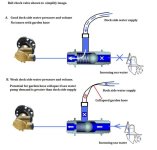
Here's a Flush Pro kit below. These kits are intended to be used "in the water".
(you can substitute "antifreeze" for "dock side" water)

Note the spring loaded check valve. If the sea water pump is pulling more volume than the Antifreeze Supply, the check valve releases and allows sea water to make up for what antifreeze it cannot pull in (or if just flushing... the same thing).

Or... if you're out of the water and on a trailer.... it would simply pull air in (not necessarily a deal breaker as long as the impeller remains wet).


Bottom line for ME (raw water cooled engines)..... if you're hell bent on doing this, do one of two things:

  • Begin with a fully drained engine block, and hope that you achieved a full exchange. :confused:
  • Drain again after wards, and sleep well at night. :D

If you did not read this earlier... perhaps read it now.
Also, read Kghost's second paragraph in his post # 8 again.

 

Attachments

  • Flush kit w weak water supply.jpg
    Flush kit w weak water supply.jpg
    59.4 KB · Views: 1,038
Last edited:
I have a closed cooled 496 Mag, Bravo III. I fully drained my engine, both with the air pump and by manually pulling the drain plugs. I also opened up some hoses to drain anything that was hiding. The Flush kit should work will in my application.
 
  1. I have a closed cooled 496 Mag, Bravo III. I fully drained my engine, both with the air pump and by manually pulling the drain plugs.

  2. The Flush kit should work will in my application.

  1. If your engine is Closed System cooled (i.e, heat exchanger w/ ethylene glycol coolant), why are you draining the engine of your coolant?

    In addition to the rust and corrosion prevention, and a better cooling media..... one of the beauties of the Closed Cooling system, is that we do not need to drain engine blocks and cylinder heads during winterizing.

  2. With a closed system, you would be flushing the sea water pump, H/E and exhaust system only.
 
Last edited:
I have a Bravo III with engine mounted pump. The fitting that I'm looking at has a removable valve that allows you to pour the anti-freeze in.

Don't need that "kit". Pouring in is dubious. I Installed a bronze "T" with a 1/4 turn ball valve towards the leg. The other side went to the raw water pump. I installed a reducer and a garden hose bib valve on the third leg. To winterize or flush after daily use.

Shut T valve. Attach short length of garden hose to the hose bib. Stick other end of garden hose in a 3 to 5 gal pail that either has a free running water hose running water into it ( to flush) or filled with antifreeze to winterize. Start/ run engine. Make sure you never let the pail run dry with engine running!!! Note: this ONLY works for engine mounted pump systems with heat exchangers !!!! DO NOT HOOK garden hose directly to the hose bib valve as pressure from hose can damage the raw water pump impeller. That impeller is designed to only ever suck water never get water forced into it!

Make sure you open the 1/4 turn and close the garden hose valve before attempting to start/run the engine normally. The commercial product is supposed to make this procedure easier for you with a spring loaded port, however, I've seen reports of this port sticking and causing overheating problems.
 
Last edited:
Back
Top