I have a Bravo III with engine mounted pump. The fitting that I'm looking at has a removable valve that allows you to pour the anti-freeze in.
OK..... with the Merc B drive, Volvo Penta I/O or I/B, Crusader I/B, Indmar I/B, PCM I/B, etc......, the sea water pump would be engine located.
So with these systems, the flush kits do what you suggest.
But now we need to know if the engine is Raw Water cooled, or fitted with a Closed Cooling system if you plan to use this kit to introduce antifreeze into the system.
Let's back up for a minute:
With either a RW or CC system, most all sea water is actually by-passing actual engine cooling demands.
IOW, it's going right on out the exhaust.
I don't know what an accurate percentage number would be, but let's say that only 30% or 40% of the sea water is required for engine heat removal, and that the remaining 70% or 60% goes right on out the exhaust system.
Now add that when we winterize, our engines are not under load.... which means that the cylinders are not producing the same amount of heat, which also means that the thermostat may not be opening the same amount as it would while under load.
Our engine block coolant jackets and cylinder head coolant jackets do not offer a clear clean shot for coolant flow.
There are many more twists and turns for the coolant to make it's way through, and many more areas for residual sea water to hide... (possibly later diluting the antifreeze).
With a RW cooled engine, we need lots of antifreeze
(my joke solution to this) and lots of time in order for the antifreeze to make a full exchange with the existing sea water......... (unless we begin with a fully drained block!)
In contrast, our exhaust manifolds and elbows offer a fairly clear shot for coolant to flow through them.
With a Closed System, we'd be introducing antifreeze into the sea water side of the Heat Exchanger, and into the exhaust system
only.
With these systems, we can expect a fairly full exchange of sea water for antifreeze, and in a rather short amount of time.
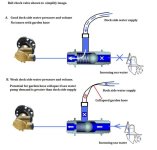
Here's a Flush Pro kit below. These kits are intended to be used "in the water".
(you can substitute "antifreeze" for "dock side" water)
Note the spring loaded check valve. If the sea water pump is pulling more volume than the Antifreeze Supply, the check valve releases and allows sea water to make up for what antifreeze it cannot pull in (or if just flushing... the same thing).
Or... if you're out of the water and on a trailer.... it would simply pull air in (not necessarily a deal breaker as long as the impeller remains wet).
Bottom line for ME (raw water cooled engines)..... if you're hell bent on doing this, do one of two things:
- Begin with a fully drained engine block, and hope that you achieved a full exchange.

- Drain again after wards, and sleep well at night.
If you did not read
this earlier... perhaps read it now.
Also, read Kghost's second paragraph in his post # 8 again.