Logo

Water recycling pump replacement

poloperson57

New member
Hi,

This weekend I hope to replace the raw water recycling pump (open system I believe) on my Mercruiser Mag 350 MPI inboard. The last one died a sudden death when the bearing must have disintegrated, as the serpentine belt came off and the pulley wheel was *very* wobbly.

I have a new water recycling pump, but I have a couple of questions. First is, can I do this without taking the boat out of the water? The engine is in a Rinker 242 Fiesta Vee. The recycling pump is fairly near the top of the engine, and I think its above the waterline, but when I spoke to a marine engineer he said (after sucking in the air through his teeth) it would need to come out of the water, or it would just syphon sea water up and into the boat. I can't see how water can flow up hill if the pump is above the waterline?

Second thing is, my boat has its hot tap water heated by the engine. The new pump I have has 2 brass plugs in it, and I'm guessing these will need to be removed and the existing pipe connectors located here as (again, I'm guessing) I think this is where the system takes off the raw hot water to heat the fresh hot water in the system? Would that be right? I can't look at the existing pump as I'm nowhere near the boat and I cant remember what hoses are connected to the pump.

Thanks for your help!
 
you shouldn't have to haul the boat to change the circulating pump...worst case (depending on the version you have) is you will have to plug the water inlet hose...and it doesn't have to be tight - any weeping should be handled by the bilge pump...

On the hot water heater, only the return hose should connect to the circulating pump...you should be able to remove the fitting from the old pump before you remove the pump...
 
you shouldn't have to haul the boat to change the circulating pump...worst case (depending on the version you have) is you will have to plug the water inlet hose...and it doesn't have to be tight - any weeping should be handled by the bilge pump...

On the hot water heater, only the return hose should connect to the circulating pump...you should be able to remove the fitting from the old pump before you remove the pump...
Thanks for the advice. Really helpful (and reassuring!). On the hot water, I don’t suppose you know if it’s the big blanking plug or the small one I’ll need to remove so I can insert the return hose fitting? They are odd sizes (not metric I don’t think, imperial maybe, probably because it’s American), and I’ll need to buy a tool to get the blanking plug out.
 
Those will be NPT (National Pipe Taper) threads on the water pump. Not odd at all. Should be something like 3/8 or 1/2 inch NPT. Me forget. Don't remove those plugs until you have the pump with you at the boat so you can see which one the heater goes in. It will be obvious. Don't know what tool you need for the plugs. They come in recessed Allen, regular hex, square (both male and female), Torx, slotted....
 
the hoses going to the water heater's heat exchanger are either 1/2" or 5/8" ID....all of the newer installs I've seen used the 1/2" ID hoses...

And 2X on the variety of drive options on the plugs....
 
Again, great advice folks, thanks very much. Looks like I'm going to have to kit myself out with some new (odd!) tools to fit these boys. I only have metric, so anything other than that is odd to me. ( I know, I'm a Luddite and a simpleton, but I am trying!)

Seriously though, thanks for all the advice. I'll let you know how the replacement goes.
 
So, an eventful weekend! I managed to replace the water circulation pump without an issue. However, when I replaced the serpentine belt (after inspecting it was all ok) the engine fired up fine, and ran nicely. so I let it get to temp, and rev'd up a few times, and all looked god so I took her for a test run by chugging up the river at low speed. 10 minutes in, engine stops. Belt had come off. So I put the belt on again and made sure it was a bit tighter this time (spec said 6mm movement on longest run between pulleys, with moderate thumb force. What's moderate thumb force?!) Anyway, belt back on and engine would not start. Just cranked over but no start. Checked and re-checked everything and all looked good so put the aux engine on and limped back to my mooring.

I thought it might be fuel related, so I took fuel pipe off and wanted to stick it in my spare fuel can direct which I'd done before when I'd run out of fuel, but this can was too big so I couldn't do that. So I admitted defeat, put the fuel hose back on, and started looking up marine engineers to call out. I thought I'd try it one more time before finally giving in, and boom - she started straight away! Ran her for 15 mins in neutral at idle, 1,000 rpm, and revving up and down from time to time, and all good. Stopped and restarted several times and all good doing that too.

So, it begs the question why didn't she start after the belt was put back on? The only thing I can think of was an air lock in the fuel line which was cleared by me taking the pipe off and putting it back on again? Or is there another explanation perhaps? (I'm sure you guys will know).

And I do have another problem. It's running far too hot (around 225F) - it always has done since I got the boat a month ago. So I'm going to replace the thermostat next to try to get her running at the right temp. I don't think this is related but I thought I'd mention it.

Anyway, thanks to all your great advice, I replaced the water pump without a problem. I just have this unanswered problem when she didn't restart when the belt came off. I'd like to understand this before I take her out again.
 
Got hot and vapor locked the fuel line. EFI must have constant, air-free supply just like a diesel. The lift pump or the pressure pump likely lost prime due to the air in the line and couldn't pump. By allowing the lump to cool off, the fuel seeped back into the line as the air contracted. You got pump prime back, the fuel began moving again and off you went. Buy a new belt and keep a spare on board. If you get the belt and cooling sorted, you should be OK with the fuel thing.
 
Got hot and vapor locked the fuel line. EFI must have constant, air-free supply just like a diesel. The lift pump or the pressure pump likely lost prime due to the air in the line and couldn't pump. By allowing the lump to cool off, the fuel seeped back into the line as the air contracted. You got pump prime back, the fuel began moving again and off you went. Buy a new belt and keep a spare on board. If you get the belt and cooling sorted, you should be OK with the fuel thing.
Thanks for this. That makes perfect sense. The more I read, the more I understand the temperature needs fixing before anything else. Hopefully, as you say, if I can sort that then everything else should fall into place. The belt is pretty new, and there is already a spare on board, so once the temp is ok, I reckon I should be good to go. Thanks for your help!
 
Those will be NPT (National Pipe Taper) threads on the water pump. Not odd at all. Should be something like 3/8 or 1/2 inch NPT. Me forget. Don't remove those plugs until you have the pump with you at the boat so you can see which one the heater goes in. It will be obvious. Don't know what tool you need for the plugs. They come in recessed Allen, regular hex, square (both male and female), Torx, slotted....
By the way, this (thread question) piqued my interest so I started researching different threads etc. Found out all about NPT for tapered threads on pipes etc, but also UNC, UNF, BSF, BSP, BSW, BA and AF! Threads have a fascinating history, with many evolving from USS (United States Standard Thread). The differences in thread sizes etc. caused huge problems during World War 2 when British, American and Canadian parts weren't interchangeable due to different thread standards, and resulted in the Unified Thread Standard being agreed in 1949. (National Coarse(NT), National Fine(NF), and NPT all evolved from this standard).

The most interesting find for me was that one of the original British threads, the Whitworth thread, was developed by Joseph Whitworth in 1841 in the UK. Joseph Whitworth also invented the "Whitworth Sharpshooter" rifle, which was widely used by the Confederates during the American Civil War. It was seen as the first ever sniper rifle.

Every day is a school day, eh?! (And I now know why most of the world has adopted the Metric system for nuts, bolts and threads!)
 
Got hot and vapor locked the fuel line. EFI must have constant, air-free supply just like a diesel. The lift pump or the pressure pump likely lost prime due to the air in the line and couldn't pump. By allowing the lump to cool off, the fuel seeped back into the line as the air contracted. You got pump prime back, the fuel began moving again and off you went. Buy a new belt and keep a spare on board. If you get the belt and cooling sorted, you should be OK with the fuel thing.
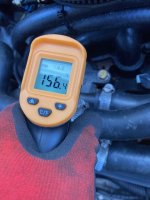
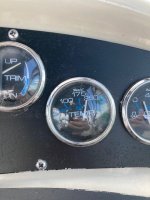
So, back after another repair stint to my boat. Started off changing the Thermostat, mainly because it was the easiest part to get to, and I was feeling lucky. Sadly this made no difference, but something had been bugging me. My temp gauge is actually reading as per the photo. But I was wondering, as this looks to be reading around 215 - 220F, why didn't I have an engine alarm? surely I should have some indication it was overheating? So, I used my shiny new laser thermometer, and the hottest point I could find on the entire engine was top of the thermostat housing, and it was measuring 156F tops (at idle speed). Many areas close by were much less - around 120F or so.

So I am wondering if I am actually running hot at all? Does anyone know the spec of the temperature sender and/or the temperature gauge? I have what I need to measure resistance etc. and can hook up a potentiometer to simulate the sender, to see if the gauge is calibrated, but I don't know what the resistance of the sender should be at set temperatures? Anyone know where I can find data on this? Thanks!
 

Attachments

  • IMG_6648.jpg
    IMG_6648.jpg
    57.2 KB · Views: 38
  • IMG_6638.jpg
    IMG_6638.jpg
    64.5 KB · Views: 41
If I remember correctly, there are two types/resistor value senders. 95% are all the same. 5% have a slightly different resistance
 
Perfect! Thank you. One question, are the red and blue lines the tolerances?
keep in mind these gauges are not meant to be real accurate, just in the neighbor hood type indication. At well below 250 your alarm would be going off, this is a separate switch not part of the gauge sender. Test your temp sender with info Jack sent, most likely replacing the sender will fix this.

if you take wire off the sender the gauge should be zero, ground sender wire to engine block it should peg high. if it does gauge is working properly
 
keep in mind these gauges are not meant to be real accurate, just in the neighbor hood type indication. At well below 250 your alarm would be going off, this is a separate switch not part of the gauge sender. Test your temp sender with info Jack sent, most likely replacing the sender will fix this.

if you take wire off the sender the gauge should be zero, ground sender wire to engine block it should peg high. if it does gauge is working properly

Shorting the sending unit to gauge wire, only tells you the gauge is functioning. It does NOT tell you it is working properly as it could be showing incorrect temp.

I would say the average marine temp gauge reads within 3% or so of true temps. The graph can help determine if the sender and gauge are sending/ reading the proper temp.
The other way is to have a known good gauge to compare.

I have a small test box with a temp gauge and wires to isolate sender or gauge or wiring....great tool when testing these kinds of issues!
 
Well, back from another working day on the boat, and thanks to Jack's graph I can now say the gauge is functioning correctly. (I put a 90 ohm resistor across the signal terminal and ground and the gauge was reading round about 170F, so I conclude that the sender is officially duff, and will be replaced. Many thanks for all the words of wisdom on that one.

Now, I have one outstanding problem ...... and that is I can't seem to keep my serpentine belt on. It was fine when we went out on Thursday, but on Friday we went up the river, against the (strong) tide so running at higher revs, after about 10-15 mins we conked out again. Looking at the belt, it had ridden up onto the lip of the bottom pulley wheel (so not exactly off, but not really on properly). I worked out this is the crankshaft wheel, so the one that drives everything else. I guess, as it wasn't on properly, it must have been slipping, and not driving the rest of the wheels properly, so we probably overheated and cut out. (Because guess what... my temp gauge isn't reading correctly!!).

The belt *looks* fine, (no cracks or fraying or anything) but I'm wondering if it has become stretched and needs replacing? It does seem I have to crank the adjustment up as hard as I can to get what I think is the right tension. (I wish I knew what moderate thumb pressure is, so I could exert this on the longest part of the belt and see if it moves 6mm or 1/4 inch. How do you gauge "moderate thumb pressure".?)

And the other thing I've noticed is (you folks are going to get Soooo fed up of me asking stupid questions! Sorry!), I checked the engine oil when we last conked out, and I think it has far too much oil in it. I've attached 2 pics.... one of the dipstick clean so you can see where the oil should be, and one showing where the oil is. I don't think there is water in with the oil as it's not gone milky. The oil itself looks nice and clean and new. (I've only had the boat a couple of months and I'm still finding out everything that's wrong with it!)

Should I get some of that oil out somehow?
IMG_6657.jpg
IMG_6658.jpg


Thanks guys.
 
Hi,

This weekend I hope to replace the raw water recycling pump (open system I believe) on my Mercruiser Mag 350 MPI inboard. The last one died a sudden death when the bearing must have disintegrated, as the serpentine belt came off and the pulley wheel was *very* wobbly.

I have a new water recycling pump, but I have a couple of questions. First is, can I do this without taking the boat out of the water? The engine is in a Rinker 242 Fiesta Vee. The recycling pump is fairly near the top of the engine, and I think its above the waterline, but when I spoke to a marine engineer he said (after sucking in the air through his teeth) it would need to come out of the water, or it would just syphon sea water up and into the boat. I can't see how water can flow up hill if the pump is above the waterline?

Second thing is, my boat has its hot tap water heated by the engine. The new pump I have has 2 brass plugs in it, and I'm guessing these will need to be removed and the existing pipe connectors located here as (again, I'm guessing) I think this is where the system takes off the raw hot water to heat the fresh hot water in the system? Would that be right? I can't look at the existing pump as I'm nowhere near the boat and I cant remember what hoses are connected to the pump.

Thanks for your help!

Was the "last one" the original pump, or a replacement? Marine circulating pump seals need to be able to work in fresh water OR coolant. If they're not made for water, the pump will fail.

How tight was the belt?

What year of boat? The water enters the engine, where? If it's directly to the circulating pump and the hose coming from the oil cooler, use something to pinch the hose and water won't be pushed into the boat.

Has the old pump been removed? If not, can someone send photos to you?
 
Was the "last one" the original pump, or a replacement? Marine circulating pump seals need to be able to work in fresh water OR coolant. If they're not made for water, the pump will fail.

How tight was the belt?

What year of boat? The water enters the engine, where? If it's directly to the circulating pump and the hose coming from the oil cooler, use something to pinch the hose and water won't be pushed into the boat.

Has the old pump been removed? If not, can someone send photos to you?
Hi Jimn, I’ve already replaced the water circulating pump and that all seems to be working ok on that front. It’s a raw water engine, so water is taken in and pumped up to the water recirculating pump via the raw water pump (impeller etc). I don’t know if the last pump was the original. It’s a 1999 boat, but has at some time had either a new engine or a reconditioned one. It looks in really good condition (except for the old recirculating pump!).
 
Hi Jimn, I’ve already replaced the water circulating pump and that all seems to be working ok on that front. It’s a raw water engine, so water is taken in and pumped up to the water recirculating pump via the raw water pump (impeller etc). I don’t know if the last pump was the original. It’s a 1999 boat, but has at some time had either a new engine or a reconditioned one. It looks in really good condition (except for the old recirculating pump!).
I know how this works, but as I posted, the seal needs to be able to survive raw water- coolant acts as a lubricant and that's the reason a car/truck pump shouldn't be used.
 
I know how this works, but as I posted, the seal needs to be able to survive raw water- coolant acts as a lubricant and that's the reason a car/truck pump shouldn't be used.

What does any of this have to do with his problem/question regarding the serpentine belt coming off?

Maybe stick with the issue and not go down a rabbit hole about other unrelated subjects....??
 
Did you do an oil change? If so how much oil did you get out of the engine before refilling? If you did remove the oil, how did you do it?

What do you feel is the right amount of oil for that engine (in quarts)?

Also you said its a different than original engine, How about some more specifics?

Serpetine belt issues can only be a few things.

1. Pully alignment, one may be out of alignment. Pay close attention to crankshaft pully, make sure the harmonic balancer hasnt seperated at the rubber dampening ring

2. A bad pully, the grooves are all buggered up or worn off.

3. Idle tensioner is not tensioning properly.

4 bad belt.

Thats all I can think of off the top of my head.
 
What does any of this have to do with his problem/question regarding the serpentine belt coming off?

Maybe stick with the issue and not go down a rabbit hole about other unrelated subjects....??
I replied to one post- didn't read all of the others.
 
Did you do an oil change? If so how much oil did you get out of the engine before refilling? If you did remove the oil, how did you do it?

What do you feel is the right amount of oil for that engine (in quarts)?

Also you said its a different than original engine, How about some more specifics?

Serpetine belt issues can only be a few things.

1. Pully alignment, one may be out of alignment. Pay close attention to crankshaft pully, make sure the harmonic balancer hasnt seperated at the rubber dampening ring

2. A bad pully, the grooves are all buggered up or worn off.

3. Idle tensioner is not tensioning properly.

4 bad belt.

Thats all I can think of off the top of my head.
Thanks for this. No, I’ve not done an oil change, I’ve only had the boat for a few weeks, and am still discovering what’s wrong with it. And I can’t give any specifics about the engine, as I don’t know them really. Not that that should matter tbh. It is what it is - a mercruiser mag 350 mpi. I’ll take a look in the manual to find how much oil should be in there, I just wanted to know what the impact of having what looks like too much oil in there right now is. Will that cause problems? Can I just leave it until the next oil change? Should I take some oil out?

Regarding the belt, I’ll just put a brand new one on and go from there. The pulleys all look good to me. No play on any of them, and grooves look, well, groovy!
 
Too much oil will cause foaming and could casue the oil pressure switch and possibly the oil pressure sensor to see no oil pressure intermittenly.
 
One more thing for you "It is what it is".

Only an amature would buy a boat and not change oil and filter and do a complete tune up replacing any servicable parts that can be replaced including a full outdrive service.

That way one would have a BASE LINE of known new and good parts to start ownership of someone elses problem.

Boats are not like autos....

I purchased a used 2014 truck with "only" 50,000 miles on it 2 ywars ago.
I did oil and filter, full transmission service including filter and torque converter flush. Transfer case and rearend service.
Plugs, wires, transmission cooling lines as one was seeping.

All of this before i put 50 miles on it.

You know why? Its the right thing to do.
Now I know where everyrhing stands to start my ownership.
 
One more thing with regards to the serpentine belt issue.

Pulleys looking ok is not an answer.
I pointed out to look for any that are not 100% in alignment with any others. For this a good straight edge may help.
Also the crank pulley should be inspected if that may look out of alignment.

If this engine suffered several high revving situations the harmonic balancer could have been damaged and the crank pully attaches to that.

But if you know best, and simply a quick glance and everything is groovy then Go for it!
 
One more thing for you "It is what it is".

Only an amature would buy a boat and not change oil and filter and do a complete tune up replacing any servicable parts that can be replaced including a full outdrive service.

That way one would have a BASE LINE of known new and good parts to start ownership of someone elses problem.

Boats are not like autos....

I purchased a used 2014 truck with "only" 50,000 miles on it 2 ywars ago.
I did oil and filter, full transmission service including filter and torque converter flush. Transfer case and rearend service.
Plugs, wires, transmission cooling lines as one was seeping.

All of this before i put 50 miles on it.

You know why? Its the right thing to do.
Now I know where everyrhing stands to start my ownership.
Thanks Jack. Really helpful. And it’s amateur, not amature.
 
Back
Top