Logo

Second timer base failure in 2 years?!?!?! 1981 140 hp

partybarge21

Contributing Member
Hello all, I have a 1981 140hp Evinrude V4 (E140TRLCIM). In 2009 I summons the groups vast knowledge for my powerhead rebuild. I had cylinder # 2 break rings and self destruct.

I tracked the "root" cause down to what I found at the time to be a faulty timer base. Long story short cylinders 2 and 1 were going on and off at random. NOW the boat has 2 year old coils and power packs and also a 1 year old timer base.

Motor ran good all summer but started to idle odd towards fall. Got it out for spring tuning and found with my timing light that cylinder # 2 was not firing again. Swapped coils and power packs with working ones and still have issue.

I then checked out the timer base (CDI Model # 33-3376) with my Fluke meter and read the following resistance.

White to Green (cyl 4)= 30.8 ohms
White to Blue (cyl 2)= OPEN CIRCUIT
White/Black to Blue White (cyl 1?) = 29.3 ohms
White/black to Green/White Cyl 2?) = 29.2 ohms
CDI book resistance value says 15-50 ohms.

Soooo, it looks like a failed timer base. As we all know this is not a cheap item. I am asking for your input as to what could cause a timer base to fail and how can I troubleshoot it and correct that issue before installing a new one.

THANKS IN ADVANCE FOR YOUR HELP.
 
Last edited:
Re: Second timer base failure in 2 years?!?!?!

I e-mailed CDI today about warranty but luck would have it I bought the last one on 3/21/10 and there is a 1 year warranty on it. 6 days over :mad:

I figure I will hear back from them tomorrow.
 
Re: Second timer base failure in 2 years?!?!?!

CDI should quibble about six days. I've replaced complete powerheads that were a couple months over warranty. There's always a little leway when dealing with reputable companies.
 
Re: Second timer base failure in 2 years?!?!?!

Hopefully you guys are right. I should hear back tomorrow.

What in your professional opinions would cause a timer base to fail? Something made the original one fail also? From what I have read here it is very rare for one to fail like this.

Thoughts? :confused:
 
Re: Second timer base failure in 2 years?!?!?!

It could be a case of very low voltage finding its way into that area due to a short or a mistake in wiring.

This happens with the black/yellow wire on powerpacks occasionally due to a ignition switch failure that would allow a very low amount of voltage pass over to the raised tower like "M" black/yellow wire terminal of the switch.

Even a microvolt will eventually destroy the pack or other components in time. It might be worth checking the wires that lead to the timer base for any voltage (the slightest meter reading) with the key in the ON position.

Then again, the failure may have simply been due to a percentage failure in the mass production scheme of things. This area will drive one nuts! Let us know what you find.
 
Re: Second timer base failure in 2 years?!?!?!

So far I got an e-mail back from CDI tech support saying they would forward my info to the warranty dept.

Well it was 30 deg and snowing yesterday but 60 deg and sunny today :confused: so I figured I would check for voltage on my kill wire (Black/Yellow) and here is what I found.

With the power packs unplugged.....
Ground lug to kill wire on the motor with key "off" - 0.00 ohms, 0 volts
Ground lug to kill wire on the motor with key "on" - Open Loop for resistance, 24.2 mV
Ground lug to kill wire on the motor with key "on" and control harness unplugged - 0 volts

So this weekend I will dig into the wireing harness up to the controls. My multimeter is not strong enough to pick up the leak so I will use my megger on a low setting to try to isolate it (with harness unplugged from motor).
 
Re: Second timer base failure in 2 years?!?!?!

If by the statement of "Ground lug to kill wire on the motor with key "on" - Open Loop for resistance, 24.2 mV" you're saying that with the key in the ON position, you're reading 24.2 mV between the engine wiring harness unplugged black/yellow kill wire and ground, do the following test.

Plug the RED large electrical plug back together. Leave the black/yellow wire unplugged from the powerpack. Disconnect that black/yellow wire from the back of the ignition switch. Now, test for voltage as before. If you now show no voltage between ground and that black/yellow wire at the engine's wiring harness with the key in the ON position, replace the ignition switch as a short surely exists between the "A" terminal of the switch and the raised tower like "M" terminal that the kill wire attaches to.

Note that the black/yellow wire must attach to the raised tower like "M" terminal with absolutely no other wire attached to it, otherwise a voltage back feed will exist.
 
Last edited:
Re: Second timer base failure in 2 years?!?!?!

Finally a nice day to work on boat.

When I said "Ground lug to kill wire on the motor with key "on" - Open Loop for resistance, 24.2 mV" I meant open loop on the resistance test and 24.2 mV on the voltage test. I think you understood what I meant :confused:

Anyway here are my test results.

I disconnected the black/yellow wire from the raised M terminal and I still had 20-30 mV on the yellow/black wire. There was 0 v on the raised M terminal with it unhooked. Switch tested good. I unhooked other switched wires in the same wiring harness until the voltage dropped. When I unhook the solid purple wire the meter goes to 0 V.

So based on that I went on a search for the issue with the purple wire. I could not find anything. There are no splice points from the key switch to the Amphenol plug @ the motor. On the motor side I completely disassembled the wiring harness and found nothing wrong with the wire or any corrosion/short point. Is it possible I have corrosion within the molded Amphenol connector?

If you say that the 20-30 mV is enough to cause electrical part failures than I should run another new seperate kill wire from the controls to the motor right?

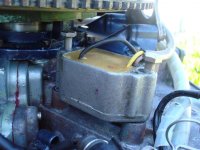
On a side note, the purple wire only goes to one thing on the motor (from the remote control cable anyway). It is not on any print I have so can you look at the picture and tell me what it is and what it does? On the print the purple wire goes to an empty terminal on the strip where the charge wires are.

DSC04736 (Large).jpg
 

Attachments

  • DSC04736 (Small).JPG
    DSC04736 (Small).JPG
    69.3 KB · Views: 156
Re: Second timer base failure in 2 years?!?!?!

That item appears (to me) to be a voltage regulator.

Yes, any voltage applied to that black/yellow wire will create problems.

I have encountered conductive voltage type shorts pertaining to the black/yellow wire within that RED plug in the past. The cure was to jump the plug with the black/yellow wire from one side to the other, bypassing the plug completely.
 
Last edited:
Re: Second timer base failure in 2 years?!?!?!

If I have to cut into the harness anyway that would be a great starting point. Thanks for the info Joe.
 
Re: Second timer base failure in 2 years?!?!?!

On the forward portion of the wiring harness at the RED plug, there is but one black/yellow wire...... on the back portion of the RED plug (engine wiring harness), there is usually two black/yellow wires.

When jumping over the plug, I usually install a knife connector and insulating cover between the single to dual wire connection to eliminate wire cutting in future work.
 
UPDATE:

The 20-30 mV I was reading with the switch on has been elimiminated by jumping out he main red connector at the motor. I am now reading +/- 1mV (0V)

CDI let me swap the timer base out as warranty and I installed the new one.

I got the engine fired up and it purrs like a kitty. If the weather ever stays nice I will take it out for a trial.

Joe,
Thank you for your advice. It was very helpfull.

Eric
 
Back
Top