Logo

Rochester 4 barrel flooding

sammi

Regular Contributor
I have 1986 454's with rochester carbs. The port carb if flooding. I rebuilt them the beginning of last season and they ran great all last season and up until last week. I was running at 3000rpm for 10 minutes and when I slowly throttled down coming into the marina my engine just flooded out and died. It was idleing for about 3 minutes before it quit. I was able to get it restarted to dock it. It ran fine in the stall for about 5 minutes so I thought I just had a piece of dirt in there and it worked it's way out. Yesterday I went to start it and it flooded right away and died. I took it apart and the float is correct and working. That just leaves a bad needle and seat right? This was the first time I had not run it in 2 weeks this year. I noticed a white residue in the bowl and I'm guessing that the fuel evaporated and left that residue on the needle/seat. I've got a new kit on order to replace the float and seat. Anything else I should be looking for?
 
If those are the original carbs, you should get brand new ones. Those were made with the assumption that you'll be running leaded gas with no ethanol. They are not going to get any better and they are obsolete. I strongly urge that you replace them with new Edelbrock Marine carbs from Jegs. They have the best price anywhere. You'll be amazed by the difference.
 
Maybe a wintertime project there with the Edelbrock's, but for now I just want to fix it and finish up what little season there is. Just 2 reasons for flooding right? bad float or bad needle and seat? It is a mechanical fuel pump so pressure I doubt is the issue.
 
More than the needle and seat remain.....the fuel pump's diaphragm could have given up the ghost. Check the sight tube and see if it wet.

if you opt to join the 'Edelbrock Generation', I'd be happy to provide your quadrajets with a new home.
 
Report back after you have spent (insert 4 hour delay) time repairing the carbs. I'll bet that the thought of new ones will creep into your skull at some point during the process. Just sayin'
 
I checked the fuel pump tube and it appears dry. I also removed it when I was running it at the dock because that crossed my mind as well. The pump is only 3 years old but you never know.

o2batsea: do you work for Edlebrock? LOL. Trust me I have read every post about the edlebrock carbs and especially the thread where a guy goes over all the parts needed to change them over but these carbs have probably run 8-10,000 gallons of gas through them and have been mostly troublefree.
 
I may have found the problem. When I removed the brass seat for the needle valve the washer underneath has a rubberized coating. Half of it was peeled away and I wonder if it wasn't a gas tight seal anymore. Of course, maybe it just peeled away as I removed it. I will find out tonight.
 
If you have a hand held vacuum pump and a couple adapters, you can use it to check the integrity of the assembled needle and seat once reassembled. It is not uncommon to find marginal needle and seat combinations, brand new, especially with 'off brand' suppliers.

Better to find out while it is off than once reassembled.

Don't forget the oil and filter change once the carb is done.
 
So far so good. I put it on at lunch and ran it for about 10 minutes and no flooding. I'll go back down after work and run it a little more.
 
Nope. Still flooding. New needle /seat float will be here tomorrow. I put on a rebuilt carb I had in the basement and it is working ok so it appears to be a carb issue only. Not engine or fuel pump related
 
Sammi,

My boat has the exact same issue. 7.4L Mercruiser 370HP, Qjet and Bravo 1 setup.

It runs great on the hill, and will run at low speeds all day. When I run it above about 1500RPM for more than 3-4 minutes, she begins flooding. It floods bad, and you can hear/see the fuel still pouring into the engine after I shut it off. I have to wait 30 minutes with the carb open to dry it out enough to start. Sometimes its good to go at idle, but most often its goes back to a flood in just a minute.

I've had the top off the carb about a dozen times. New float set/seals, new accel pump (Viton), lighter Power Piton springs, lowered the float (about 3/8" versus recommend 1/4" = less fuel in bowl), but still have the same problem (worse now in fact). I have drained the fuel water separator several time (yes there was water) - and the fuel is old (1 year).

It seems like the fuel pressure is too high (5psi max for Qjet). I have the stock, mechanical Mercruiser fuel pump (not sure if I have the Airtex or the Carter model) - which has worked for 4-5 years, since I put this new engine/carb in.

I can't imagine ethanol ruining the pressure regulator in the fuel pump, but am thinking this could be the problem.

Any luck on your end?
 
Last edited:
Humm - found another thread that mentioned:

"If the diaphram in the fuel pump ruptures the carb will suck raw fuel from the tattletale hose. That will give you all the symptoms you describe plus one more. You will have fuel in your crankcase oil. The level will be high and it will smell like fuel."

http://www.offshoreonly.com/forums/general-q/236488-carter-carburetor-keeps-flooding.html

But - when I look in the carb when its flooding (engine just turned off), I see/hear fuel pouring into both prmaries from down lower, while the fuel pump vent hose is plumbed high into the stbd primary venturi, so that can't be the problem. I've even pulled the vent hose off to see if anything is coming through, and its dry (plugged?).

I'll dig deeper ... this sounds like my problem. I know the Qjet's float valve can't hold back more than about 5psi, which is what the MerCruiser mechanical fuel pumps are supposed to be.
 
As noted, when the fuel pump diaphragm goes, it will dump into the one primary bore, not both.

Did you change the gasket under the needle seat?

Can you determine where in the primary bore your fuel is appearing from? Also, any coming out in the secondaries?
 
No fuel coming up fuel pump vent hose (is it clogged, forcing fuel through the main line?).

Yes - changed gasket & new needle. FYI - brass float - not leaking (dry).

Coming from low in both primary bowls - not sure where. When its running fine, I don't see fuel flowing there at all. When its flooded, you can hear/see it "gurgling" out.

Nothing coming through the secondaries. The secondary metering rods are free (had an issue once in my 72 Chevelle SS where the secondary rods would hang and flood similar to this).

Thanks for helping out, MakoMark!
 
Are you sure the float is the correct part for that casting?

Did you check the needle and seat, after installation, to make sure they were sealing?

Where did you get hose parts and have you changed the air horn gasket recently?
 
95% sure float is right - it worked for 4-5 years. I changed float level to about 3/8" or 9/16" (1/4" recommended) to reduce fuel in bowl - no effect. I even shortened the Power Piston spring about 1/8" (softer) so it will open later.

Did not change air horn gasket, but it looks good, and I always torque in sequence.

The needle and seat work on the hill - I can run it for 1/2 hour, shut it off, restart it (many times). Idles @ 750RPM, revs to 1500 or so easily (2,000 briefly) and then goes back to idle fine (don't want to run at elevated RPM on the hose). Shut it off start it again in 8 hours - run 1/2 hour, etc. and its fine. When I put it in the water and run it for 3-4 minutes at 1500+RPM. Then it loads up.

Hose parts? No hose. Not sure what you're saying here?
 
I never did solve my problem. I went with the edelbrock 1409. It runs great but don't you know I still get gas out the exhaust when cold. When it warms up no exhast gas sheen. I'm going to do fastjeff's remove 1 wire at a time technique and see if I have a cylinder not firing.
 
I used to have a Carter AFB square-bore on my old 454. When I put the new engine in, I tossed the AFB and went with a Qjet (4th one I've owned over the years), fas it gets better fuel efficiency when its set right, yet gives great power when you open it up occasionally. The combo worked great for 4 years - we've been 60 miles offshore with 1 engine, burning 95 gallons in a day, and now this.

I also have a Qjet on my old Corvette (rebuilt 20 years ago) and it runs fine on the same fuel I buy for the boat. Its does have a newer Holley fuel pump and many other mods, but the carb works great.

I really question the fuel pump - but can't figure out why it would have more pressure at high RPMs, unless its internal regulator is shot.
 
Last edited:
Mack:

DUH!! "hose parts" = typo....should have been "Those Parts" - source for needle, seat, float, etc.

Power piston (& spring) won't have anything to do with a flooding condition if correctly installed.

Does the float hinge pin only "fit" one way - ( I know, easy to ask now...)? Installed that way? Plastic stuffer reinserted?

Sammi - try adjusting the initial setting of the choke on the 1409? They don't have a pull-off so there isn't much else to adjust.
 
Mako,

Those parts - gotcha - don't remember - the latest parts came from Cliff Ruggles - www.cliffshighperformance.com - one of the most well know Qjet guys in the world.

I was taking a chance on the spring - it does affect when the Power Piston opens, but didn't fix my problems (long shot).

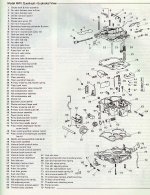
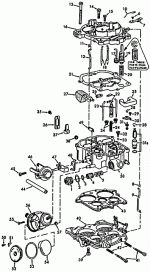
I think I have the "Float Hinge Pin" installed with its bend to the Left (from the front), and I do have the plastic "Float Bowl Insert" is in place. I'm looking at 3 different drawings of the Qjet. Now, I'm really confused ...
4mv.jpg

exploded.gif
pencil.png
 
Last edited:
Cliff's stuff is real good but not perfect....I think if you ask, he would recommend verifying the seal on the installed needle and seat as a good practice.....did you leak check it once installed?

All of the marine castings I've played with wouldn't let the float sit correctly on the hinge pin if the pin was installed backwards. I'm pretty sure the open end go to the accel pump well. (those drawings are notoriously inaccurate for details like this one - many times a "generic" photo is used, even in the marine OEM factory manuals, today.)

So, besides the check above, the only other item is to verify the fuel pressure at the inverted flare inlet.
 
Hi,
Make sure the float needle pull clip end is facing the front of the carburetor and not getting caught up in the two small holes on the float arm. Also if someone got a bit crazy tightening the needle seat they may have put a hairline crack into the fuel bowl that will cause flooding issues. Make sure the carb. top is flat with a straightedge. Do not exceed 15 ft lbs when tightening the carb. mounting bolts. Also make sure all of the little holes on the carb top are clear and not being obstructed by the gskt. Ck fuel press first. Always keep flame arrestor wing nuts or bolts just tight enough to prevent vertical movement, any tighter and the carb. top can distort in some cases not allowing the secondary air flaps to open. Always disassemble when cool.

Good Luck
Jon Allen
 
I'll ask Cliff which way the hinge goes - right or left. I think the plastic insert only lets it fit one way, but its worth checking.

Float needle clip is forward.

Float needle seat could have a crack ... its a rebuilt carb from a 1974 Chevy ... who knows ?

I'll check the crab top with a straight edge - good tip!

I torque in proper sequence with proper torques.

I don't have a fuel pressure gauge. Any tps on what to buy and how to hook it up?

I disassemble when the engine is warm (not hot) ...

Mako & Jon - Thanks for the tips - I really think I need to get some data on the actual fuel pressure.

Anyone ever have the fuel pump's internal regulator go bad?
 
Pretty simple to check the fuel pressure. You need a gauge, to start.

Tons of options, but this one is cheap:
http://www.amazon.com/Actron-CP7803-Vacuum-Pressure-Tester/dp/B0006V2BS2/ref=pd_sbs_indust_4#_

The vacuum side of the guage will come in handy for tons of stuff also. You can tell a lot about the mechanical integrity of your engine by its manifold vacuum. Good tool to have around!

Using the supplied "T" fitting (or if you need a larger one, check Kragen, AutoZone, etc), hook the guage into the fuel line. Fire her up and monitor the pressure. Not sure exactly what the fuel pressure SHOULD be, but it doesn't really matter for your issue. Check the pressure at idle, then run her up and watch the pressure. If she floods out and the pressure does not increase noticeably, pressure is not your problem. If she floods out and you notice your fuel is at 10psi or something, that could very well be the problem.
 
Last edited:
All lines from the pump to the carb are hard copper, with brass compression fittings - no place for a "Tee". I'll have to build a manifold to connect to I suppose. Hoped there was an easier way.
 
I'd encourage you to replumb the fuel delivery system omitting ALL compression fittings - they are bad practice on a marine install. The factory hardline used 3/8" inverted flare fittings.

As far as plumbing in the gauge, I use 3/8" inverted flare "stubs". Remove the line from the pump to the carb and install the 'stubs' at both ends. a couple pieces of 3/8" ID fuel line are clamped over the stubs. The free ends go to a TEE with the empty end of the TEE going to the gauge. Not easy but the best setup I've found for leak free troubleshooting.

A welder friend had a neat setup - he fab'ed the line from the pump to the carb with a TEE that had a 1/4" pipe plug in it and kept it in line permanently. To take a reading, he'd remove the pipe plug and screw in a hose barb and then connect the gauge to it.

Never seen a pump develop too much fuel pressure after placed in service. Have seen a couple 'out of the box' that were a bit high.

I'll ask one last time - did you test the needle and seat after install during the rebuild?
 
I, too, can't imagine how a mechanical fuel pump can, over time, gain fuel pressure. It's set by the force of a compression spring, right? Can a spring become stronger/stiffer over time?
 
Sorry guys - I meant 3/8" flare fittings, not compression fittings.

I did not check the needle and seat after the rebuild - but did use it for several years. The newest needle/seat has not been tested, and only leaks after 3-5 minutes extended use (in water) at load over 1500RPM ... How would you propose I test the needle/seat?

The stub idea is good - as long as I can clamp in a Tee ... don't think I have enough gear to do it here - will have to get some fittings and a fuel pressure gauge.
 
Last edited:
Hey Mack,

I was racking my brain about your issue last night, and wanted to run an idea by everybody. I could be wrong, or even WAAAAY off, but this is a possibility I guess.

Your engine runs seemingly fine when it is cold, correct? When it does start flooding, you can cool down, restart, and no flooding for a bit? I would have to imagine your needle and seat are sealing just fine then. Unless temperature is somehow making it leak? Doesn't sound logical.

You said once the flooding starts, fuel will continue to flow into the carb even after the engine and fuel pump stop turning, correct? What could cause this? I think air is being introduced into your fuel line somehow. Bare with me...

Fuel is not compressible and should not expand with temperature (unless it is boiling), but air certainly can. When the engine is cold, there is not enough heat to make any air in the line expand and cause any issue. When the engine gets hot, and your fuel (and air) is running up a hot metal pipe next to your hot engine, the air will expand, increase the line pressure, and force fuel into the carb at more than the specified 5psi.

Does this make sense? Does anybody else feel this is a possibility? You may have a pin-hole leak in the hose between your tank and pump, or the pump itself may be sucking air?

If this sounds like a logical possibility to you, I have a method to create you own fuel delivery system to temporarily run off. It involves some fuel hose, a small fuel container raised 9-11 feet, and some ingenuity. Let me know what you think.

Heading up to my boat today (40 miles away... sigh) to do some work as well. I will check back here again tonight.

You guys hear about that Wahoo in LA Harbor? Crazy season!
 
Eric,

I have wondered the same thing - air in the line could make this happen.

I don't think the carb is getting very warm/hot, as its an Edelbrock Air Gap manifold (air between the crab and engine), but it wouldn't take much is there was air in the line.

Could be a pin-hole leak in the fuel hose somewhere or I wonder if the ethanol ate the seals in my fuel pump and may be sucking in air there. Anyone ever seen this problem?

Hate to buy a fuel pump until I know ...

Fuel system:
1) Aluminum 100 gal tank
2) Pickup in tank
3) fuel hose to fuel Shutoff valve
4) fuel hose to Flo-Scan pickup
5) fuel hose to Fuel/Water separator
6) copper line to Carter or Airtex fuel pump (not sure which) mounted on sea water pump bracket
7) copper line to Qjet filter
8) Qjet

Really appreciate the help - brainstorming the problem is very helpful!
 
Last edited:
Back
Top