

Logo

Removing calcification from Honda BF15 (or BF20D)

Hotmath

New member
I went years in salt water without fresh water flushing and I am now paying the price. Major blockage causing overheating (limp mode). No water flow out of exhaust port.

Have replaced impeller and thermostat, tried Barnacle Buster, still no water flow out of exhaust port either running or using flush port.

I removed the water jacket and scraped out tons of calcification blockage everywhere I could reach with o-ring tools. That gunk is TOUGH.

But, after that, flushing via the flush valve (with thermostat out) still does not provide any water outflow at the exhaust port. All other output ports flow fine. I think I need to find another way to access the engine block to continue scraping.

I deserve your comments about my stupidity but please help after that. I am paying the price and am reformed.
 
Hi,

"Stuff happens"...I won't be flaming you cuz I ain't perfect either.

Could you clarify what you mean by "water doesn't come out of exhaust port"?

Are you referring to the exhaust port.at the rear, center of the outboard?

Or might you be talking about the tell tale or "pisser"?

Or, something else?

That port at the rear center of the outboard doesn't typically have water coming from it. Occasionally it might spit a few drops or a light, temporary, spray but, for the most part, it should be just exhaust gasses.

The exhaust gas and cooling water exit the head, through the oil case and into the "exhaust chamber". There they get separated in the chamber with gas exiting that rear center port and the water, along with some exhaust gas, dumping into the extension case and out through drains.

AT ANY RATE, from what you've described, I think that you may need to remove the cylinder head and see what you might be able to do in order to do more scale removal. But, I don't know.

I've worked on many of the 20D Hondas and I also own one. But I have never had one scaled up like yours is, nor have I ever needed to remove a head on one. So, just a guess.

You probably already know this but I'll say it anyway....be really careful removing minerals because, they tend to bond with the metal and, if you get too frisky scraping and prying, you could accidentally remove a chunk you didn't mean to.

If you can make enough progress so that she will run in a trashcan for a while without overheating, you might make some more progress by letting it run in a solution of vinegar. A trashcan rigged with a hose bib drain near the bottom that you can adjust drain flow with, you can then hang a garden hose at the top and keep the water temp in the trashcan cool.

Good luck and I'm hoping that you can have some success with this.
 
I haven’t made any progress but noticed that while flushing from flush valve, there is outflow water gushing from the front of the lower unit from the lower rubber mount cover. I initially took that as progress, but maybe that is a clue. Could I have put things back together wrong? Anyway, I’ll take off the lower unit today …
 
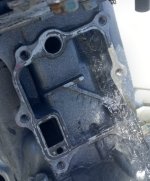
I took the exhaust port cover and gasket off and flushed via flush valve. You can see water coming in at upper right which looks like it is distributed to the exhaust port hole and down to the port in the prop. Does this look normal?

The second pic, same flushing, shows water coming out at the top of the lower rubber mount cover. Does this look normal?
 

Attachments

  • IMG_1168.jpeg
    IMG_1168.jpeg
    856.6 KB · Views: 56
  • IMG_1169.jpeg
    IMG_1169.jpeg
    44.6 KB · Views: 68
I don't honestly know what the flow should look like in the exhaust chamber because Honda doesn't explain it and I've never run one without the chamber cover and gasket removed. Pouring water in through the flush port might not give you a real good idea about flow either. But it looks like there IS plenty of water so that tells me there's little or no blockage there.

The water spilling out at the front of the gear housing might indicate that the water blockage grommet for the pump (see item 8 in link) is damaged or missing. That grommet often gets overlooked when people take the gear assembly off.


I thought that your plan to take the gearcase off to see if you could find a problem was a good one.

If you do, pay particular attention to the water delivery tube installation and the water grommet in the bottom of the oil case....item 3 in link below.


That grommet will wear out over time and it can accidentally get shoved up inside the case when putting the gearcase back because you can't see up in there.

If that grommet wears out and rubs through, the water tube will rattle around in the hole and damage the oil case. But I've only seen that on very high hour outboards and never on a 20 D.

All in all, if you don't find a problem with the pump and water tube....and....your pump is fairly new....then what you've already said about scale would still concern me about the condition of the head.

Good luck.
 
I stopped by the local Honda shop and the mechanic was nice enough to look at the pics and thought things looked ok, so now I'm going to try to get it started and see where I’m at. Expecting some trouble but hoping for none …
 
Had to replace the gas because it had water in it but after that, ran great for 30 minutes at the dock at high idle, no overheating. Yay. Then it died. I restarted but it sounded awful, wouldn’t run above idle and if I put it in gear or tried to increase above idle, it sounded way off balance. Hope it is a spark plug failed, will see in the morning what’s up. What does my motor sound like with a failed spark plug?
 
That doesn't sound good to me.

If it's only firing on one cylinder, I wouldn't expect it to stay running at all when put into gear. But, you can do a cylinder contribution test in neutral to see if it does have a weak/dead cylinder. I can explain how to do that if you don't already know.

The BIG red flag to me though is that you were running water through that carburetor!

Those particular little carbs are highly sensitive to that. I have had to clean MANY of them because of that.

If that water was DISTILLED, reverse osmosis water that's one thing. But we both know that's not the case.

It's likely rain, lake or bay water, all of which have a variety of particles and minerals in them.

Some of whatever was in that water is now inside that carburetor that has passages measured in THOUSANDTHS of an inch and THAT could cause you to have to pull it off, take it apart and THOROUGHLY clean it out.

You could first try running a fuel additive like Sea Foam or Ring Free in it to see if that helps. Actually, you should do that anyway even if the carb isn't the issue at all.

But, most of the time additives won't get these carbs "rinsed out" well enough to restore full power. They are finicky, tricky little beasts once contaminated and can be a booger to clean for the uninitiated DIY-er.
 
Thanks. I returned the next morning and it ran fine, although I didn’t run it for very long, maybe 5 minutes. My theory of why it died after 30 minutes and wouldn’t run well after that is heating not detected by the overheat sensor. Since I never run for more than 5 or 10 minutes, I decided to replace spark plugs, replace fuel filter, add a racor filter/water separator, put some Stabil in my fresh (10% ethanol regular) gas, and use it for a while and see what goes. I’ll let you know if something interesting occurs, thanks again for your helpful commentary, very much.

PS on the outside face of the carb, there is a metal 1/4” plate that I removed from my older carb for curiosity. Inside was just a 1/2” deep circular cavity with two small tunnels leading left and right. Can you tell me what that is for?
 
Hmmmm...

That doesn't sound familiar to me and doesn't match anything I see in the carb manual.

The two diverging passages sound like air vent drillings but they aren't covered by a "plate".

Was the plate held on with a screw? Or, did you have to pry it up? There is an expansion plug covering the accelerator pump drilling but it's much larger than 1/4".

Could you post a picture or two?
 
The circular plate is near the bottom, a little right of center. I drilled a small hole and pulled it out because someone told me there was an adjustment screw there. Wrong. I’m guessing has something to do with manufacturing process. I can try to get a decent pic of the inside if you would like.

IMG_1177.jpeg
IMG_1177.jpeg
 
I can't tell. Could you circle the area?
Anyway, if you had to drill a hole to pry it out then it was probably an expansion plug to seal a cross drilling from manufacturing like your buddy said.
The same function that those little bearing balls do for smaller passages.
 
Back
Top