Logo

Rebuilding twin 440

GHopper

New member
Hi Folks, I'm new to this type of format so bare with me . Heres my situation have a 74 Tolly Craft Tri Cabin with LH / RH rotation, 1 engine has been stripped down and found hole in top of 1 piston from corrosion the other sits untouched other than pulling plugs to find that the ends on most plugs were mashed. I knew that i would be doing this one day so 2 years back i bought and stored 2 x 440 1983 LH / RH Low hours ? The numbers on lets say the newer engines do not corrispond to my originals which indicate LH / RH. They are T440TE or I440TE and on block 4006630-440-9 the other reads 06SLSW or MS7S90 i also discovered that the carbs are not matched which is making me think that these were not a matced pair and the rotation is not L & R.
Is there another way to check rotation without running engines. Remember i have 4 almost complete 440 missing 1 starter only and i am also not a mechanic. Any help will be apreciated Best Regards from west coast of Canada Gary Hopper
 
Do this: Pull the distributor caps and crank the motors over with a starter. The rotor MUST turn the correct way (not sure which way that is, but you can figure it out from the firing order on the cap and wires). Now, if the distributor turns the wrong way, try a different starter until you find one that turns the distributor the correct way. Then note which way the FLYWHEEL is turning. That will tell you which rotation (normal or reverse) each motor it is. Finally, for your sanity's sake MARK the valve covers with your findings!

Jeff
 
Thanks Jeff, so is it only the starters that turn the motor in the Right or Left rotation, If its a right hand starter in a left rotation engine and you turn it over can it break anything in side. Gary
 
Just ''bump' the starter enough to see which way the distributor is turning. (Unless you crank the beegeebers out of it you'll be okay.) If okay, note the way the flywheel is turning. If the distributor turns the wrong way, pull that starter and try another one--you have a bunch of them! (Jumping the starter itself will show you which way IT is turning, saving you effort.)

You'll get it--and don't forget to mark everything--starters and motors--once you "Git 'er done!"

Jeff
 
FYI, distributors on both standard and counter rotating 440s turn CCW. If you look at the wear pattern on the ring gear teeth on the flywheel, it should be apparent which direction the starter was turning. And re your question, NO, the starter does not dictate the operational direction, however, it is critical that the starter be of the correct rotation. Did you look on the intake manifold to see if there is a firing order stamped anywhere? Should be 1-8-4-3-6-5-7-2 for standard rotation (LH, CCW) flywheel (usually port side), and 1-2-7-5-6-3-4-8 for counter rotating (RH, CW) flywheel (usually strb side).
 
Thanks Jeff, so is it only the starters that turn the motor in the Right or Left rotation, If its a right hand starter in a left rotation engine and you turn it over can it break anything in side. Gary

I would not recommend powering the engines over for informational purposes. Instead turn engines by hand with 1/2-drive ratchet and (is it a 1 3/8 inch?) socket on crank shaft nut.

Also, it is preferred to turn engine opposite of its running direction. This loads the gears so they mesh the same as if running, eliminating the backlash you'd see if turning in running direction. Note: always do this when setting timing by hand.

You can test direction of starters on the bench instead of on the engine.

,Noel.
 
..."I would not recommend powering the engines over for informational purposes. Instead turn engines by hand with 1/2-drive ratchet..."

There is no way--NO WAY--this engine will be damaged by bumping it over a few revolutions with the starter.

Jeff
 
If I remember correctly, you can also tell which is the counter rotator by looking at the hieght of the distributors. I seem to recall the counter rotator distributor sits higher. Jeff, does this ring a bell? I'll try to check this weekend. Suggest a web search also.
 
Looking at the engine from the rear, a regular or standard rotation engine will spin clockwise. With that in mind it is pretty simple to see which way the engine is oriented assuming the diz and wires are in place. Otherwise a simple removal/replacement of the distributor will tell (don't turn anything). Just need to see the diz gear on the camshaft.
 
Don't even think of pulling any distributors! Not only is that totally unnecessary, it could lead to massive confusion!


I repeat, there is NO danger whatsoever in bumping the engines over with a starter--and even if one turns the wrong way! I and other actumechanicsics have done that a zilllion times without any problem whatsoever.

Jeff
 
I and other
actumechanicsics
have done that a zilllion times without any problem whatsoever.

What is an actumech, actumechanicsic, aw heck I can't even WRITE it let alone say it....

I was attempting to point out that without any external clues, like a starter or anything else...say a bare lump...you can't tell unless you eyeball the cam gear.

Don't even think of pulling any distributors! Not only is that totally unnecessary, it could lead to massive confusion!
Um, I think the OP is already there. Thus this thread. If he's looking at a pair of dusty 440s that were RTOs and have had no love in the last several years, which I think he is, then he need do nothing more than look at the diz and see which plug wire follows #1.
 
The usual reason the plugs/pistons get melted is from old gas, happens all the time after a sale where the boat has been sitting and the new owner runs the engines up hard. On Gary's Tolly like mine you can't hear the detonation or pinging until it's too late. If your fuel is old don't run the engines above about 2000 rpm until it's used up and refilled with fresh fuel. Yes you will ruin your new rebuilds just like the old ones. No you can't add enough fuel treatment or octane booster to help when the boat holds 440 gallons.

Dan
 
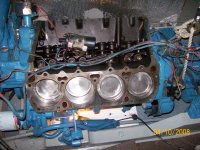
And how do I know all of this? See pic.

Dan
 

Attachments

  • Nov 2007-Nov 2008 063.jpg
    Nov 2007-Nov 2008 063.jpg
    95.9 KB · Views: 156
  • Nov 2007-Nov 2008 065.jpg
    Nov 2007-Nov 2008 065.jpg
    98.3 KB · Views: 207
  • Nov 2007-Nov 2008 336.jpg
    Nov 2007-Nov 2008 336.jpg
    82.9 KB · Views: 120
Re: Rebuilding twin 440 more Questions & Confusion

Thanks for all the info. heres were i'm at now. Striped one of the newer engines down thats in my container and got the Crank to turn by hand have some scraping in a couple of cylinders, no corrosion and very little carbon buildup they almost wipe clean with a rag and cleaner,So i'm thinking thats a good sign. Still trying to figure out what rotation these engines are, I checked for a firing order stamp on the intake manifolds and they all say 2-8-0-6-1-7-8 which i think is a casting number ,other than that there are no other numbers. The existing engines in the boat are definatly marked LH & RH and i found a tag fastened to the Starboard motor # M440-EWR 19 / 578 . Does the 19 have any bering on anything. Dan did you pull your engines right and redo the bottom end, if so did the block fit through the sliding window. I also noticed that the cylinder tops on yours seem to be concaved, mine are flat? The other engine in the container is complete including starter & plug wires still conected and i was able to turn it over by hand, So if i understand Jeff,If i bump the starter motor i should be able to tell the rotation from the distributor. Excuse the blathering Gary
 
It may be too late now but as o2batsea mentioned earlier, find which cylinder the next wire after number one goes to from the distributor and that will tell you which direction the engine turns. I posted firing orders for rotation in post #6. Also as mentioned, look at the ring gear.
 
Gary, by lifting up the tranny several inches I was able to pull the pan out from under the engine and replace the broken piston in the boat. I had some small scratches in the cylinder wall but just ran a ball hone thru then put it back together with new rings and rod bearings. If your block isn't really scored just fix it in the boat. Have a valve and guide job done on your heads at your local machine shop and put it back together. Many Tolly club members say the bottom ends are good for 3000+ hours but need valve jobs every 1000 or so hours and I agree. If you hook up a battery to the starter on your core engine you need to note which was the crank turns not the dist. as they both turn the same direction. I am available on my cell most of the day.

Dan
425-785-1387
 
Here is another thought, does your core engine still have the spark plug wires attached? You can determine the rotation by the firing order mentioned above or compare it to the engines in your boat.

Dan
 
1 engine has been stripped down and found hole in top of 1 piston from corrosion the other sits untouched other than pulling plugs to find that the ends on most plugs were mashed. ...

There is no way--NO WAY--this engine will be damaged by bumping it over a few revolutions with the starter.

Jeff

I'm not disputing the notion of turning an engine over with power but he already has "MASHED" spark plugs. What does he do now, bury what's left into the tops of the pistons? This is a case of unknowns. So why take the chance of creating more damage when it can be avoided? Turning over by hand will allow him to feel any interference and let him back off to investigate, where power will not until it is too late.

Turn engine by hand with spark plugs out and find #1 TDC. Keep an eye on timing marks and direction of turn. (Note: as you turn engine you can mark flywheel or balancer at each piston's TDC. This will resolve any dispute of firining order and get your head more wrapped around your equipment). Insert rod or other long tool into plug hole and count firing order of engine as pistons come up. Compare this with book firing order. If it doesn't make sense in one direction, try it the other. It probably will corespond then.

Good luck.
 
If there's that much damage the lower end is already junk, for the only way plug ends get mashed is via excessive rod bearing clearance.

Jeff
 
I'll try to keep this as short as I can but I'd like to tag along on the subject of rebuilding the 440. I recently purchased a nice older boat with 440's that have had the heads rebuilt 25 hrs ago. the engines have right at a 1000 hrs but run great. My dilemma is that I am planning on doing a refit/remodel to the interior and I was thinking to do the engines first and then complete the interior because the engines are housed under the cabin sole and I know there is no way I could get them out without somewhat of a mess in the interior. I read earlier in this thread that Tolly family stated he has seen the bottom ends of the 440 go as many as 3000 hrs. If that is the case I'd let the engines alone and focus on the interior. Let me know your opinions and Thanks to all you regular contributors for making this a great site!!!
 
IMO, it's not so much the hours as much as the way the engines are run and whether proper maintenance was done. To me, that tells me more about how long I could expect an engine to last.
 
I'll try to keep this as short as I can but I'd like to tag along on the subject of rebuilding the 440. I recently purchased a nice older boat with 440's that have had the heads rebuilt 25 hrs ago. the engines have right at a 1000 hrs but run great. My dilemma is that I am planning on doing a refit/remodel to the interior and I was thinking to do the engines first and then complete the interior because the engines are housed under the cabin sole and I know there is no way I could get them out without somewhat of a mess in the interior. I read earlier in this thread that Tolly family stated he has seen the bottom ends of the 440 go as many as 3000 hrs. If that is the case I'd let the engines alone and focus on the interior. Let me know your opinions and Thanks to all you regular contributors for making this a great site!!!

If the mechanic who performed the work was reputable, when he had the heads off he would have noticed and been been alerted to any further issues with engines. Since he only replaced the heads (maybe lifters, rods, timing chain too) tells me that compression (rings>maybe he replaced them too) cylinder walls and action of free rotating crank were still in pretty good shape.

Perhaps while keeping crank and cam bearings in place, pulled pan and replaced rings/rod bearings, not uncommon and perfectly acceptable.

Its hard to imagine that the heads would be replaced and these items would not be taken into consideration. He is in business to perform work, not turn it away if its needed.

I'd let it go as is.

,Noel.
 
Last edited:
There is actually a guy in the Tolly club with 5500 hours on the bottom ends and many with 3000+ but they have all had valve jobs about every 1000 hours. In a big boat these engines are usually run between 2700 rpm and 3000 rpm so they get little wear. A ski boat motor that has been run hard is a whole different situation. The reason it's so easy to find maniflods and other parts out west is because so many Purse Seine tenders still use 440s.

Dan
 
Back
Top