

Logo

Question for your Merc B drive enthusiasts !!!!

RicardoMarine

Gold Medal Contributor
I am very familiar with the Volvo Penta cone clutch system, of which Merc gained the copy-rights to just prior to the introduction of their B drive.
Very similar to the Volvo Penta transmissions, within the Merc B drive cone clutch system you'll have a conical shaped sliding sleeve and two corresponding conical shaped gear cups... one above and one below the sliding sleeve.
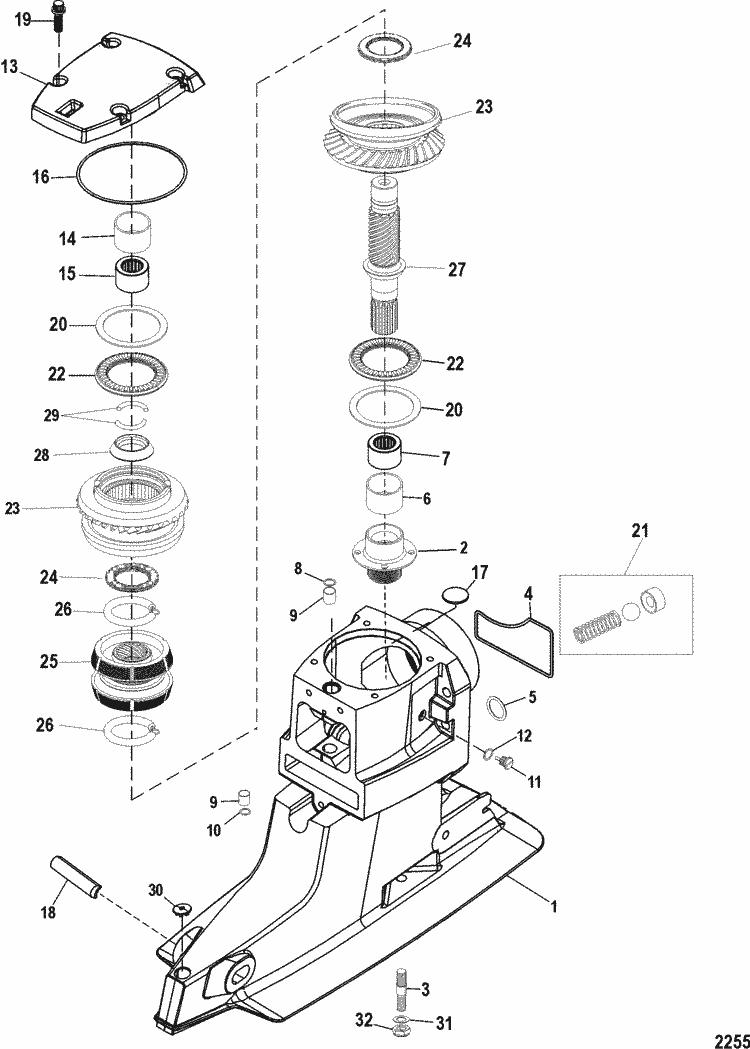

2255.gif


These two gear cups (SEQ # 23 ) rotate when ever the engine is operating.
The sliding sleeve (SEQ # 25) is splined to the vertical shaft, and is static until a gear selection has been made.
Note the steep cut spiral splines on the vertical shaft (SEQ# 27).
The same shaped splines are found within the sliding sleeve.

These steep cut splines cause any sliding sleeve/gear cup friction to cause further engagement, until enough friction is gained to create complete lock-up.
Much like the principle used on a twist style EZ Out bolt extractor...... (I.E., the more resistance, the more lock-up until both rotate 1:1.)

The conical shaped gear cup surfaces are smooth.
The sliding sleeve friction surface is machined with oiling grooves, both perpendicular and concentric with it's friction surface.
These grooves allow the oil to escape gently as the surface gently comes into contact with the rotating gear cup creating a gentle lock-up..... yada, yada, yada and so on.

While the B drive does not use a Volvo Penta style eccentric piston and shift shoe, it does incorporate and shift plate, of sorts, that lifts and lowers the sliding sleeve into contact with the corresponding and rotating gear cup.
Just as with the Volvo Penta system, the sliding sleeve is static (on either a running or non-running engine) until a gear selection has been made.

The Volvo Penta sliding sleeve can be operated statically without causing any damage.

Merc says that we should never make a B drive gear selection unless the engine is running.
So now the question:

Would one of you be able to explain why Merc does not want their cone clutch system operated with a non-running engine?
IOW, what is it that could cause damage if a gear shift was made while the engine is not operating?
I am curious!


.
 
It's hard on the shift linkage.

Jeff

PS: The inventor of the modern outdrive--Dr. Strang (who was working for Mercury at the time)--used the cone clutch for his desigh, which became the original Volvo Penta. Mercury then had to buy the rights from them to use it on the Bravo drives. I suspect Mercury wouldn't have gone to the rough, dog and clutch design if they didn't have to spend the $$ on something their own engineer designed!
 
Unless the entire assembly is spinning the mechanical linkage can not overcome the force/pressure required to mechanically shift the cone clutch assembly.

The shift fork which moves the cone clutch assembly is more than strong enough but the associated linkage is not.

Items 14 and 18 are the linkage, the shift cable is also not the most powerful component but could make it move.

http://www.marineengine.com/parts/m...iversal-joint-and-shifter-components-standard

Actually if the drive is in neutral one could get it to shift into gear but due to the linkage and the springs used it is almost impossible to go from gear to neutral.........
 
Jeff and Jack, thank you for the replies.

My question stems from the idea that:

1..... the drive would be in neutral when the engine is NOT operating.

2..... the sliding sleeve and vertical shaft are stationary while in neutral..... even while the gear cups are rotating.
IOW, there is no contact, engine operating or not operating.The sliding sleeve is stationary until friction contact is achieved.

It would appear to me that the force required to either lift or lower the sliding sleeve would be the same.... engine operating or not operating.

Could Merc's suggestion be nothing more than a disclaimer?????

I am curious and would like to hear about the specific damage that may occur, and exactly why!!!!

(we do not have this issue with the Volvo Penta cone clutch)


.
 
Last edited:
put a parts breakdown like the one you posted for bravo but for Volvo

I have no idea what a Volvo looks like on the inside
 
Post deleted... technical difficulties
 

Attachments

  • Internal view.pdf
    5.2 KB · Views: 104
Last edited:
The cone clutch moves up and down a spiral shaft so moving it while static will put a lot of pressure on the linkage. It is just better for the drive linkage and the control box if the assembly is rotating. The weak link is the linkage.
 
The inventor of the modern outdrive--Dr. Strang (who was working for Mercury at the time)--used the cone clutch for his desigh, which became the original Volvo Penta

Not quite but he was involved, it was Jim Wynne who overcame the inherent design difficulties of the cone clutch and u-joints. The design Wynne patented in 1958 actually originated when his former boss, Charlie Strang, sketched it in 1948 as a young boat racer and MIT engineering student. Ten years later, Strang and Wynne pitched the idea to their boss, Mercury founder Carl Kiekhaefer, who rejected it. The pair, along with co-worker Charles Alexander, talked of forming their own company to bring the sterndrive to market. After a falling out with Kiekhaefer, Wynne left the company, filed a patent, and sold the rights to Volvo Penta, the entire time working clandestinely with his cohorts to fine-tune the design. Volvo Penta’s “Aquamatic” was introduced in 1959 to great fanfare, which motivated Kiekhaefer to have Strang begin work on a Mercury version of the drive.The secret of the sterndrive’s development was one that Jim Wynne took to his grave, but it was revealed in 1991 with the publication of Iron Fist, the biography of E. Carl Kiekhaefer .Charlie left Mercury in 1964 2 years after the Mercruiser drive was introduced and soon became VP of OMC(Johnson/evinrude)
 
Last edited:
Seems you read 'Iron Fist' as well!

Interestingly, when first told about stern drives, Carl Kiekhaefer sneered at the idea, saying that turning a V-8 vertically and mounting it on an outboard tower would make more sense. Whan I read that in 'Iron Fist' a few years ago, I sneered at Carl's lack of imagination but...

What's Yamaha 300 hp OB? but a 5.3 liter V-8 turned vertically and mounting it on an outboard tower!

Big power OBs are getting VERY popular with mid-30 foot boat builders, so the old grouch was right yet again!

Jeff
 
V8's may be entering the outboard market and they have been around for a while.......But back in his day they had no such technology........you were looking at a flat head ford or something like that.............not an all aluminum blocks and small bore, small piston as today's.......

It may seem practical today but to put a v8 back then vertical was completely not practical......

I wonder what that V8 Yamaha block weighs in at?

A v8 from back then would be I would guess 2X the weight.

Not to mention the unreliable ignitions and carburetors of the day........

Don't forget there was no "solid state" electronics either...........so a generator for charging, not a mini alternator and the size of the starter was also very large and heavy.
 
The cone clutch moves up and down a spiral shaft so moving it while static will put a lot of pressure on the linkage. It is just better for the drive linkage and the control box if the assembly is rotating. The weak link is the linkage.

A bit of clarity if I may.
The cone clutch is the sum of all three components.... (i.e., one "sliding sleeve" and two "gear cups".)

I'll agree that the sliding sleeve moves up/down on it's steep spiral cut splines (vertical shaft splines).
The steep spiral cut is what creates "lock-up" after initial rotational friction is achieved.

While in Neutral, there is no friction between the sliding sleeve and gear cup whether the engine is running or not.
Also while in Neutral, the sliding sleeve and the vertical shaft remain static whether the engine is running or not.
Neither the sleeve nor vertical shaft will begin to rotate until a gear has been selected with a running engine.

So back to a new version of my question:
Is Merc suggesting that it's more laborsome for the linkage to move the sleeve with the engine off, than it is with the engine running?


.
 
V8's may be entering the outboard market and they have been around for a while.......But back in his day they had no such technology........you were looking at a flat head ford or something like that.............not an all aluminum blocks and small bore, small piston as today's.......
.

Actually the original 265 ( from which the venerable 283 SBC was an over bore) first saw production in 1955.
Ford discontinued the flat head after 1953. The mid and late 50s saw lots of 300CID ++ engines in the low to mid 200 HP range. Back then, Pontiac, Olds and Caddy designed and built their own engines @ GM.
 
Ya I know but I was a little unsure of the time frame of the guys time with merc and I did not look at the earlier post to find out. Still 200 hp heavy V8 vertically mounted with lousy ignitions and charging still equated to poor HP to weight ratio.........Christ most barley got 60,000 miles out of those motors without **** wearing out. It would have been a disaster on an outboard especially in salt water.......lol

One other thought, the small block back then was almost exclusively for the corvette..........they really did not use a motor as that for a conversion to an outboard.......way to expensive............
 
A bit of clarity if I may.
The cone clutch is the sum of all three components.... (i.e., one "sliding sleeve" and two "gear cups".)

I'll agree that the sliding sleeve moves up/down on it's steep spiral cut splines (vertical shaft splines).
The steep spiral cut is what creates "lock-up" after initial rotational friction is achieved.

While in Neutral, there is no friction between the sliding sleeve and gear cup whether the engine is running or not.
Also while in Neutral, the sliding sleeve and the vertical shaft remain static whether the engine is running or not.
Neither the sleeve nor vertical shaft will begin to rotate until a gear has been selected with a running engine.

So back to a new version of my question:
Is Merc suggesting that it's more laborsome for the linkage to move the sleeve with the engine off, than it is with the engine running?


.


NEED A PICTURE OF the inside of a VOLVO DRIVE!!
 
That is exactly what they are saying.

I believe that is correct. It can be shifted into gear while not running, but it cannot be shifted back into neutral until it is turning.
Have witnessed this at dealer meetings in the past - customer playing with the panel switches, controls, etc., shifts into forward
with engine off, tries repeatedly to go back into neutral, will not shift, puts a lot of strain on the control, cable, linkage. Even had
one or two with a dead battery and we had to rotate the props by hand to get it out of gear.
 
Back
Top