Logo

New Crusader Owner needs help with engine tuning/timing

shinola

Regular Contributor
Hi everyone, I've been a member here for years but spent most of my time over on Evinrude or Yamaha outboard forums. I've owned a Shamrock years ago, the 17' baby Shamrock with Mitsubishi inline 4, and now I own a Chevy 350.

A few months back, while searching for a repower Yamaha for my Bay boat, I came across a 1974 Chris Craft 22' Tournament Fisher (or maybe also called a Cutlass) with a 2004 repower carbureted Chevy 350 from Crusader. It runs well but has a few issues. Research led me to check timing, so I'll list that below.

The issues:
1. Sometimes diesels when I shut off the engine. Not always though.
2. Is hard to crank when warm. I took it offshore here in Melbourne Beach FL a couple of weekends ago to troll for Kings. If I shift to nuetral from idle trolling to clear weeks or a tangle, it shut off, dieseling sometimes. It then took about 15 min of wait before I could crank again. This happened 3 or 4 times.

I checked timing after some research suggested timing could be an issue. Per my manual, timing at 4000 RPM should be 26 Deg BTDC. I'm afraid to run on the hose above 3200 RPM. Timing measurements at various RPMs:

RPM Timing (Degrees BTDC)
=============================
780 6
945 7
2000 24
3200 30

Is this "close enough" or should I adjust?

OR.... Am I looking at the wrong potential cause?

Thanks,
Brian
 
What's the serial number of the engine?

Have you pulled and checked the spark plugs?

I'd say the timing, if it is consistent, is in the realm of the original specification - what manual are you using? You should NOT run the engine above idle when operating it off of a garden hose...in the water is fine for checking the timing across the RPM band.
 
Model: CXLAVRL152D
Serial: 640608
Manual (document number in footer): L510019-04

I haven't pulled spark plugs. That's going to be fun! But I guess I'll get that done.

I won't be running over idle going forward. Thanks for the info. I didn't like the feel anyway.
 
The manual is Crusader Owner's Operation and Maintenance Manual. Appears to be the original. It says 2004 300HP Carbureted 350.
 
IMG_5364.JPG
 
so they are fresh water cooled - real good, especially in FLA...

Do you have any maintenance history? Specifically interested to see if the exhaust risers have ever been changed?
 
The manual has 2 pictures for fresh water flow. One is "with Risers" and one "without Risers". The only difference is an approximate 4 or 5" piece between the manifold and exhaust elbow. My engine does not have this "riser". I had thought the elbow portion was called the "riser"...

I don't have any history. I'm told it's low hrs, but no telling how it was maintained. I can't tell by looking if they have been replaced, but the paint matches perfectly suggesting to me they are the risers/elbows that came with the engine.

Since it's freshwater cooled, would I only have to maintain the "riser/elbow" portion of the exhaust, or could the manifolds also corrode? And is replacement the only option, or can they be cleaned of corrosion?
 
poor choice of words on my part...

if you have only the elbows (no risers), then only the elbows should need the regular maintenance (replacement). Depending on the use and the operating environment, they typically have a 5 year service life. Some people have extended it a couple years with regular fresh water flushings after every use.

The elbows rust out and the thin portions give up first. the end result is the (raw) cooling water enters the exhaust passage 'early' and the water winds up in the exhaust manifold. Allowed to continue, the water eventually winds up in the cylinders...the slow cranking could be a result of this process, which is why I suggest pulling the plugs...

With the inline gear, the rear most cylinders are the most likely candidates, so you can start there.

another check is to read the dipstick
 
Last edited:
thanks Makomark. Which dipstick? I'll pull plugs this weekend. Am I looking for corrosion? Elbows are easy access. I can pull those and inspect the interface to the manifolds also. I saw some options for stainless exhaust elbows. If only a couple of hundred $ difference, maybe that's worth it to prevent what you are describing.

I changed oil 2 weeks ago with Shell Rotella T4.
 
the oil dipstick...if the engine gets frequent use, little water may make it into the pan. Its a rise in the oil level due to the water in the pan...you can also see the water once enough gets into the oil.

could be raw water on the plugs/in the cylinders or corrosion - it the engine was run recently, the corrosion may be masked.

I haven't seen any stainless elbows since Mercruiser has them back in the 90's...they work as I had them...but not in all applications. They had a short run and then it was back to cast iron...couldn't beat the stainless from a cost point and the bean counter won, again!
 
When I changed the oil a couple weeks back, the oil I extracted did not look like it had water in it. Weather is bad here so no work this weekend on the motor.

I did find some used stainless MerCruiser risers on Ebay. One titled "

Mercruiser 816900A5 816900-c 4” stainless steel exhaust riser 5.0 5.7 7.4 8.2 Li"​


Acutally there are plenty of those risers at good prices. Do they last forever?

I'm still wondering if those would be compatible. AI is not convincing.

Also, as education for me... The risers have water jacket ports to pass to the manifolds. If the manifolds are fresh water cooled, and the risers raw, is this what the "cut off plate" does for close loop cooling? I see those parts for Crusader risers on the web.

Also, I'll pull plugs soon and post findings, and pictures if anything interesting.
 
good on the old oil...bummer on the WX...

The Merc S/S elbows had a short production run so hard to characterize the lot of them...that said, I got over 15 years on mine...only gasket weeps since. I couldn't say positively on the compatability with the crusader manifold but surely wouldn't bet on it. the cheapest method would be to get both gaskets and see if they overlap. I had the old style log manifolds...and when it came time for new elbows, I cringed at the prices...the mercruiser center-riser style were a no-brainer upgrade, especially with the S/S elbows...working for a large Mercruiser dealer had its benefits...

On the block off (cut off) plates, yes - they keep the coolant and raw water flows separated...You description is a bit inaccurate but you got their purpose correct...
 
Looks like they mad a mistake in that Crusader diagram…they have coolant exiting the manifold on the right side of the picture (with riser) but none going in as it should be entering the bottom port and exiting from the top port…
 
OK. so I have an idea... "Hold my beer"

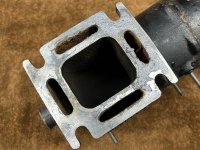
Per Makomark's comments, I ordered gaskets for the Crusader replacement elbows, and the Mercruiser stainless elbows. From pictures on web (and ebay) they looked close. Turns out they are close, but not exact. So here's the idea. The overlay picture shows that the exhaust opening in the crusader manifold is slightly larger in one direction than the opening of the Mercruiser gasket. It doesn't appear to be significant to me. Does anyone think that will restrict exhaust flow significantly?

If I purchase a Mercruiser stainless set, and open the fastener locations up just slightly to line up with the Crusader manifold interface, then use the closed loop manifold gaskets for the Crusader side, do you think it would work?
 

Attachments

  • gasket overlay.jpeg
    gasket overlay.jpeg
    54.9 KB · Views: 7
  • side by side.jpeg
    side by side.jpeg
    128.3 KB · Views: 7
  • ss elbow.jpg
    ss elbow.jpg
    453.4 KB · Views: 5
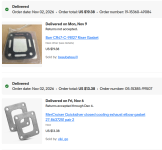
See photo of both ebay purchases. The slotted gasket is BARR aftermarket for Crusader part number, and closed gasket is for Mercruiser.

I sent AI off on a search (second attachment) and it found your thread from 2009. I think it says you had "log style" manifolds. Does that affect the interface pattern for the elbow? Did you have to modify the elbow to mate to the manifold as I'm suggesting?
 

Attachments

  • Screenshot from 2026-11-10 10-19-46.png
    Screenshot from 2026-11-10 10-19-46.png
    204.1 KB · Views: 2
  • Screenshot from 2026-11-02 13-21-35.png
    Screenshot from 2026-11-02 13-21-35.png
    67.4 KB · Views: 2
Also, just held it up to the elbow. Hard to get a picture, but the slotted gasket aligns with the bolts on Crusader. There is a separate part that is used with 2 gaskets as a cutoff plate. Those parts are integral in the Mercruiser cutoff gasket. I figure if I do this, I'll have to use the Crusader side for sure to be certain that I isolate the fresh water securely, and then maybe also put the Mercruiser block in the stack to do the same on the elbow.... Will have to see what that stack looks like, Might be too "soft" to get a good exhaust seal.
 
Thanks for the clarification...I don't think the interface will induce a lot more restriction...maybe at high RPM.

that gasket interface is nothing more than a blockoff plate...the concern I have is to make sure the gasket is sandwiched between the metal parts to minimize the exposure to the hot exhasut gases...may also consider using permatex #3 on the gasket as well.
 
I believe the flanges are getting pretty weak with the illustrated modification below. What do you think?
 

Attachments

  • Screenshot from 2026-11-10 11-48-46.png
    Screenshot from 2026-11-10 11-48-46.png
    902.2 KB · Views: 0
On the log manifolds, they were the Crusader design prior to what you have...I replaced the entire crusader exhaust assembly with the Mercruiser version. I was working at a shop at the time and the price for the mercruiser parts (dealer cost) was drastically less that the crusader parts...so did the swap. Only drawback was having to use reducers in the exhaust hose downstream from the elbows...and that got removed when I resized the rest of the exhaust - from the elbows to the transom..
 
the flanges just get the clamping force from the fasteners...I'd be more worried about the water passage wall thickness...If they don't get reduced much, you should be ok as there's not much water pressure there...

you could always go and do the swap (merc manifolds) if you have any reservations...more money but not worries with any adaptions/modifications.
 
Back
Top