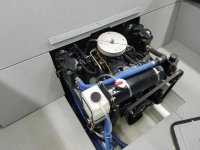
OK let's be clear. Start-in-neutral protection is a great safety measure BUT it is not a mandatory thing. That is, there is no authority going to slap you with a fine or impound your boat or anything at all like that. A NEW boat must be equipped with this to be sold, but there's nothing stopping you from disabling it as soon as you get the boat home. Of course the insurance company won't be too happy about that, but hey it's your vessel.
OK That said I do not recommend that you do not have start in neutral protection. In fact, you should also have a low oil pressure shut down switch, and a high temp shut down switch to save the engine from friction-welding itself into a useless blob. Both of the latter are cheap cheap, screw into existing holes on the engine and are quickly wired in to the IGN circuit that sends power to Mr Coil, so that if either of them trip, the spark stops.
I recommend that you stay with a single lever control that has the neutral safety built in. This will prevent one of your drunk buddies from taking the drive out of gear at WOT (or you). A single lever is easier to place and install, and just makes life easier. Try to find a used one on eBay or craigslist, or toddle down to your local boat junkyard. I guarantee you can score one for a few tens.
My current boat (a 1969 ChrisCraft) came without neutral safety built in. I'd considered on and off over the years to retrofit the switch until 3 years ago. My wife and I had our boat launched at the usual spot and began the 20ish min run to our summer slip. The boat started in the ramp normally, idled normally to warm up (at least enough to move @ 140)... backed out of slip, do-s-doed around another impatient boater looking to pull his boat out @ same ramp. Ran @ 1500 RPM a couple mins to mid river (the Toms) turned to port put in on a plane then up to 2500. Went about half a mile, then up to 3000. Turned north on the Intracoastal, ran up to within 100 yards of the RT37 bridge and cut back to idle... Engine stalled DEAD. Into Neutral... restart... but would not run under 1400 RPM! Too high to shift a Volvo. Several attempts same result. Soooo, given that I do not have a Neutral Safety switch, I started it in gear. A bit of a lunge @ start, but it started and ran. Ran th several miles to "summer home" and as I approached the outer breakwater of the marina, slowed down... got below 1500... cough/die. Several attempts to restart... same thing, would not run below 1500. Soooo... Start in gear, kill ignition soon as boat started to move, drift to stop, repeat... until I got close enough to the slip to snag the outer piling.
Re: single lever vs dual... In addition to my boat which has a first generation MORSE side mount single lever, I regularly "drive" two other club owned boats. One a 24 ft inboard Privateer, the other a 23 ft inboard CC Mako. Both have 350 CID engines of about 225 HP. The Privateer has a Morse top mount single lever, the MAKO has a Morse dual lever. My "mission profile" for both boats involves management of sailboat races, and as such some amount of close quarter maneuvering is involved.
Of the three boats, I prefer the dual lever for maneuverability. I find with the single lever control boats, that when "sudden" shifts from FWD to REV or visa versa are made, one can quite easily overshoot the "detent" (such as it is) and give the boat a "goose" when engaging gear, when all one wanted was an engagement @ idle RPM. With the dual lever MAKO, I set the engine @ idle and can control the boat in close quarters maneuvering ( for those of you that sail, for being the "pin boat @ start" and monitoring the "line" where boat location within a tight area is required) with just careful in/out of gear and no throttle... not unlike what you would do while fishing hard structure.
Re: No oil and hi temp shutdowns.
While a No oil pressure shutoff to electric fuel pump is a USCG requirement, I would not install one on an engine with a mechanical fuel pump. Nor would I install an engine high temp shut off on any engine. A big loud alarm, yes.... instant auto shut off NO. Scenario... coming in thru a nasty inlet... no oil, or hi temp.... Engine stops... OOPS!!!! Maybe you are in a situation where potential future engine damage needs to be traded off vs running the boat for another couple mins to be safe.
Just my OPINION based on about 50 years of boating in such spots as Barnegat Inlet and the Point Pleasant Canal.