Logo

MX 6.2 MPI idle issue?

What is "connected to the block on bb rear side of the motor"?
should mean that this cable is connected to the port side of the motor where other ground cables are connected as well (like the transom)

The light flashes once, short pause, twice and repeats three times, right? That's what you should see and it's the way it shows the number 12 and it's the beginning of any codes that were stored. After the codes have been displayed, it will flash the same 12 code to indicate the end. Now, count the flashes between. The attachment shows MEFI codes and what they indicate- don't worry about the numbers at the end of each line, those are just the page numbers in the manual I have.
already realised - the "flash - pause - double flash" is the only signal code - no further failure codes

DON'T REPLACE PARTS WITHOUT KNOWING THAT THEY'RE BAD! The resistance of most senders and sensors can be measured easily, although a TPS with a short, intermittent problem needs special equipment.
yes - wasted enough of money without progress...
BTW- if you want to measure vacuum, look at the base of the throttle body for an unused port- it may have a rubber cap. You can also use the PCV hose with an adapter- remove the PCV valve, attach the adapter for the vacuum gauge and start the engine for the test.
great - will use the PCV hose
 
I am just back from the boat after putting the engine in base timing mode again. Double checked: LED signals the Diag-Mode only as described above, no further codes. The Motor runs on 1,200 goes down on 1,000 goes up to 1,400 then back on 1,200 for about 5 sec. so seems that the sensors are not the reason why?

In normal mode disconnected TPS, no change, cannot press the throttle plates more down, they close completely.

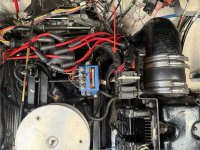
concerning the loose ground cable 2 pics enclosed. The "block" is directly behind/under the ignition coil...

1step close to order a diacom in the states - no service company with a scan tool is available short term, already in touch with rinda...

weekend i will test vacuum - is this still under suspicion?
 

Attachments

  • Image (1).jpg
    Image (1).jpg
    292.6 KB · Views: 58
  • Image.jpg
    Image.jpg
    254.6 KB · Views: 47
I am just back from the boat after putting the engine in base timing mode again. Double checked: LED signals the Diag-Mode only as described above, no further codes. The Motor runs on 1,200 goes down on 1,000 goes up to 1,400 then back on 1,200 for about 5 sec. so seems that the sensors are not the reason why?
I would NOT discount the sensor inputs based on your test. The ECM still uses their inputs to control the engine - It just does so with a fixed timing value.

As far as the unused ground wire goes, I'd suggest you get the Delphi (GM) MEFI-3 manual. It has schematics of each 'subsystem' and will show what is grounded...you can them eliminate each sensor one-by-one...the oddball will be the ignition system as the GM EST ignition isn't used by Mercruiser on the 6.2L engines...
 
I am just back from the boat after putting the engine in base timing mode again. Double checked: LED signals the Diag-Mode only as described above, no further codes. The Motor runs on 1,200 goes down on 1,000 goes up to 1,400 then back on 1,200 for about 5 sec. so seems that the sensors are not the reason why?

In normal mode disconnected TPS, no change, cannot press the throttle plates more down, they close completely.

concerning the loose ground cable 2 pics enclosed. The "block" is directly behind/under the ignition coil...

1step close to order a diacom in the states - no service company with a scan tool is available short term, already in touch with rinda...

weekend i will test vacuum - is this still under suspicion?
Before answering any other questions,

Has the fuel pressure been checked? I don't remember seeing anything about it, other than post #2.

Test at Key On/Engine Off
Idle
2000RPM
WOT

Fuel pressure MUST be tested on the water, with the engine under load. Testing on the trailer or in neutral isn't a valid way to do this.

Vacuum is always important but if you find a manual, you can use a voltmeter to measure the control & return voltage on each sensor (TPA, MAP, ECT) and measure the resistance on the ECT, to make sure it's within normal range. That one won't cause the engine to hunt for the correct engine speed, though- it will make hot starting difficult if the resistance is too high or it will run too lean if it's too low.

A quick version of what happens when these systems operate, assuming you have no training on this-

When the key is turned to ON, the MAP sensor reads the barometric air pressure, even if the key goes directly to Crank- it takes a very short time to read this and it continues until the engine shuts off.

RPM- at or below 300 RPM, the engine is cranking, not running. Above 300 RPM, the ECM program acts appropriately for a running engine. The ECM is programmed to idle at about 600-700 RPM- the timing mark will jump around at idle due to the program using Spark Stabilization to ensure smooth idle. It's not for performance, it's because people like smooth idle.

The TPS tells the ECM whether the engine is idling or at higher speed when at or below 2% throttle position and during idle, it controls the engine. If it fails, the ECM defaults to a fixed 12% Throttle Position and the engine will run, but it won't be as responsive as it should be. If the throttle position reads 100%, the engine won't start or run because that is when the throttle 'is' wide open and during cranking, shutting off the fuel flow will clear a flooded engine. The TPS also delivers more fuel when the throttle opens 20% or more in a short time- this is called 'acceleration enrichment', when it closes by 20% or more in a short time, it delivers less fuel, in what's called 'deceleration enleanment'.

MAP sensor- in addition to reading barometric pressure, it acts as an electronic vacuum gauge for the ECM. Highest vacuum means the throttle is closed, lowest vacuum means it's closed. Hard acceleration (sudden drop in vacuum) will make the MAP sensor deliver more fuel and hard deceleration (sudden increase in vacuum) will cause it to deliver less fuel.

When the engine is running, the MAP sensor runs the show.


That said, MAP sensors and the rubber tube do fail, occasionally- one test for this is to disconnect the rubber tube and if idle settles down, check the tube for cracks and loose fit at either end. I have seen both. If the tube is OK, use a vacuum pump to test the MAP sensor as mentioned in pot #5- this is more easily seen with the diagnostic computer/software, but it can be done with a multimeter, too. Increase vacuum using the pump (not a lot- the sensor's diaphragm is relatively fragile):


Map sensor wire colors-
Light Green- Return signal, sent to ECM as voltage range of ~2VDC to ~5VDC
Gray- 5VDC reference voltage
Black- Ground

TPS wire colors-
Dark blue Return signal, same voltage range as MAP sensor
Gray- 5VDC reference voltage
Black- Ground

 
Fuel pressure MUST be tested on the water, with the engine under load. Testing on the trailer or in neutral isn't a valid way to do this.

not in that detailed way: It is not possible to drive or put the gear in, the rpm are too high (of course I could push it put it "feels" wrong and it far to fast in the box...)
That said, MAP sensors and the rubber tube do fail, occasionally- one test for this is to disconnect the rubber tube and if idle settles down, check the tube for cracks and loose fit at either end.
which rubber tube do you mean?
Map sensor wire colors-
Light Green- Return signal, sent to ECM as voltage range of ~2VDC to ~5VDC
Gray- 5VDC reference voltage
Black- Ground

TPS wire colors-
Dark blue Return signal, same voltage range as MAP sensor
Gray- 5VDC reference voltage
Black- Ground

Thanks all, much appreciate. I organized a Mechanic with a Diacom - need to wait until 3rd of June....... so time to try with the multimeter. He already mentioned that he is more "comfortable" with newer MPS, not with the old MEFI ones.. halleluja...
 
not in that detailed way: It is not possible to drive or put the gear in, the rpm are too high (of course I could push it put it "feels" wrong and it far to fast in the box...)

which rubber tube do you mean?

Thanks all, much appreciate. I organized a Mechanic with a Diacom - need to wait until 3rd of June....... so time to try with the multimeter. He already mentioned that he is more "comfortable" with newer MPS, not with the old MEFI ones.. halleluja...
After I posted, I thought about the intake manifold-mounted MAP sensor might be on your engine.

Remove the MAP sensor and plug the hole in the intake manifold, so you won' have an uncontrolled vacuum leak, then attach a tube to the sensor so you can test it as described.

I trained on MEFI 1 through 4 between 1998 and 2001 and the info I have posted came from my service manuals.

One thing about testing voltage on sensors and their harnesses- DO NOT pierce the insulation. That's a good way to allow moisture to affect the Copper wires. Use thin, stiff wire pins (used by people who sew and do needlepoint) and insert one into each silicone rubber insulator on the backside of the plug, to make contact with the terminals.

The theory behind MEFI and other systems is basically the same- similar or same sensors with the addition of others (IAT, MAF, O2) and some have catalytic converters, so the program is more accurate, but the older MEFI was used successfully in a lot of boats.

BTW- if you know someone who can program a MEFI ECM, an IAT (Intake Air Temperature Sensor) can be installed, to make the engine more efficient. one of the techs I worked with trailered his boat to Mastercraft training and one of the techs who worked for the trainer ran diagnostics and changed the program to enable it- IIRC, he used Diacom. Maybe you could ask the mechanic about doing this.

The boat that received the IAT was a Malibu with TBI and we mounted it in the plate for the flame arrester that sits on the throttle body- I looked at the diagram for your engine and this could be mounted at the under side of your flame arrestor to prevent the need to drill through the plastic shroud.

Just as a way to cover all bases, it might not be a bad idea to check the nuts or bolts holding the throttle body onto the intake manifold.
 
Hi! I came across this thread because my 6.2 MPI pre-2001 idle was floating 600-1600 and in the end finished 1600 all the time. Today we spent some time checking vacuum, sensors, connectors and what not. In the end we found the problem: TPS was slightly jamming. A few gentle screw attempts of the disconnected TPS with a screwdriver resolved the issue. After the assembly the engine started and we got back our 600 idle. Ordering a replacement TPS just in case it evolves. Check it out, might be your case too @Skyline2000

Oh btw can't give you a good advice on the disconnected mass cable because we also have it and it does not seem to affect anything. I can give you better photos of this black cable later if needed.
 
A few gentle screw attempts of the disconnected TPS with a screwdriver resolved the issue. After the assembly the engine started and we got back our 600 idle. Ordering a replacement TPS just in case it evolves.
Hi - I disconnected and removed it, there was abs. no difference. The thing is, that the idle is not stable in any position - floating 1,400-1,800 in „normal“ mode when everything is connected (or even disconnected) and 1,000 - 1,400 in Diagnose mode….
Oh btw can't give you a good advice on the disconnected mass cable because we also have it and it does not seem to affect anything. I can give you better photos of this black cable later if needed.
So you have this loose cable as well? I tried to recall what I have removed during installation: can only be Coil, fuel rail, mercathode, ignition cap….
 
Hi - I disconnected and removed it, there was abs. no difference. The thing is, that the idle is not stable in any position - floating 1,400-1,800 in „normal“ mode when everything is connected (or even disconnected) and 1,000 - 1,400 in Diagnose mode….

So you have this loose cable as well? I tried to recall what I have removed during installation: can only be Coil, fuel rail, mercathode, ignition cap….

How have you checked for vacuum leaks?
 
The thing is, that the idle is not stable in any position - floating 1,400-1,800 in „normal“ mode when everything is connected (or even disconnected) and 1,000 - 1,400 in Diagnose mode….
Did you physically check and if found necessary readjust the ignition timing by using a timing light and turning the distributor assembly?

If not then maybe the following videos will help point you in the better direction of how to if needed.


Is V8Lounge
1 month ago
I'm building a 6.2 merc too. Greetings from germany You? I was wondering if maybe this Merc wiring video may help pick up on what that black wire goes to. :)
 
Did you physically check and if found necessary readjust the ignition timing by using a timing light and turning the distributor assembly?

If not then maybe the following videos will help point you in the better direction of how to if needed.


Is V8Lounge
1 month ago
I'm building a 6.2 merc too. Greetings from germany You? I was wondering if maybe this Merc wiring video may help pick up on what that black wire goes to. :)
Thanks mate - I think I know nearly every MPI Video on YT :) . I will set the timing new next week with the base timing mode. But this seems not to cause the idle up and downs
 
Did you physically check and if found necessary readjust the ignition timing by using a timing light and turning the distributor assembly?

If not then maybe the following videos will help point you in the better direction of how to if needed.


Is V8Lounge
1 month ago
I'm building a 6.2 merc too. Greetings from germany You? I was wondering if maybe this Merc wiring video may help pick up on what that black wire goes to. :)
That top video might be OK if it showed how the jumper changed the engine's speed and the timing, which sounded too advanced, judging by the uneven cranking speed. Also, the ALDL/DLC (Assembly Line Diagnostic Link or Data Link Connector) is the capped plug NEXT TO the one he's holding in his hand- I don't know what that one is or where it was connected.

He also used a wide piece of tape to show the timing mark without drawing a line over the groove- a better way is to mark ONLY the groove, so the timing can be set accurately, not ±~5°. I would have picked a video to show working with a Mercruiser distributor that shows the type used in the OP's engine- the one with the flat area and two harness connections isn't what he has and some Mercruiser distributors act more as a connection after the coil than a GM distributor with the ICM (Ignition Control Module) inside, controlled by the ECM.
 
So.. Updates:

Yesterday we adjusted the Ignition timing with idle mode A/B Jumper - ✅

Idle still fluctuated so I checked the MAP - it was on 1.39-1,6V up and down. So I THOUGHT I found the failure. Then I wanted to measure the TPS as well and was searching for the dark blue cable at the connector..WTF - there was only a green one.

Looking around and found a blue one.. connected to the Fuelsensor.............. what the hell... could that be? YES - switched both connectors, started the engine - it directly went up to 2,000 rpm and dropped immediatly to 650.. test drive--- okay, seems all working now. MAP on 1.8V so okay as well - Decided to take the trip to my harbour over about 1.5hours.. the boat just ran perfectly. seems that i mixed the connectors in winter installing the new injectors.

So I thank you all for all the ideas and the technical background. I learned so much about my engine (and my skills). I take the complete blame.

Take care and bless you
Stephan
 
Last edited:
So.. Updates:

Yesterday we adjusted the Ignition timing with idle mode A/B Jumper - ✅

Idle still fluctuated so I checked the MAP - it was on 1.39-1,6V up and down. So I THOUGHT I found the failure. Then I wanted to measure the TPS as well and was searching for the dark blue cable at the connector..WTF - there was only a green one.

Looking around and found a blue one.. connected to the Fuelsensor.............. what the hell... could that be? YES - switched both connectors, started the engine - it directly went up to 2,000 rpm and dropped immediatly to 650.. test drive--- okay, seems all working now. MAP on 1.8V so okay as well - Decided to take the trip to my harbour over about 1.5hours.. the boat just ran perfectly. seems that i mixed the connectors in winter installing the new injectors.

So I thank you all for all the ideas and the technical background. I learned so much about my engine (and my skills). I take the complete blame.

Take care and bless you
Stephan
Interesting- most connectors can't be inserted anywhere but their intended device (aside from multiples, like injectors) if they reach more than one.

Good to see the problem is gone.
 
So.. Updates:

Yesterday we adjusted the Ignition timing with idle mode A/B Jumper - ✅

Idle still fluctuated so I checked the MAP - it was on 1.39-1,6V up and down. So I THOUGHT I found the failure. Then I wanted to measure the TPS as well and was searching for the dark blue cable at the connector..WTF - there was only a green one.

Looking around and found a blue one.. connected to the Fuelsensor.............. what the hell... could that be? YES - switched both connectors, started the engine - it directly went up to 2,000 rpm and dropped immediatly to 650.. test drive--- okay, seems all working now. MAP on 1.8V so okay as well - Decided to take the trip to my harbour over about 1.5hours.. the boat just ran perfectly. seems that i mixed the connectors in winter installing the new injectors.

So I thank you all for all the ideas and the technical background. I learned so much about my engine (and my skills). I take the complete blame.

Take care and bless you
Stephan
Good to know you settled this one. Not too many ppl out there with pre-2001 6.2 mpi do it all themselves and are willing to share the experience.
 
Back
Top