Logo

MX 6.2 MPI idle issue?

Skyline2000

New member
Hello everyone,

since I can't find any more ideas in Germany, I have to ask you. My name is Stephan an I am based near Berlin. In my Maxum 2700 I have an MX 6.2L MPI from 2001 (MEFI 3 ECU), there is no serial number stamped on it, as it is a replacement engine with part number 832760R01 from 2008, which replaces the serial number range 0L680003 to 0M299999. Mileage 900h.

Now to the problem: I got through the last season well with the engine, but I always had misfiring above 4,000 rpm. In addition, the impeller broke. After consultation with the local mechanic, the ignition system was completely replaced in winter storage (ignition coil, plugs (AC Delco), cables (some of the old ones had corrosion), distributor cap incl. finger - all original Mercruiser, everything was actually heavily corroded). I also replaced the burnt exhaust flaps including hoses etc.

The ignition itself was then adjusted by the service technician - the engine started immediately and initially ran without any problems at the beginning. But as soon as I put it into gear, it sounded like not running on all cylinders. After several checks, it was determined that the plugs of the fuel injectors were no longer making proper contact - corrected, all injectors spray accordingly. The injectors themselves were serviced last year for cleaning.

The compression was tested on all cylinders and is between 10.5-12 bar cold.

Now to the actual problem: Now that all the parts have been replaced, the engine revs to 1,800 rpm immediately after starting and keeps fluctuating to 1,200 and back up again. The IAC was tested - it's not the fault, a new one didn't change anything, the old one works. The pressure regulator was also replaced, as was the fuel pump.

The only other thing that comes to mind is the coolant temperature sensor. If it is sending the wrong data to the control unit...... but could this make sense?

Does anyone else have any ideas?

By the way, there is a ground cable coming from the engine and I have no idea where it goes. MAybe this could make the difference as well? The lenght could fit to the coil or mercathode... but cant see any point to connect it. Unfortunatly the file upload is not working - i will try again later.

Thank you very much!
 
Last edited:
10.5 - 12 bar is a 20% variation (145 - 175 psi) and being cold,

Fuel pressure should be about 3 bar (43 psi)

the engine revs to 1,800 rpm immediately after starting and keeps fluctuating to 1,200 and back up again. The IAC was tested - it's not the fault, a new one didn't change anything, the old one works
The one IAC test doesn't rule out completely the IAC might be the issue. Surging and high idle is the IAC, worn or damaged throttle plate and leaking IAC gasket or throttle body (vacuum leak)

Does the idle settle down during base timing mode? (when jumper across pins A and B of the DLC
 
My gut says there is more to the story.....

Regarding the file upload - used to require a user to have more than five posts before attachments could be added...

agree that you are likely looking for a vacuum leak on the intake side...the few vacuum hoses are likely candidates as is a loose throttle body.

disconnected grounds can cause many types of abnormal behavoirs but I discount high and varying idle being one.
 
thanks - so I will upload as soon as I have the right to do so.

Concerning the IAC: I used a new one and faced the same issue. After starting the motor with the new IAC I tested new and old by just turning the key on ignition (w/o starting) and both did the same: turn in for the start, turn out after switching off.
So I am very sure that it has sth. to do with IAC at all - when I cover the bypass in the throttle body the idle goes down but still not stable. So my thought was that maybe sth. is wrong with the signal/ information the ECU gets. And since the whole system ran a bit hot because of the broken impeller could it make sense that the cooling temperature sensor is damaged and sends rubbish?

When I cover the bypass where IAC gets the air from the motor turns off immediatly.

@AllDodge: What do you mean with A and B jumper on DLC? Unfortunatley I dont have a Diacom at hand....

Edit: The mechanic wanted to bypass the ECM after adjusting the ignition timing, which was apparently possible on older models. According to him, the control unit would otherwise have immediately re-adjusted the ignition timing again. He couldn't bypass anything on my control unit – could that be related?
 
Last edited:
A san tool would allow you to easily assess the condition of the input sensors...

The edit section of the last post, on the timing, doesn't make sense...

You can always get a vacuum gauge and hook it up to the intake manifold...

On the uploads, go to the forum home page and scroll down to the bottom...there is a section for test posts...you can make a trial there and add several dummy posts until the attachment is allowed...used to need t post.
 
here we go.. this is the ground cable comming from behind the motor

IMG_5827s.jpg
 
Throttle body ports.jpg


when I cover the bypass in the throttle body the idle goes down but still not stable. So my thought was that maybe sth. is wrong with the signal/ information the ECU gets. And since the whole system ran a bit hot because of the broken impeller could it make sense that the cooling temperature sensor is damaged and sends rubbish?

When I cover the bypass where IAC gets the air from the motor turns off immediatly.
Covering the idle port causes the motor to idle down but not die gives me more reason there is a vacuum leak somewhere.

@AllDodge: What do you mean with A and B jumper on DLC? Unfortunatley I dont have a Diacom at hand....
The Data Link Connector (DLC) is normally near to the ECM but can also be near the thermostat housing. It has a black plastic cover which snaps off to expose the pins. Jumping pins A and B puts the motor in "base timing mode". When oins are jumped the MEFI-3 ECM stops adjusting timing

Edit: The mechanic wanted to bypass the ECM after adjusting the ignition timing, which was apparently possible on older models. According to him, the control unit would otherwise have immediately re-adjusted the ignition timing again. He couldn't bypass anything on my control unit – could that be related?
Putting motor into base timing mode is probably what your mechanic mentioned.

So was the mechanic not able to find the DLC or was it found and jumping A and B did nothing?

DLC with LED code reader.jpg
 
Ah okay - thanks for clarifying. So just to be clear: When I cover the IAC hole 100% the motor turns off immediately. I meant when I just slightly cover it then the rpm goes down.

Concerning the base timing: Does it make sense to do this now and test it or do I need to adjust the timing upfront? Disconnect the batteries necessary? Do I need to put in the led or is it just for failure codes?

And what should the reaction of the idle / motor be when doing this? And how long do I need to to this? And do I need to pull the jumper out when engine is running? Sorry for any stupid question :/

He wasn’t sure about this „hack“ - he has more experience with the older Mercruiser versions I guess.
 
Ah okay - thanks for clarifying. So just to be clear: When I cover the IAC hole 100% the motor turns off immediately. I meant when I just slightly cover it then the rpm goes down.
ok, there is a vacuum leak, the IAC is most likely for the most part closed off, and every time it even slightly opens RPM goes higher

Concerning the base timing: Does it make sense to do this now and test it or do I need to adjust the timing upfront? Disconnect the batteries necessary? Do I need to put in the led or is it just for failure codes?
A jumper "must" be installed to even begin to set timing, it has to be in base timing mode to set correctly.
If timing was done any other way than it is not correct

How to set timing. I edited for your ECM specifically

1. Connect timing light to number 1 spark plug wire.
2. Start engine and run at 1300 rpm until it reaches normal operating temperature.
3. Stop engine and connect "jumper" to the DLC connector
4. Start engine, allow rpm to stabilize.
MEFI-3 models only, ECM will automatically adjust engine rpm to approximately 1200 rpm when put in the service mode on a scan tool or when using the timing tool or jumper.
5. Check ignition timing. If incorrect, rotate the distributor until timing is correct. Torque clamping screw to 18 lb-ft (25 Nm).
6. Recheck ignition timing.
7. Disconnect scan tool or timing tool or jumper from DLC connector.
8. deleted
9. Restart engine, increase rpm to 1300 then return to idle position slowly. Ensure that
engine returns to idle rpm. Readjust throttle cable, if required.
10. Shut engine off.
 
Great stuff - I will try asap!! We def. did not do this.

Last question on this: No. 4 says start the engine - number 9 restart engine. After which number I need to shut the engine off between 4 & 9?
 
Last edited:
I deleted a shut down in number 8 because you won't need to return throttle

8. If required, return remote control throttle lever to idle position and shut off engine.

Basically warm the motor up, turn off, install jumper, restart and set timing, turn off and remove jumper
 
thanks - so I will upload as soon as I have the right to do so.

Concerning the IAC: I used a new one and faced the same issue. After starting the motor with the new IAC I tested new and old by just turning the key on ignition (w/o starting) and both did the same: turn in for the start, turn out after switching off.
So I am very sure that it has sth. to do with IAC at all - when I cover the bypass in the throttle body the idle goes down but still not stable. So my thought was that maybe sth. is wrong with the signal/ information the ECU gets. And since the whole system ran a bit hot because of the broken impeller could it make sense that the cooling temperature sensor is damaged and sends rubbish?

When I cover the bypass where IAC gets the air from the motor turns off immediatly.

@AllDodge: What do you mean with A and B jumper on DLC? Unfortunatley I dont have a Diacom at hand....

Edit: The mechanic wanted to bypass the ECM after adjusting the ignition, which was apparently possible on older models. According to him, the control unit would otherwise have immediately re-adjusted the ignition timing again. He couldn't bypass anything on my control unit – could that be related?
How would he bypass the ECM, or did he want to bypass spark stabilization?

You can connect terminals A & B with a paper clip, jumper wire for a meter or other wire. This is at the ALDL (Assembly Line Diagnostic Link) and you would use the Check Engine Light to see the codes, but it also serves to go into diagnostic mode, for setting/checking timing. You'll need to increase throttle to 1000RPM for this and you'll be setting BASE timing. The reason I used capital letters is because the timing will be fairly
thanks - so I will upload as soon as I have the right to do so.

Concerning the IAC: I used a new one and faced the same issue. After starting the motor with the new IAC I tested new and old by just turning the key on ignition (w/o starting) and both did the same: turn in for the start, turn out after switching off.
So I am very sure that it has sth. to do with IAC at all - when I cover the bypass in the throttle body the idle goes down but still not stable. So my thought was that maybe sth. is wrong with the signal/ information the ECU gets. And since the whole system ran a bit hot because of the broken impeller could it make sense that the cooling temperature sensor is damaged and sends rubbish?

When I cover the bypass where IAC gets the air from the motor turns off immediatly.

@AllDodge: What do you mean with A and B jumper on DLC? Unfortunatley I dont have a Diacom at hand....

Edit: The mechanic wanted to bypass the ECM after adjusting the ignition timing, which was apparently possible on older models. According to him, the control unit would otherwise have immediately re-adjusted the ignition timing again. He couldn't bypass anything on my control unit – could that be related?
The IAC is the only place where air enters for idle, so covering it SHOULD kill the engine. If it doesn't, it means you would have a large vacuum leak.

The IAC IS NOT a sensor- it's a dumb device that sends no information, anywhere.

I wasn't aware that the ECM cound be removed from operation on ANY injected models, but Mercruiser may have allowed it- I trained on Mastercraft & Indmar, which used DELPHI MEFI controllers and they could not be left unused because it needs the signal from the sensors to allow the engine to run at all, let alone well.

I would like to see info from the manual or training that shows how the ECM can be disconnected and let the engine run- there would be no info about temperature, vacuum (via the MAP sensor), throttle position, knock, RPM or anything else.
 
The IAC is the only place where air enters for idle, so covering it SHOULD kill the engine. If it doesn't, it means you would have a large vacuum leak.
ok, good to know - it 100% kills directly when covered - so no vacuum check needed? no idea where to connect the tester which is on the way from amazon...

The IAC IS NOT a sensor- it's a dumb device that sends no information, anywhere.
I know, the question was, if it gets the right information from ECM when and how to open
I wasn't aware that the ECM cound be removed from operation on ANY injected models, but Mercruiser may have allowed it- I trained on Mastercraft & Indmar, which used DELPHI MEFI controllers and they could not be left unused because it needs the signal from the sensors to allow the engine to run at all, let alone well.
we should leave this topic - I really don't know in detail what he meant, but I am pretty sure that he want to put a kinda jumper as you described but wasn't aware how to do this on this MEFI3. So I will check as you guys described above shortly. hopefully this covers the issue
 
ok, good to know - it 100% kills directly when covered - so no vacuum check needed? no idea where to connect the tester which is on the way from amazon...


I know, the question was, if it gets the right information from ECM when and how to open

we should leave this topic - I really don't know in detail what he meant, but I am pretty sure that he want to put a kinda jumper as you described but wasn't aware how to do this on this MEFI3. So I will check as you guys described above shortly. hopefully this covers the issue
In your first post, you mentioned the unconnected ground wire and showed it in a later post- what is at the other end?

Did you or the mechanic connect it to the block? If so, what changed (if anything)?


Put your hand over your mouth & pinch your nose- how well can you breathe? Think of the throttle plate as your mouth and the IAC as your nose- those are the only ways for air to enter the engine, or should be.

The ECM uses MAP and RPM to 'know' how far to open the IAC- above 300 RPM, TPS is used when opening/closing the throttle quickly ±20% and it's also used to clear a flooded engine (open throttle to WOT and crank).

The fact that it draws air into the IAC orifice doesn't mean you don't need to do a vacuum test- each cylinder needs good vacuum in order to draw the correct amount of fuel and air into the cylinders. IAC is there to allow the engine to start and run without opening the throttle, add air during hard acceleration or close during hard deceleration.

The IAC is called a 'stepper motor'- it opens & closes in discrete increments and in the program, the ECM closes it after the engine shuts off, then opens it a specific number of steps (that's called 'parking' or 're-parking' the pintle), which allow it to start. If that changes (the pintle stays open too far or not enough when it parks, RPM will be too high or low, respectively.
 
Is the mechanic using a diagnostic device that shows data, or just a code reader with some kind of light flash? Someone needs to look at all of the data in order to see if the sensors are operating correctly, the real temperature (the voltage sent to the ECM, not the gauge), voltage (not the same as what the voltmeter will show if a grounding problem exists).
 
Hi all - thanks for all your input. I went to the boat and tested the A-B Jumper on the DLC. Result: Idle went down to 1200rpm as it should. BUT not stable.

Really weird that with the first start today the motor stayed on 750 rpm for half a minute, then went up to 1,600. After warm up he is constantly on 1,800, moving all 15sec. down to 1,600 and up again.

@jimn the ground wire is connected to the block on bb rear side of the motor - so no idea where to connect. I was hoping someone else with this early MX 6.2 here in the forum who could check his wiring scheme...

We have no diacom so I need to get in touch with still active service companies - my mechanic retired and seems that he run out of ideas now. I connected a 12V Led to the DLC - no codes to see. Just during the A/B jumper setting before the start it flashes 3 times every 5 sec. (ignition position). After start to blink.
 
Have you disconnected the throttle cable from throttle body to see if it idles down with slight pressure hold TB closed?
 
disconnected the TB yes but closed IAC hole (not the whole TB) then motor shut off.

What is your thought since you directly asked for the reaction after A/B jumper?
 
You can usually Tee the vacuum gauge into the hose going to the fuel pressure regulator...not having a scan tool is going to make it a bit tougher to diagnose. Another thing you are facing is that the MX6.2 configuration you have was only used a very short period in time...so there won't be a lot of history to be shared...
 
Have you disconnected the throttle cable from throttle body to see if it idles down with slight pressure hold TB closed?
disconnected the TB yes but closed IAC hole (not the whole TB) then motor shut off.

What is your thought since you directly asked for the reaction after A/B jumper?

I'm not talking about the IAC hole inside the Throttle body (TB), I'm talking about the holding the throttle plates closed by hand. Remove the throttle cable from the TB arm and use fingers to push the arm on the TB closed, Does this idle it down?

The A/B jumper told the ECM to disregard all sensors and idle it at 1200 to set timing. So the sensors (MAP, TPS, ECT) are causing the ECM to increase rpms

You can use a digital voltmeter to measure the TPS and MAP to better understand what the ECM is seeing
 
Ok - looking into the part catalogue I can’t see a MAP sensor for the early stage MX 6.2, right? so if it’s not the TPS it sh/could be the coolant sensor?
 
What is your thought since you directly asked for the reaction after A/B jumper?
Thus far from the description of things done, it seems possibly the technician working on it, the timing wasn’t adjusted correctly by not going into base timing mode before readjusting at some point…. Even if done correctly, it still needs double checking as it could cause high idle too not adjusted correctly… you need to know for sure before moving to much forward.

The black wire might go to the transom assembly to connect the anode corrosion circuit… see if there’s a black wire from the rear of the engine block to the transom housing ‘often found on the port side of the boat… if not, and wire is to the housing, try posting an overall picture of the whole engine area as maybe it will help ring a bell… since there is already a negative black wire on the mercathode, it probably isn’t the one though it looks close to it in design.

Yes your EFI will have a MAP sensor for sure.
 
Okay, MAP found - i will check. Hope to get a diacom shortly

Transom is connected with a ground cable - connected to the same block where the lose one is coming from
 
Hi all - thanks for all your input. I went to the boat and tested the A-B Jumper on the DLC. Result: Idle went down to 1200rpm as it should. BUT not stable.

Really weird that with the first start today the motor stayed on 750 rpm for half a minute, then went up to 1,600. After warm up he is constantly on 1,800, moving all 15sec. down to 1,600 and up again.

@jimn the ground wire is connected to the block on bb rear side of the motor - so no idea where to connect. I was hoping someone else with this early MX 6.2 here in the forum who could check his wiring scheme...

We have no diacom so I need to get in touch with still active service companies - my mechanic retired and seems that he run out of ideas now. I connected a 12V Led to the DLC - no codes to see. Just during the A/B jumper setting before the start it flashes 3 times every 5 sec. (ignition position). After start to blink.
What is "connected to the block on bb rear side of the motor"?

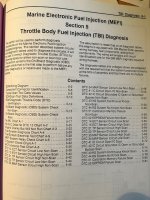
The light flashes once, short pause, twice and repeats three times, right? That's what you should see and it's the way it shows the number 12 and it's the beginning of any codes that were stored. After the codes have been displayed, it will flash the same 12 code to indicate the end. Now, count the flashes between. The attachment shows MEFI codes and what they indicate- don't worry about the numbers at the end of each line, those are just the page numbers in the manual I have.

DON'T REPLACE PARTS WITHOUT KNOWING THAT THEY'RE BAD! The resistance of most senders and sensors can be measured easily, although a TPS with a short, intermittent problem needs special equipment.

BTW- if you want to measure vacuum, look at the base of the throttle body for an unused port- it may have a rubber cap. You can also use the PCV hose with an adapter- remove the PCV valve, attach the adapter for the vacuum gauge and start the engine for the test.
 

Attachments

  • MEFI Codes.jpg
    MEFI Codes.jpg
    147.4 KB · Views: 37
Back
Top