Logo

more issues

sammi

Regular Contributor
OK, having fixed the alternator issue and having run the used 318 in my driveway with a hose connected to it I decided to take the 24' lyman out for a test run. At 3300rpm the gps read 13 mph. The engine sounded as if it was running at 1500 rpm. I thought "no way is the tach right" but I got nervous running at 4000 rpm even though it seemed like it was running 2000 at the most. Also, the temp read 140-145 but I smelled a bit of burning rubber smell. I got nervous and put the boat away and went out on my 31 Tiara.
2 questions:

1. Tonight I see the tach is set at 6c. Should it not be at 8c for an 8 cylinder engine?
2. The engine has that silly(to me) 2 rubber impeller pump in one unit with no circulating pump. Is it possible that one impeller is shot? If 1 is bad would the other pump have enough pressure to keep the engine cool and is it possible that the part supplying water to the T stat is working but other parts of the engine are overheating? I could touch each exhast manifold without burning my hands by the way.
 
Yes, that raw water pump is "silly"--it's also a nightmare!

ALL of the water goes through the manifolds eventually, so if they are cool to the touch you should be pumping enough water. Time to buy an infrared temp gun (under 30 bucks).

Jeff
 
Thanks Jeff. What do you think of the tach wiring? Should that be set at 8C? Looking today I think I may have smelt the belt. The edges are glossy and I have about 3/4 to 1 inch of play.The owners maual says only 1/4 inch.
 
Flip the tach switch to "8C" then wiggle it back and forth to improve the contact. Next, remove that belt and take it to NAPA. Have them match it up, then tighten it good when you replace it.


Jeff
 
Ok, so I take the boat out today with the tach at 8c and a new belt. It ran superb for about 45 minutes at all speeds up to 3200rpm. I didn't push it any harder. we came in to the dock and shut it off for 20 minutes. Tried to turn back on and it cranked and cranked but would not start. plenty of gas when I hit the throttle. Pulled the coil wire and tried to get a spark to jump from the coil to wire, nothing. Pulled the coil wire from the distributor to get a jump and it tries to start. hook back up and it starts immediately. Ran ok at idle but anything above 1500 rpm was missing. Got it to the ramp and put it away. Getting better but what caused the issue. To refresh:
used 318 engine with 1200 hrs previous owner changed to electronic ign. The coil says "used with primary resistance wire or external resistor" I see no resistor so question.
1. what is a primary resistance wire?
2. any idea why it would run perfectly for 30- 40 minutes then, once I shut it off, not start until I took off the distributor/ coil wire and missed the rest of the time I ran it above 1500rpm?

Oh yea, as long as it was running the temp never went above 140 degrees and the manifolds were never too hot to touch.
 
Last edited:
That coil is designed to start at 12 volts but run at 9 volts, so it needs a ballast resistor. Follow the wire that goes to the "+" terminal on hte coil and you should find the ballast resistor. If it's not there, that means your coil burnt up from running on 12 volts directly.

Jeff

PS: NAPA sells a nice ballast resistor with bolt on wires. Part number ICR 11.
 
The coil is what I suspected as well so I put my original coil on from my 1977 318. It says "no external resistor required" still didn't start. Now, it is old as well so who knows.
If I run the engine and check votage at the + terminal of the coil it should read around 9 volts if there is a resistor? If it says 12, no resistor? A resistor is that white ceramic part with 2 terminals right. Just so I know what I'm looking for.
 
I found the owners manual for the new electronic ign the old owner put on. It says "the electronic ign is self-current limiting. Therefore, it does not require additional resistance in the primary circuit. If the primary circuit contains any resistance, ie ballast resistor or resistance wire, the performance of the electronic ign will be adversley affected. I know it doesn't have the resistor anymore but how do I tell if I have a resistance wire? It also says to use a Presolite 5-69 electronic ign coil. I think I will try to locate one and start from there. What I can't figure out is the guy I bought it from says it ran fine so why not now. MAybe he was not being quite forthright and that is why he sold it. It sounds great and ran fine for awhile.
 
so the manual says use a prestolite 5-69 coil and the manual also says to remove the ballast. prestolite 5-69 coil says external resistor required. Will I continue to burn out coils by removing the ballast resistor?
 
I know this stuff is confusing! Here's the deal: IF you have a "no external resistor" coil, it's designed to run on a full 12 volts. No vballast resistor is needed. But if you have a "external resistor or resistance wire required" coil, it's designedf to run on about 9 volts and MUST use a ballast resistor (to limit the voltage).

Here's a setup my buddy went to that works terrifically: He bought a high performance 12 volt coil (45,000 volts) and installed it with a 1.5 ohm resistor. (NAPA part # ICR11). Why the resistor in this case? If someone leaves the ignition on by accident the coil doesn't burn up. THe system made his 360s run better than they ever did.

Jeff
 
Sounds good Jeff. Now what do I ask for at the auto parts store as far as coil goes? Any 12 volt coil that says "no external resistor required"?
 
My buddy ordered his coil from Summit Racing. It's a Mallory 45,000 volt super coil. The resistor can come from there as well, if you wish, or NAPA.

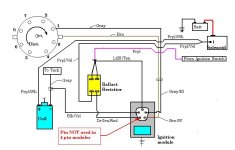
Attached is a simplified wiring diagram of the stock Chrysler ignition. Note that one circuit on that stock ballast resistor is not even used (with a 4 pin module--all you can buy any longer). Also note that the 12 volt feed to the coil for starting only comes from a terminal on the starter solenoid.


Jeff
 

Attachments

  • ignition.jpg
    ignition.jpg
    44.7 KB · Views: 1,878
So I have the new Blaster coil installed. No resistor, as the instructions say you can use it or not and the electronic ign instructions say remove it. Ran it for about and hour and it ran great. Then I was idling around and it died like I shut the key off. I was able to restart and it died after 5 seconds of running. The coil was warm to the touch but not hot. New voltage regulator but it was reading 14.8 14.9 volts at my VHF radio. That still seems too high to me and I still wonder if the coil is getting too hot(even though not to the touch). Maybe the electronic ign can't take that high of voltage. I don't know what more to do than spring for the 1 wire alternator with internal regulator, right?
 
Could be. Better check the electrolyte levels of your batteries as well with that much voltage going on.

I strongly recommend the ballast resistor be maintained, by the way. It protects the coil from what you've experienced, plus goofs like leaving the key on by accident.

Jeff
 
I had the resistor in the boat and started to wire it up. It gets awful hot. How hot is normal? Also, did you say an alternator shop can convert a 3 wire to a 1 wire system with an internal voltage regulator? I could just take the alternator from the old engine in this week.
 
Any good alternator shop can do that for you at a fraction of the cost of a new one. They can also upgrade its output.

Jeff
 
So took the alternator in today to ask about a 1 wire system. The guy says "why". I told him my problem and he says "run the voltage regulator to the "on" ignition switch, not the coil. That will solve your problem" I'm skeptical, but it is free so I try it. Don't you know I'm at 13.6 volts at all rpms! As I'm running the boat in my driveway it quits. I start it back up and it runs for 30 seconds then quits again. I remove the electronic ignition and its all melted on the bottom and smells really bad. The guy I bought the motor from gave me a box of parts, and in it is a brand new electronic ignition. I put it in and it runs great. The instructions say anything over 14 volts will ruin the module. I think I finally have it fixed(knock on wood). I'll put the resistor in as well and see how it runs. How hot should that resistor get?
 
Tell you little story: Built a race car a few years back (Fiero autocrosser) that was stripped bare for lightening. I made the mistake of running the alternator feed directly to my accessories instead of to the battery FIRST. The tach went up in smoke when I fired the motor up! Rearranging things so the battery took the voltage first cured the problem and 'we' went on to win many a race.

Jeff
 
I have 1 more question. When I did my previous test I didn't run the wire all the way to the ignition but to the starter solonoid for the 13.6 volts. I then realize I can't do that because that is always on(no damage done as I turned my battery switch off after the test) . Tonight I run the wire to the ignition switch. I'm a little concerned because the igntion switch reads 1/2 volt less than the starter soleniod. Sure enough, I'm reading 13.9-14.1 volts at the battery with the engine running. The ballast resistor brings the voltage down to 11 at the coil. This is where the electronic ignition is hooked to. So the electronic ignition is only seeing 11 volts right? Not the potentially ruining 14 volts?
 
I don't see how that can be. The electronic ignition is one of those aftermarket kits that go inside the distributer. 2 wires come out, one to the coil + and one to coil -. The coil reads 11 volts.
 
If that's the case, every one I've seen is a straight 12 volt system: 12 volts to the coil, and 12 volts to the module.

Jeff
 
Well, I think I have it solved anyway. I was reading 12.8 volts at the solenoid and only 12 volts at the ignition wire on the switch. The wiring harness has 3 plugs as it travels from the engine to the switch on the dash. I measured voltage at each junction and it dropped a little at each one. I cleaned them all with contact cleaner and smeared dielectric grease on them and I now read 12.8 at the solenoid and the switch with the engine off. Fired it up and I'm at 13.6 volts running at all speeds. 13.6 volts before the resistor and 10 volts after the resistor. We'll find out tomorrow!
 
So far so good. I ran the boat for about 20-25 miles this morning and came back under my own power. between 13.6-13.9 volts at the battery the whole time!
 
Back
Top