Logo

Mercruiser 3.0 problem

Blue2

New member
Hi,

Sorry for my bad English, I hope I will be able to make my self understood anyway.

I have a Sea Ray 175 with a mercruiser 3.0, Alpha II drive from 2003. Last weekend I removed the stern drive unit in orderto do some maintenance. I was going to replace some O-rings, gasketsand the impeller. I began to drain the oil, removed the stern drive unit and disassembled the upper part from the lower part. I also managed to assembly the unit again and was going to go on and begin winterizing the engine. I drained the cooling system by loosing the two blue hoses in the engine compartment.


Isthere any draining plugs I need to unplug or is it enough to loosethe 2 hoses? Are in that case the plugs blue and where are theylocated?

My next step was to start the engine to heat up the engine oil before draining it. So I attached the "water muffs"(the boat is on land) and tried to start the engine, but it did not start. It "crancked" so I guess the start engine is ok andI know that the battery is fully charged. It is 2 weeks ago I started the engine last time.

Now I am not a expert on engines but thethings I described above that I did (disassembled the drive) shouldnot interfere with the engine start up, or?

I checked the dead man grip. My next step will be to change the spark plugs and replace the gasket in the fuel pump. If this would not work, what would be the next step?

I only have 10 days left before the boat needs to be ready and winterized. So I wonder how can I winterize the engine if I will not be able to run it. I am most worried about the water in the cooling system. Can I just pour antifreeze through the 2 blue hose, will that do?


I would appreciate all help I can get


Many Thanks
 
Last edited:
When you reinstalled the outdrive did you have the shift control in full forward gear?

When you re installed the outdrive was the outdrive in forward gear?

if either of these are not true then you have a shift cable issue causing the shift interupter switch to activate.

No need to replace any ignition parts.

See picture below, the shift arm in the lower unit must be facing forward and to do this you must turn the prop C'clockwise by hand to hold it there (NO KEY IN IGNITION, MOTOR OFF!!!!)

The upper shift link in the picture will be facing straigh forward when you shift the controll all the into forward gear diriection and full throttle position.

You will have to remove the outdrive and set this up before reinstalling it. It is some what tricky but it must be done correctly.

Do you understand?
 
[FONT=Verdana, Arial, Tahoma, Calibri, Geneva, sans-serif]k[/FONT][FONT=Verdana, Arial, Tahoma, Calibri, Geneva, sans-serif]ghost,

Thanksfor the fast reply.

The outdrive was in forward gear. I put itin forward gear before I begun the disassemble and kept it there allthe time. I dont think you can disassemble the unit otherwise. Iguess question one and two is referring to the same thing?

Iam 99,9% sure that the shift link is in place, facing forward. It wasa lot of work to get it in place. I was forced to keep it locked inplace as you wrote. I can always double check. Should be able to seewithout disassemble, just tilt up. Will be able to do that thisweekend.

One thing I was thinking about is that the engine"back fired" the last 2-3 times I turned it off. By "back fire" I mean that it cought before it went to silence.
[/FONT]
 
kghost,

Thanksfor the fast reply.

The outdrive was in forward gear. I put itin forward gear before I begun the disassemble and kept it there allthe time. I dont think you can disassemble the unit otherwise. Iguess question one and two is referring to the same thing?

Iam 99,9% sure that the shift link is in place, facing forward. It wasa lot of work to get it in place. I was forced to keep it locked inplace as you wrote. I can always double check. Should be able to seewithout disassemble, just tilt up. Will be able to do that thisweekend.

One thing I was thinking about is that the engine"back fired" the last 2-3 times I turned it off. By "back fire" I mean that it cought before it went to silence.

If it coughed just as you stopped cranking, that is a good indication that the kill switch on the throttle has become switched to the off position. When this happens it will crank, but not start. You should recheck this switch.
Pull a plug wire and see if there is spark while you are cranking. It sounds like you have no spark.

Rod
 
[FONT=Verdana, Arial, Tahoma, Calibri, Geneva, sans-serif]k[/FONT][FONT=Verdana, Arial, Tahoma, Calibri, Geneva, sans-serif]ghost,
One thing I was thinking about is that the engine"back fired" the last 2-3 times I turned it off. By "back fire" I mean that it cought before it went to silence.
[/FONT]

He kinda forgot to mention in his first post the back fire...........I understand the language barrier so no offense intended, But without his information it seemed to be strickly a shift interuptor issue.

The back fire changes the whole diagnostics picture......


That being said, Maybe some more info may be needed as maybe there is more that was left out.
 
rod_steward and kghost thanks again for the reply I really appreciate your effort to help me

I admit my knowledge is very pour regarding the subject. The reason I did not mention the back fire in the first postis because I was able to start the engine 2-3 time although the back fire, before the disassembly of the drive unit.


Now knowing better maybe I should gave it more attention.

So theproblem as I saw it was caused by the disassembly. But as I understand the back fireing might be the cause and I was "unlucky" to get the problem tied up with the disassembly.


Information wise the only thing to mention is that I have 1/10 of the tank with fuel (condensation and water in the tank?) Can that be something to check?

Tomorrow I will check the kill switch on the throttle, check the spark and double check shift arm.

Many thanks and have a nice weekend if we dont get in touch before
 
Information wise the only thing to mention is that I have 1/10 of the tank with fuel...

Backfiring can be caused by a lean fuel condition and/or bad gas. Try starting the engine w/an auxilliary 6 gallon fuel tank w/fresh fuel treated w/a stabilizer. If it runs on the 6 gallon tank you might consider pumping out the main tank to see if the remnants in the bottom of the tank are a combination of old gas, water and debris.
 
this engine has a low oil pressure switch oil pressure must be up before switch will allow ignition . did you use synthetic oil if so change oil. the 3.0 carb set up from the factory was adjusted very lean to meet epa standards you need to drill out the cap that covers the idle air adjustment turn in 3/4 turn to enrich. verify ignition lay spark plug wire 1/2 from engine block while trying to start. at night no lights needs to be very dark look for coil arching to ground while trying to start.
 
Hi,


I double checked the shift arm and it is in place. I looked in mymanual but was not able to find the kill switch, but I guess it is the red button. I checked it and it was not activated.


I dont have a spark tester and neither did the local hard wear shop have any. So tried to check the spark the “old fashion” way, putting the spark plug against the engine block and looked for sparks when I kranked the engine.


No sparks at all, I changed spark plug but it did not help. I only checked the spark plug for the first cylinder.


I did not go on to check the fuel by using a auxiliary tank. Did not see any reason when I did not get any spark.
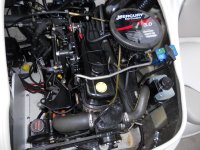
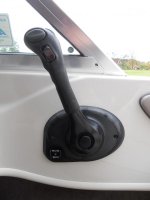
shift.jpgengine.jpg
 
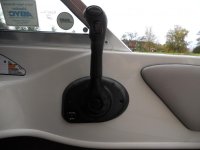
The kill switch if equipped, is mounted on your throttle quadrant.
Depending on the age of the boat, it may not be equipped with one.
They started to appear in the early 1990's or so.
The fact you have no spark is a good indicator of either the kill switch, or the shift interrupt switch.
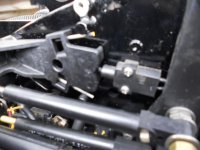
Find the switch interrupt switch on the shift plate where the upper and lower shift cable connect to the shift arm. It is just on the starboard side of your valve cover in your picture.
You will find a micro switch with a roller wheel on a springy lever. The roller must be in the V notch of the actuator plate, or the engine will not start.
If it is in the V notch, then the switch may be faulty, or the wiring may be shorted.
How the switch works, if it is out of the V notch, it shorts the ignition to kill the spark.
This is essential to being able to shift out of gear.
But in all other normal conditions it should be in the V notch, and the switch should be open circuit, not closed. You can check it with a DVM.

Here is my detailed writeup on shift interrupt switch operation:
Shift Interrupt Switch Problems (Not applicable to Bravo drive units)

NOTE: The interrupt switch is located on a cast bracket where the shift cable from the throttle quadrant attaches. It is usually mounted at the rear of the engine on the upper exhaust elbow, or a bracket on the valve cover. The front cable is the upper one, and the lower cable runs from the bracket out behind the exhaust down pipe, and to the transom plate assembly.

  1. The shift interrupt switch (aka “Kill” switch) is a normally open switch for carb applications. It’s roller (or plunger) normally sits centered in a “V” shaped notch in the actuating arm of the shift cable bracket assembly. The arm tends to stay centered due to a fairly stiff centering spring.

  1. Normally, whenever the shift lever is moved from Fwd or Rev gear into neutral, there is a brief moment when the lower shift cable meets resistance. This is caused by the tendency of the rotating prop dog clutches to stay engaged when the prop is turning in water. This resistance overcomes the centering spring, and the switch roller rides out of the V notch and CLOSES the switch.

  1. The closing of the switch then shorts out the points (or the Thunderbolt ignition module) and kills the engine’s spark. The engine momentarily dies and this small interruption allows the gear dog clutches to disengage.

  1. Once the gears are disengaged, the resistance in the shift cable is relieved, and the centering spring returns the switch roller to the V notch. Spark resumes and the engine picks up to normal idle speed once again. This whole sequence happens in a fraction of a second, and is barely noticed by the operator.

  1. Whenever the shifter is in neutral, Fwd, or Rev, the switch roller must be centered in the V notch. If it’s not, the switch will be closed and there will be no spark. The engine will not start or run, though it will still crank over.
The position of the switch should be checked first if there is no spark. Also check the switch and wiring with an ohmmeter to make sure it is not shorted out even when the roller is in the V notch.

  1. If the interrupt switch is not killing the ignition properly it will be very difficult to shift the drive out of gear, when the boat is in water. (It may still seem to shift fine during a driveway test, with no water resistance.) You can check the switch operation by manually depressing the switch roller with the engine idling. If the switch is working, the engine should die immediately. If it does not die, either the switch is not closing, or the wiring is faulty.


  1. If the engine inexplicably dies when shifting into gear, or while accelerating or decelerating, the interrupt switch may be the cause. If the shift cables are out of adjustment, or if the lower shift cable is damaged or stiff (or the drive leg shift mechanism is stiff), this will put extra load on the actuator arm (sufficient to overcome the centering spring) and the switch will close, thus killing the engine.

  1. To resolve this situation first make sure the shift cables are adjusted correctly per instructions. If this does not resolve the issue, disconnect the upper shift cable eye, and manually move the lower shift cable lever back and forth to push the lower cable in and out. It should move freely from stop to stop without binding or tight spots or excessive effort. One finger should do it easily. If binding or sticky such that the switch V notch arm visibly moves, the cable likely needs replacing, or the shift lever mechanism in the drive leg needs servicing.

  1. Since replacing the lower shift cable with the engine in place is a rather ugly job, first remove the drive leg and recheck the cable operation. The problem may be in the drive leg shift shaft mechanism, or the upper shift shaft arm, or the roller and slider mechanism. Make sure these all operate freely, then re-install the drive leg and retest the lower shift cable.

  1. One caution: On EFI engines the interrupt switch is a normally closed type. This type of switch has a gray body and an actuator pin that sits in the V notch, instead of a roller. Thus when the switch pin rides out of the V notch, the circuit OPENS. This action then kills the ECM controlled spark.

  1. This means that for EFI engines the interrupt switch needs to complete the circuit for there to be spark. If there is no spark, check to see if the switch pin is in the V notch, and that the switch circuit has continuity. Otherwise the theory of operation is the same as for carb engines.

  1. One further note: Your installation may include a so-called “shift assist” assembly. This is essentially a spring-loaded centering device that connects to the same pin as the upper shift cable end. It has a black plastic body that is about ¾” diameter X 9” long, and sits right alongside the upper cable sleeve. The spring tries to return the shift lever to neutral from either Fwd or Rev, and it’s sole purpose is to reduce the effort required to shift out of gear. Shifting will work fine without the shift assist; it will just take somewhat more effort to return to neutral. Merc recommends that the shift assist only be used with single lever throttle quadrants.

R. Stewart Mar 2008
 
[FONT=Verdana, Arial, Tahoma, Calibri, Geneva, sans-serif]Goodmorning,[/FONT]


[FONT=Verdana, Arial, Tahoma, Calibri, Geneva, sans-serif]Someprogress after following rod stewards instructions. [/FONT]


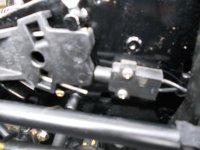
[FONT=Verdana, Arial, Tahoma, Calibri, Geneva, sans-serif]Ifound the shift interrupt switch and something is not correct. Iattached some pic just in case.[/FONT]


[FONT=Verdana, Arial, Tahoma, Calibri, Geneva, sans-serif]Pic1the throttle control handle not in neutral (forward gear) at the sametime the shift interrupt switch in the “neutral” position pic2[/FONT]


[FONT=Verdana, Arial, Tahoma, Calibri, Geneva, sans-serif]Movingthe throttle control handle to full speed in forward gear pic3,nothing happens with the interrupt switch (did not move from theposition showed in pic2)[/FONT]


[FONT=Verdana, Arial, Tahoma, Calibri, Geneva, sans-serif]Movingthe throttle control handle to neutral pic4 the shift interruptsystem moves to the position showed in pic5 (revers position??)[/FONT]


[FONT=Verdana, Arial, Tahoma, Calibri, Geneva, sans-serif]Icant move the throttle control handle in revers.[/FONT]


[FONT=Verdana, Arial, Tahoma, Calibri, Geneva, sans-serif]Soit is obvious that something is wrong. Just from the top of my head,when I reinstalled the drive unit I had some difficulties with a partthat I know is part of the gear system. Its a gray plastic partcalled “cable slide”. Showed in the SELOC repair manual section10-37 fig 154 and 155.[/FONT]


[FONT=Verdana, Arial, Tahoma, Calibri, Geneva, sans-serif]Theissue I had is that this part was turning around all the time, buteventually I felt that it came in place. [/FONT]


[FONT=Verdana, Arial, Tahoma, Calibri, Geneva, sans-serif]WhenI disassembled the drive unit and during the hole time including whenI re-assembled it, the throttle control handle was in the sameposition as in pic3.
1.jpg2.jpg3.jpg4.jpg5.jpg
[/FONT]
 
I suspected and explained that u missed something with the shift system when reassembling the drive to gimbal housing.

One point I am not sure of is if you just shift into forward or reverse with motor not running the shift interuptor switch will be activated. If you spin the prop by hand it will or should return the the center of the V notch.

Try this first and report back.
 
[FONT=Verdana, Arial, Tahoma, Calibri, Geneva, sans-serif]Ican only shift in forward and as I wrote above the switch isdi-activated when I shift into forward.

Having itshifted in forward (switch di-activated = the plunger centered in theV shaped notch)
[/FONT]

[FONT=Verdana, Arial, Tahoma, Calibri, Geneva, sans-serif]Ican rotate the prop counter clock wise, it does not run smoothly, itchops a little bit. [/FONT]


[FONT=Verdana, Arial, Tahoma, Calibri, Geneva, sans-serif]Havingthe shift in a position that results the switch to be activated (neutral in my case referring to the info in my previous post) thanI cant rotate the prop and thereby the plunger is not returning to the center of the V notch.

So, then the switch is activated I cant rotate the prop and the plunger will not return to the center of the V notch.
[/FONT]
 
You need to remove the drive and install it again.
The fact you cant shift into reverse indicates something is wrong with the fitup of the shifter parts; either the shift slider or the shift shaft upper and loweer shoes.
The interrupt switch should always be centered, in neutral, forward, and reverse. It does not stay in any position other than centered normally. The only time it actuates is for a split second when you shift out of either gear. It should not move at all when you shift into gear.
The fact that it stays out of center indicates something is binding with the shifter parts. Again, the first step is to remove the drive leg and refit it with the parts correctly meshed. Otherwise you are wasting your time.

Rod
 
Last edited:
Once again thanks for yourtime Rod,


My next step will be toremove the stern drive unit.


If it is not necessary Iwould not want to remove the lower unit from the upper unit because Ijust changed the oil and would prefer not to drain the unit again.


At the same time it wouldbe good if there is some way I can test if the lower unit iscorrectly assembled to the upper. Just to eliminate any possibleissues. How would that kind of test look like?


If the lower and upperunits are correctly attached I will be able to move on andconcentrate on the assembly of the stern unit to the gimbal housing.


I would need some helpwith that step as well because I obviously did something wrong thefirst time. I read about a “shift shaft slide stabilizer tool”that I dont have. Can I manage without one?
 
I doubt there is anything wrong with the fitup of the upper and lower drive parts, as long as you followed the followed the procedure in your manual. I think you said you have the Seloc manual, right?
The problem is almost for sure in the fitup of the upper/lower shift shaft shoes, or the shift slider when you replaced the drive on the boat.
No you don't really need the plastic alignment tool. It helps to have a second person to gently push the drive into place while you are making sure the shift slider and shift shafts mate up correctly.
The roller wheel at the top of the upper shift shaft must be in the notch in the slider piece.
And the lower shift shaft leg must fit into the upper shift shaft shoe, which can only happen if the throttle lever is full forward, and the drive is locked in forward gear. In this position the lower shift shaft leg (on the drive) will be pointed straight forward; ie 12 o'clock position.
The above things are absolutely critical to getting the drive leg back on correctly.
Don't feel bad if this is your first time and it did not go perfectly. We have all been there.

Rod
 
Your manual no doubt has a good procedure for re-installing the drive leg.

In case it helps you at all, here is my procedure:
[h=1]Re-installing the Drive Leg; Alpha & Gen II Sept 2011[/h]First check the gimbal bearing by turning it by hand to make sure it is not rough. Any roughness or stickiness at all is cause to replace it, and this is the time to do it. Give the U joints a few shots of marine grease (if greaseable). Gen II and earlier U joints had grease nipples up until about 1996. If you did not disturb the engine mounts the alignment is likely OK, but it’s wise to check it anyway if you have an alignment bar. If the engine has been moved or the drive has not been off in a while, check it for sure. Check the bellows for tears or soft spots; replace if needed.

Install new O rings on the drive input shaft. Then liberally grease both the splines and the O ring section of the input shaft. Grease the inside of the gimbal bearing inner race. Tie the trim cylinders up as high as possible out of the way.

Always use a new gasket set and make sure the gasket surfaces are clean. Make sure the large square O ring is in place in the nose compartment of the shaft opening in the gimbal. Use 3M yellow weatherstrip cement to seal it. Make sure the water passage 1-5/8” O.D. O ring is in place; again use 3M yellow weatherstrip cement to hold it. You can use a thin film of lubriplate or 2-4-C on the gasket faces, but do NOT use silicon or any other sealant. Grease the studs and place the gasket on the studs, noting the correct location of the lube oil anti-dribble valve hole.

Put the throttle quadrant control in forward gear. Put the drive in forward; by turning the shift shaft lever arm CW to the straight forward 12 o’clock position, while turning the prop CCW from the rear, to lock it in forward.

Make sure the upper shift shaft crank roller engages the shift slider in the bell housing. The receiver shoe on the bottom of the upper shift shaft (just below the exhaust passage) should be pointed straight forward. Liberally grease the shift slider mechanism and it’s receiver slot in the drive, and check it frequently as you fit the drive into place.

It works best to block or support the drive at about the right height to slide it in, so you don't have to lift it. As you slide the shaft into the gimbal race, do not force it; it should go easily by hand. If the splines don’t mate exactly with the engine coupler (the drive will jam about 3” out), turn the prop shaft slowly CCW until the splines engage. There will also be some resistance as the new shaft O rings compress into the gimbal bearing race (the last inch or so). A few persuasive taps with a rubber hammer will help. Before sliding the drive in the last inch or so is a good time to inspect the shift slider and the upper and lower shift shafts for proper fitup.

It’s OK if necessary to use two of the nuts to evenly seat the drive the last ¾” or so, as long as you are SURE the shift shafts are mating correctly, and there is nothing else binding. Once the drive is fully seated, check forward and reverse gears for proper and complete shifting. If shifting is not right, remove the drive and start again. If OK, progressively tighten the six elastic stop nuts to 45 ft lbs in increments. Then untie and reconnect the trim cylinders. Raise the drive and re-connect the speedo tube fitting just in front of the lower shift shaft.

Lower the drive and fill with Merc high performance gear lube from the bottom until it flows out the top vent. Then insert the vent plug and give it another two shots. Then disconnect the pump and quickly insert the bottom drain plug. Tighten the vent and drain plugs. Top up the monitor reservoir as required to the FULL line.

Test run on a hose. Check for any leaks. Check proper gear shifting and shift interrupt switch operation. Be sure to check the lube oil reservoir level and top up after the first hour or two of use. It will drop slightly as the air bubbles come out, and you don't want to run the gears dry.

Rod
 
Drained the drive andremoved it again. Unfortunately the gasket broke so I have to order anew one. Will take a day or two to get it.


During the time I amwaiting and with the drive removed, can I check if the throttlecontrol handle is align with the shift switch? Don’t know why itshould not be, but a check would isolate the problem to the assembly.


If I understand it correctly the plunger should be centered in the V shaped notch when the throttle control handle is in forward, revers and neutral. When should the plunger not be centered and should it be above or under the notch?


BR
 
As I said earlier the only time the switch should be out of the notch is a split second when you shift OUT of either reverse or forward gear. But this will not even happen with the drive leg removed and not turning.
What you can do now is check your gear shift lever to see that it easily moves into forward, neatral and reverse.
Have someone else do this slowly while you watch the shift slider mechnism to see that it moves correctly and does not bind on anything, since the drive leg is off and will not guide the end of the slider.
Also, you can make a suitable gasket out of thin sheet stock gasket material. Just trace the old one on the stock and cut it out. Its not high tech at all.
And just for the future, its always a good idea to have at least one spare drive replacement gasket kit on hand, for what they cost. JMO.
If you apply a THIN film of lubriplate or any light grease to both sides of the gasket, this will prevent it from sticking to the metal parts next time you remove the drive, plus it will help seal the gasket.

Rod
 
First, you do not need to drain the outdrive gear oil to remove the outdrive from the gimbal housing.
second you only have to drain a small amount if you are serperating the upper gear case from the lower gear case.

below is a shift cable adjustment proceedure used when replaceing a short shift cable or when cables are out of adjustment.

Read thru it and see if you understand it. because your system worked before you serviced the outdrive I dont think you need to physically adjust the cables so I would suugest not adjusting anything until you fully understand.

What I hope this explanation/shift cable adjustment proceedure does is teach you how the cables are adjusted and what/how to do it.

As I said you may NOT need to adjust your cables.

read thru the adjustment and if you have any questions please ask.

SHIFT CABLE ADJUSTMENT PROCEEDURE

Trim out drive up 2 inches from all the way down.
Take keys out of ignition!!!!!!!!!!!
Have a second person stand at the prop.
You, remove the short shift cable from the shift bracket.
After the cable has been removed, push the plastic cable end all the way in and hold in place while prop is being spun C’Clockwise by second person..
Have second person rotate prop counter clock wise until the prop is fully engaged and wont turn anymore. Maintain light effort on shift cable plastic end pushing it to keep forward engaged.

Measure the distance from the center of the brass trunion to the center of the round mounting hole in the plastic end. Adjust trunion to make that distance 6 inches. no more no less! In cases where the shift cable is old but still works well you can adjust this dimension to 5 15/16”. NO MORE.

Put shift control handle in forward FULL throttle position.
Remove the control shift cable from shift bracket at this time.

Install short shift cable back onto bracket at this time.

Take the shift control cable and adjust the trunion so it fits perfectly back into the shift bracket.
Before installing it turn the brass trunion 4 complete turns away from the plastic end and reinstall into shift bracket.

Now put shift control handle in the neutral position.
Have second person spin prop, it should spin freely.
Put shift control into the forward detent position at ~ 10:00 position. NO FUTHER.
Have the second person rotate the prop counter clockwise. You should have solid engagement with no ability to continue to turn the prop.

Now shift back into neutral. Prop should spin freely with no clacking or clunking.

Now shift to reverse to the 2:00 o’clock position detent NO FURTHER!!

Have the second person spin the prop clockwise.

If you have positive engagement with no clunking or jumping out of engagement, you are done.

If it does not fully engage into reverse than look at the shift bracket where the short shift cable mounts and there is a slot. Loosen the 7/16 hex that is touching the bracket and move the stud so you are pulling the short cable.

Try this and retest in water under load.
 
Good morning,


I removed the drive unitagain. Then the unit was removed I was able to shift without anyproblem (forward, neutral, revers) and checked the switch and itworked as it should.


So I went on andre-assembled the drive again, aligned the shift shaft with the shift coupler and made sure that the shift slide did not rotate and wascorrectly aligned. Everything went on place.


I tested shifting againbut the same problem. Was only put in in neutral , but by doing that the switch was activated and was not able to put it in revers. So Idisassembled the drive again and tried to see what the issue was.This is what I come up with but I dont know how this could happen orwhy.


Pic 1 shows the the shiftcoupler in forward, pic 2 in neutral and pic 3 in revers. As you cansee
it moves counterclockwise. I guess that is how it should work??


Now I also did the sametest with the drive unit. As you can see in pic 4-6 the shift shaftit moving (and can only rotate it) in the opposite direction(clockwise)


So its not so surprisingthat I cant get in neutral or revers when the drive unit in in place.


Any ideas what is wrong,and how it is possible??

http://www.pixbox.se/alb_show_id1235652_page0.html
 
Your problem is this.

the shift arm in your picture is in the wrong place. It should be pointing straight forward at 12:00 when in forward.

this is what you have to do. and you have to do this or it will not work!!!!!!


turn the shift arm as far clock wise as possible, turn your prop counter clockwise until it locks!! HOLD the prop in that position.

Now lift the shift arm up until it spins freely!!

now push it back down and make sure it is pointing straight forward.

If it does not point straight forward it will not shift into nuetral or reverse properly.

Some how the shift arm was lifted up and when pushed back down it is now in the wrong position.

Did you replace the shift shaft seal below the arm?

The picture I have attached is a your picture and another showing the shift arm in question. I hope this makes sense to you.

if you have any questions please ask.

Again your shift arm in the lower gear case is in the wrong position. you must lift it up while the gears are in forward and push it back down into the correct position.
 
Hi,


I think we misunderstood each other …. maybe it is my language barrier


Picture 4 shows the shift shaft (lower unit) in forward position, it is 12 o’clock and that was the position I also had when assembling.


With picture 5-6 I just wanted to show you that the shift shaft on the lower unit is rotating the wrong direction. I cant rotate it in counter clockwise direction more than to 12 o’clock.


If you look at pic 1 and 4, they are aligned as it is when assembled. Pic 2 and 5 shows they are rotating from each other and even more in pic 3 and 6. Now this cant be done when they are assembled, but I just wanted to show you.


By that I just want to say that even if I follow your instructions

  1. Turn the shift arm as far clock wise as possible ( no problem it will turn as it is shown in pic 5 and 6.
  2. Turn your prop counter clockwise until it locks!! HOLD the prop in that position. (no problem)
  3. Now lift the shift arm up until it spins freely! (no problem)
  1. Rotate the shift arm in 12 o’clock position (no problem)
  1. Push the shift arm down again (no problem)
(Just some information, after following the steps above, I was able rotate the propeller in both direction and the shift arm did not move when doing it.)


Independentlyif I rotated the propeller or not, I was able to assemble the unit.


Theproblem is that when I want to shift to neutral the shift coupler pic1 wants to move into the position in pic 2, but because the driveunits shift arm wont turn in that direction no matter what, it wontgo.


It feels like they are mirrored (working in the opposite direction from each other)


It seams that something need to be wrong with the lower unit. Could Idone something than I changed the impeller, could the shaft influence the shift shaft or something??


Thanks for your time Rod and kghost
 
No we did not missunderstand each other. You are missunderstanding what you are doing.

The shift arm in your pictures is moving in the wrong direction. The shift arm when in
forward points sraight 12:00. It MUST TURN COUNTERCLOCKWISE for nuetral and reverse.

Your picture shows the shift arm is turning CLOCKWISE. If that is true then that is WRONG.

If the shift arm turns past straight in a clockwise direction then when it is straight you are in nuetral or reverse, NOT forward........

You must do as instructed in my previous post.

Do you understand?
 
It sounds very straightforward your instructions. And I think I understand you.


It sounds very straightforward your instructions.


You wrote:
[FONT=Verdana, Arial, Tahoma, Calibri, Geneva, sans-serif]Theshift arm in your pictures is moving in the wrong direction. Theshift arm when in
forward points straight 12:00. It MUSTTURN COUNTERCLOCKWISE for neutral and reverse.
[/FONT]


[FONT=Verdana, Arial, Tahoma, Calibri, Geneva, sans-serif]Iagree with you, but I cant move it counterclockwise, it wont move. Itonly goes to 12:00 than it wont go farther. And that the problem whenit is assembled, the throttle mechanism wants to turn in as describedbut it wont, its stuck.[/FONT]


[FONT=Verdana, Arial, Tahoma, Calibri, Geneva, sans-serif]Icant get further than 12:00 in counter clock direction independentlyif I pull up or push down the shift arm.[/FONT]
 
OK we understand each other and you are correct, The shift shaft will not turn the correct way.

I have attached a picture that shows the shift shaft, the shift bell crank that the shift shaft engages into,

where the shift shaft engages into the bell crank the shift shaft has male splines and the bell crank has female splines. DO YOU UNDERSTAND THIS?


WHat has happened is the shift shaft was pulled up some how seperating the shaft from the bell crank and then installed in the wrong position.

Did you or someone else replace the shift shaft seal or remove it for some reason?


YOU have to pull the shift shaft up high enough to seperate the shift shaft splines from the bell crank splines and re-locate the shift shaft so when the drive is in forward and the proppeler is lock in a counterclockwise. You may have to loosen or remove the shift shaft seal screws to do this.

review the picture and let me know if you understand or not.
 
Back
Top