Logo

ignition relay question

rairops

New member
I am rewiring a boat/1996 Crusader 350XL. I have what I believe is called an ignition relay mounted to the same bracket as the starter relay. It is a small plastic boxed relay. Question is, what does this little relay operate or energize? I guess the answer to that will also tell if it might only require momentary "start" power or constant power when running. I can get the starter to operate without powering the little plastic relay. When I energize the plastic relay it does click but I can not determine what it is operating or suppose to operate. My only guess is it may operate the choke. Very uneducated in this area guess at that. It does appear to be wired to something though. But tracing out the wire through the taped up wiring harness and where it is located looks daunting if not impossible. Any help, greatly appreciated.
 
I'm somewhat surprised to see this on a 1996 system, but if this is a start by-pass relay (as per what I think you are describing), then that is exactaly what it's for.
IOW, while cranking, this relay sends a full 12 volts to the + side of the ignition coil, but does so momentarily during cranking only.
26-534B.jpg


Energize the starter motor, and see if pin #87 becomes live.
Follow the leads and see if it powers the + side of the ignition coil.
(#87a will not be used)

relay.jpg
 
Thanks for the response. I think I will start off powering that relay with the momentary start voltage and just see how it cranks and runs. Seems like the relay has to have something to do with the ignition so my options in powering it are very few, thank goodness. It's either momentary start power or constant running voltage. So what operates or how does the choke operate? My ignition was wired with switches, no key. Have a momentary push to start. There is nothing that initiates choke for cold starting. I just advanced the throttle some till it cranked for cold starting.
 
This is carbureted, correct?
The electric choke should actually be called an "electric UN-Choke" so that people don't become confused.
The choke Helix defaults to Choke Plate "Closed", and opens the choke plate when the Helix heating element provides enough heat to it.
So it really isn't an Electric Choke, per 'se..... it's an electric Un-Choke. LOL

Anyway..... the power to the electric Helix heating element is derived from the ignition power source.
No relay that I am aware of, unless someone installed it.
 
Likely to be the fuel pump relay vs an ignition relay.

the chokes are typically factory installed without a relay.

Does it look like the pic Rick posted or is it circular, with a pair of "big" studs and a pair of "small" studs? studs, vs the .25" male spades, is usually the starting circuit's "slave" solenoid.
 
I took a close look at this mystery relay. It does look similiar to what Rick posted. It has the numbers 14089936 on top of it. I did a search of this part number and found out it was a GM standard relay used in several different applications from fuel pumps to fog lights. My engine has a carb and fairly sure a mechanical fuel pump. All this could have been prevented. I got way ahead of myself disconnecting wires at the helm in my rewire project. I got everything rewired, new gauges and switches except for this darn little relay problem. Motor was cranking and running/idling good when I bought it. That relay was wired to something at the helm though. Got to get this figured out and back in business.
 
If you have a carb and a mechanical fuel pump, you don't have any need for the relay. 1996 stuff usually had the TBI on top of it so that config would use the relay to power the ECU (thru a fuse).

I'd suggest you trace the wires (or at least probe the connections) to see what is/isn't energized when it is supposed to be. There are specific colors associated with specific functions so it really isn't that hard (just time consuming on some installations).
 
rairops, your color codes would vary from other applications, but a five pin relay is a five pin relay Monday thru Sunday.... however, there are several amp ratings to these.
All terminal designations are the same as per the schematic that I posted earlier.

If your five pin relay was factory installed, I think that it would be using a five pin harness, in which case there would be no mistake as to the color codes, etc.
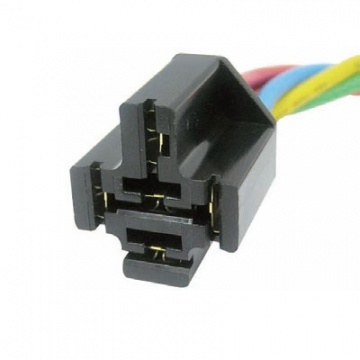
Do you see a harness connector like this one below?
(example only)


Relay-Harness-5-Pin-H663-.jpg
 
I will take a closer look at that relay tomorrow. It is not in the best location at all for tracing wires. The engine in the boat now is a repower the first owner did. I have found that some of the wiring did maintain color code and some did not. There was a lot of "rat nest" bundles of wires and numerous wires that were not being used at all. Even found that someone had used standard house lamp cord to feed some switches and some wiring in the helm area. Looks like the mechanic that installed the new engine at the time did not clean up properly from the old installation which was a Chrysler 318 I was told.
 
Had to chuckle upon seeing the photo of that relay. I use a bunch of them on my boat, to isolate the alarm system (so I can run on one engine) and to eliminate a pain-in-the-*ss starting problem.

With my port engine, for 5 years I struggle to eliminate the solenoid not engaging when I hit the key. This happened every time AFTER the boat sat for a week. I would have tor jump the solenoid to get her going. (She usually then started fine for the rest of the time we used the boat.) To elimianate thos nonsense I changed the solenoid--twice--the battery (twice), ignition switch, fuse and fuse holder, both hot and ground battery cables, and cleaned every cnnection in the circuit several times over--and all to no avail. Installing a relay (like that shown above) to energize the solenoid with 12 volts right off the battery cable totally cured the problem.

Great little tools, and cheap to buy on eBay. I paid around 5 bucks each with the connector.

Jeff
 
Jeff, I had a similar issue and solved it with the five pin relays.
I also use them for my water system pump, blower motors, etc. Great little relays.
I picked up the correct style female terminals and eliminated any splicing-in at the harness connectors.
 
Welcome aboard. Among other things, these are commonly used for electric fuel pumps as mentioned above. I would confirm the type of pump you have. We should be going back to basics though. The relay may not be the issue. What I've gotten from your posts thus far is that you have disconnected wiring at the helm, and that you can get the starter to turn over. If the relay is integral to the engine/harness and not an after market install to control something else, then it should be doing it's job unless it has failed and nothing was touched at the engine. Confirm the type of fuel pump; mechanical or electric, check that you're getting fuel at the carb, and confirm you're getting spark. What wiring at the helm if not connected properly would prevent proper engine operation? Did you hook up the ignition switch correctly? Perhaps a little more info on exactly what's happening when you try starting the engine might take us in a different direction.
 
Last edited:
Thanks guys for all the help and input. The engine was cranking and running smooth as silk before I started the rewire project. Like I said I started the rewire project and disconnected some wires at the helm junction/terminal strip before I had them all traced out. I have found the wire which leads from that junction terminal strip at the helm to the main starter relay. I have only given that a momentary power up and the starter does operate. I have not (since rewire) tried to crank her up. As far as the fuel pump please correct me if I am wrong but on my engine, 1996 350 XL with a carb they only came with mechanical fuel pumps. I just got in a Crusader XL series service manual. Per this manual the 350's have a mechanical fuel pump. The 454's had the electric fuel pumps.
 
Back
Top