Logo

Honda BF20D difficult to start

JuanToomany

New member
It is a 2004 engine with auto choke. The choke appears to work ok according to the tests. The engine has had a complete service and the petrol has been changed. It starts straight away but quickly stalls. Have to keep fast idle on for a minute or so till engine warms. After this engine runs really well. The carb has been thoroughly cleaned (?) Any help appreciated.

Also, There is a pin in a rubber boot attached to the throttle pin which seems to be associated with a socket in the carburettor cover, can't tell what it does. Does anyone know.
 
Hi Juan,
Toomany? I always thought there was never enough....
....dollars I mean..... 🛳️💲🛶

Anyways,

The rubber boot seals the accelerator pump piston chamber. That steel pin is the plunger that pushes the accelerator pump piston down each time the throttle is actuated. Often, the piston siezes in the bore and that pin doesn't move.

As to your running issue, it sounds like either the SE (Service Enrichment) isn't working properly OR the carb isn't delivering enough fuel in one of the other circuits. The carb may not be as clean as it should be.

When you say: "The choke appears to work ok according to the tests".......
Could you elaborate on that? What tests? Can you describe how you're testing?
That info might help me help you sort this out.

Welcome to the forum.
 
1718638678832.jpeg

Hi Juan,
Toomany? I always thought there was never enough....
....dollars I mean..... 🛳️💲🛶

Anyways,

The rubber boot seals the accelerator pump piston chamber. That steel pin is the plunger that pushes the accelerator pump piston down each time the throttle is actuated. Often, the piston siezes in the bore and that pin doesn't move.

As to your running issue, it sounds like either the SE (Service Enrichment) isn't working properly OR the carb isn't delivering enough fuel in one of the other circuits. The carb may not be as clean as it should be.

When you say: "The choke appears to work ok according to the tests".......
Could you elaborate on that? What tests? Can you describe how you're testing?
That info might help me help you sort this out.

Welcome to the forum.
Hi, Thanks for the reply. The piston was solid and I wasn't sure if it was supposed to move. However, the carb drawing shows the piston on top of a spring so, I took from that it should move. I put a small amount of a light oil around the edge of the piston and after a while (and a little external pressure) it came free. I took the retaining screw out, cleaned it all and now it moves freely.

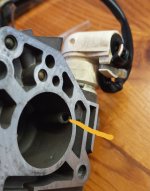
The auto choke test (according to my service manual) was, after removing the unit, to connect it to a battery and after a few minutes the piston and needle should have extended around 4mm. It did. I assume that after this time the needle cuts off the additional fuel. Also, it say you can attach a tube to the hole, shown in pic, and you should be able to breath through it. then connect the auto choke to the battery and after a few minutes you should not.

I am having trouble inserting a picture. It is at the engine end of the carb at around 2 o'clock inside the main chamber.

Any further help would be much appreciated.

I am now waiting for some gaskets and seals to arrive before I can refit the carb and try it.
 
Ok,
The SE valve sounds good. That's a good test.

Do yourself a favor before you put the carb bowl back on....

First, there are 2 passages in the bottom of the fuel bowl. Little tunnels really....
One feeds fuel to the SE valve "well" and the other feeds fuel to the accelerator pump chamber under the piston.
Make sure both of them are clear
Sometimes they get packed with "mud"

Second....and this is SUPER IMPORTANT....
Prop open the throttle all the way and look in from the back of the carb throat. Locate the brass accelerator pump feed tube at the front of the carb throat. It has a tiny spray orifice pointing to the rear. Use the spray cleaner straw and cover the orifice and give it a shot. Cleaner should exit the feed passage near the side of the carb above where the accelerator pump piston is located. If not, you need to identify that passage entrance and spray cleaner in there trying to get spray to exit the orifice in the brass tube. If not, then you need to go back to step one and cover the orifice with the straw and spray again. You need to keep going back and forth like that to get flow in that passage.

Finally....
It HAS to be clean enough so that, when you spray into the feed hole, a stream of fluid exits the rear of the carb about 8 feet.
Yes! 8 feet! If not, keep at it until it's properly clear.

There are other "backflush tricks" to get the passages clear but I have to go for now.
 
That was the image I was trying to post earlier.

The brass tube seemed clear at first as cleaner came out through the hole above the accelerator piston, but when I sprayed the other way it abruptly stopped. I did what you suggested and now it seems clear. All other passages appear clear.

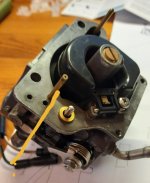
Just one more thing if you don't mind. There is a thin brass tube just above the accelerator pin (you can see it on the first image), there is a small hole in the end but it seems to be blocked. Is that right or should it be clear?

Thanks for all your help. I'll let you know how it turns out.

Regards Juan
 

Attachments

  • Carb.jpg
    Carb.jpg
    973.9 KB · Views: 71
Oh wow! Yeah, that ofice in the tube end is called the PRIMARY jet. It basically feeds ALL of the orifices (idle, transition and high speed) at the top of the carb throat. It being plugged is NOT good because I'm seeing lots of people that can't get them clear.

I just bought a set of tiny carbide drills just in case because I've read so much about people finding them clogged. Funny thing is I never have.

I can't find any info about what size that orifice is either. The smallest drill I have is 0.003"

There's been a couple of guys on this forum that had to replace the carb because they couldn't clear that jet.

You will likely never get full power from your engine with that jet plugged.

Sorry for the grim news.
 
Again, sorry about the glum news.

I have this same carb. It's on a 2006 BF20D LRTA. I love these outboards but not a big fan of the Keihin carbs. They work GREAT but are really finicky.
They're so difficult to clean a mechanic can't make any money doing it unless his clients are like mine were and have 40 of them.

I bought those little drills in case I find my jet clogged.

0.003" is 0.076mm in case you're a metric guy.

Those can be found on Amazon for about $15 for a set.

They call them printed circuit board or PCB mini drills.

The worrisome thing is that, in review after review, people talk about how easy it is to snap them off. If you snap a carbide drill off in that orifice, you're done. New carb time. But I prefer to at least give it a try.

I did help a guy here a few years back that DID get that orifice clean but it took awhile.

One thing to consider is that these outboards are so good they are very popular. That means you can still buy ALL the parts...including the carb. And, they aren't super expensive either. Knowing that is comforting to me.

You can't say that about a lot of aging Honda parts these days.

Hope you get it.

If you do, there's WAY more things you'll want to check/clean because it's obvious your carb is very dirty.

But until that orifice is open that's all you need to focus on for now.

Hope you get it!

Good luck.
 
This is the primary jet you are referring to? If so it seems quite solid about 3mm in (1/8"). I cannot push a small pin in more than that.
 

Attachments

  • Carb 2.jpg
    Carb 2.jpg
    623.8 KB · Views: 73
Yes Juan,
That's the primary jet tube. Not to be confused with the MAIN jet. Two different things.

Be careful pushing things up in there as you don't want to distort the orifice that I think is up inside. I don't know for sure because I haven't messed around with one.

Instead of a pin, try probing with a small strand of wire or maybe a bristle from a large wire brush. There's a chance it isn't plugged at all. Just don't break anything off up in there.
 
Something else you could try is reverse or backflushing to try to get some flow from the tube.

Backflushing is how I clean these little carbs.

That tube pulls fuel UP from the bowl so if anything gets lodged up there, it will likely to be easier to push it back out from above with carb spray.

The problem is that it feeds so many circuits. Closing them off to help build pressure and concentrate the spray to clean out the tube is difficult.

If you remove the slow jet tube and gently seat the idle mix screw, you can use your fingers to shut off passages to help build pressure.

On the front mount flange of the carb are two holes, one just above the other. The top one is the main air jet passage and the one closer to the carb throat is the slow air jet passage.

If you can do some "carburetor finger yoga" and block those two passages while also blocking the "jet set" (slow fuel jet) passage then cover the high speed and transition orifices with the end of the cleaner straw and blasting, you might get the primary tube cleared.

If that all sounds like gobbledy-gook to you, I understand. It's not easy to explain.
 
Hi. Been away for 2 days. The smallest SS wire i have is 0.0055 inch (very small) but comes to an abrupt stop around 1/8" in. It's hard to believe that an orifice smaller than that would allow enough fuel through to be significant. If I seal the cleaner spray to the end of the primary jet, nothing happens at all. Not enough pressure or the blockage is like concrete. I'll keep at it for a while longer, I'm still waiting for some gaskets to arrive. It's a shame that the jets can't be removed for cleaning.

Thanks for all your help and advice. I'll let you know what happens.
 
Yeah, it's funny...

I know I've probably cleaned close to 200 of these carbs but I have never found a primary jet clogged before.

But the people that report finding their's clogged said just what you say...."it's just like concrete". So, I guess I've been really lucky with them.

That's why I recommend trying to push it out from the other side because pushing on it from where it entered might only jam it in worse.

This is a case where I would put it in my ultrasonic cleaner for a day or two then try to "backflush" it out doing the finger blocking or yoga thing.

You could also make little plugs for the air jet passages and maybe even the slow jet tube seat. But you would need to make sure they can't accidentally get stuck inside or it's "curtains" for sure.

And you're right about how it doesn't seem to deliver much volume for something called a "primary" jet. It's because, in reality, it's more like a transition supply. It only acts as a back up or to supplement the main jet volume as rpm and venturi air flow increases.

But, the one guy here that I worked with to help get his cleaned was really happy with the power increase he had afterwards so it's important to the operation of the engine. He even posted a video of his boat doing near 20 mph on a lake. Or, maybe it was a fjord. I think he was in Norway.

I would LOVE to see you get it so I'll keep cheering you on.
 
Thanks. I might stop worrying about it as it doesn't affect the general running and starting. This engine is on a small river cruiser on a UK canal where the max speed allowed is only 4mph. As long as it starts well and is reliable that is probably enough for me.
I noticed that the idle screw on mine does not have the breakable cap, that seems to be the Canadian model only. Also, not sure what the idle screw does, there seems to be an orifice from it just after the butterfly valve. I would really like to get some detailed literature on the functioning of this carb.

Anyway, thanks again.
 
Hi, Just to let you know the engine is running great now. I put the carb back on yesterday, with new gaskets. It started a bit rough but settled down after a couple of minutes. The tick over was high (1500rpm) so adjusted back down to 950ish. This morning it started first time at around 1800rpm and after a couple of minutes gradually slowed to 950 (auto choke working)and didn't stall.. Left it till late this afternoon and started it again, it did the same. Very happy.

Again, thanks for all you help and enthusiasm.

Juan
 
Hi Juan,
Glad you're satisfied with it and I hope you have a great summer on the water.

Thank you for the update.
 
Back
Top