Logo

Honda 2004 BF225 HP running rough

Seachaser

Regular Contributor
My My 2004 BF225hp Honda outboard is running a little rough.

A little history; Since I've done lot of trolling and had black soot at the exhaust output, last year, I decided to run with Yamaha Ring Free mix. I did this at end of last season on the day that I hauled the boat for the season. I had run the ring free mix at the dock for 30 minutes, and then decided to run underway. I ran up to ~3,000 RPMs and the motor bogged down and so then I limped back to the ramp at <2000 RPMs, hauled it, did my year end maintenance and prep to deal with it this coming season.

Now, this new season it would not turn over. So I decided to clean up the VST. I replaced all Filters, O-rings etc. I found the fuel line connection from the rail was all crappy and the O-ring deteriorated, the High Pressure pump Filter also had some percentage of blockages (replaced). So I had my smoking guns. Also, I had my fuel injectors sent out to be serviced, diagnostic printout showed 5%-10% blockage and bad spray pattern. All clean now with new filters.

Now I put it all back together, engine started right up. Now its runs but I'll say “a little rough”. While Running Low Idle RPMs, it sometimes does not run consistently steady RPMs. Since I am just in the back yard on Muffs/Hose I did not run it too high on the RPMs for any length of time. When I run 2000 to 3000 RPMs it runs, but you can hear a faint Putt-Putt but still maintaining the higher RPMS. There is no lag when increasing the throttle. I have run with a spare 6 gallon fuel tank therefore bypassing Low Press and water Filters, with no change.

There are No audible or visible errors from my key console, just the slight rough running.

I do have an OBD software tool program; it does show that the engine had a "past" O2 Heater Failure. Still learning how to understand the live data and correlate it to my problem.

HondaDiag3.jpg

In the past I dealt with the fuel rail Mesh/Filter problem which caused the gas pressure to exceed the 41-48 Psi. and it was sending the error code "1". But that has since been corrected and I'm assuming this is the left over fault? I did clear that fault out last year. Maybe the O2 sensor went bad again?

Note 1: The cover if the VST when removed had O-ring with gasket material. When I put back with new O-ring I did not put any gasket material with it because the shop manual did not indicate to do so. Should I have added gasket material?
Note 2: Another observation, the exhaust now is very clear "not smoky". As I understand if its black smoke soot it could be a hint of the O2 Sensor malfunction?
Note 3: The current 02 sensor was installed June 2015, and prior to 2012 had the upgraded exhaust pipes.

Things to do:

  1. Clear error and see if problem changes or error comes back. Question: Would the old error confuse the ECM and cause this rough situation?
  2. Test Fuel Pressure again.
  3. Perform Diagnostic testing of O2 Sensor.

Looking for some additional troubleshooting advice, thanks!
 
Last edited:
Seachaser,

Sounds like a good plan to me.

I don't think the old error code would confuse the ECU, but clear them completely anyway. You never know what a computer will do. Then run the engine and see if a new error code pops up.

Check your vacuum lines again. If you have a vacuum gauge, test the vacuum. Don't recall what the spec is, but it's somewhere in the Helm manual.

One possibility that you likely do not want to hear - there could still have been some crap in the fuel that didn't get filtered out and could be partially blocking one or more of your injectors. I'd try to eliminate everything else before tearing back into the injectors.
 
Two steps back:

So, I cleared the error with no change in performance., Then noticed the pee stream water felt hot, and stream not as strong. Then motor shutdown. No console errors or error light. I had diagnostic s software running, no errors.. When I get home will review real time.

I quit at this point.

Water manifolds hot to the touch, like there wasn't any cooling. **** OBD Tool Program showed engine temperature sensors 2 and 3 ran up to 115 Degrees celsius. Works out to be 239 degrees fahrenheit before motor shut down ******* I hope nothing got damaged?

I'll guess it ran 4 minutes before getting hot and shutting down.

I then ran water to flush down port and cooled the water manifold very quickly.

When I ran motor yesterday, pee stream was cool to the touch, and strong.


Seachaser,

Sounds like a good plan to me.

I don't think the old error code would confuse the ECU, but clear them completely anyway. You never know what a computer will do. Then run the engine and see if a new error code pops up.

Check your vacuum lines again. If you have a vacuum gauge, test the vacuum. Don't recall what the spec is, but it's somewhere in the Helm manual.

One possibility that you likely do not want to hear - there could still have been some crap in the fuel that didn't get filtered out and could be partially blocking one or more of your injectors. I'd try to eliminate everything else before tearing back into the injectors.
 
Last edited:
WOW - that's HOT. First, all of these big Honda's will overheat on muffs. You've got to test them in water barrels.

You stated: "When I ran motor yesterday, pee stream was cool to the touch, and strong." What changed between the overheat situation and this situation?

Whenever you have an overheat situation, the chief suspect is the water pump. When is the last time the water pump was changed out? Either way, you're going to need to drop the lower end and get to the water pump. Closely inspect the impeller and make sure no vanes are missing. Make sure the shaft "key" is in place. If any questions, change the entire water pump, not just the impeller. If pieces of the impeller vanes are missing, then you will need to pressure flush the water passages through the thermostat openings.
 
Today only the port side exhaust manifold got hot, did this several times, stop the motor when it quickly ran up to 70 degrees Celsius. The starboard manifold was cool both times. The house water had good pressure, the other 2 temp sensors all around 30-38 Celsius. The pee stream seemed OK, used 200 pound monofilament to clear out.
 
Last edited:
Yes your right, regardless I should do the barrel instead of the muffs.

I'm holding off dropping pulling the lower until I have a second person, kind of heavy for just me. But when I do, it wouldn't hurt to grease the mid shaft bearing while I'm at it.

Today I'll plan to pull the thermostats inspect and test. Been reading some of your past threads and it sounds like it could be a culprit, we'll see.
 
Roger that on the t-stats. If only one side of the engine is overheating, then a stuck t-stat could be doing that. Test in a heated bowl of water on the stove with an instant thermometer. They show begin to open at 140 F and be fully open at 160 F. Fully open is only 3 mm.
 
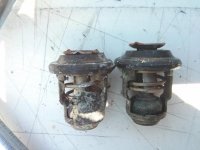
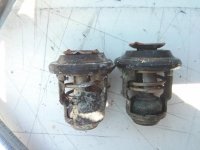
Thermos Replaced

Thermo1.jpg

Port side thermostat Port side stuck closed, Starboard side stuck open.

Replaced them ran motor, both exhaust manifolds hot to the touch. I did not have the Laptop connected so I was unsure of the temperature. It was getting late (had a Little league game to attend), I shut down motor get back at it tomorrow. Will not get Laptop back till Friday, so I'll bring IR temp gun, If flow is still in question next check the water check valves for flow obstructions.
 
Honda BF225 Overheat situation

Replaced Thermostats


Port side stuck closed, Starboard side stuck open.

Thermo1.jpg


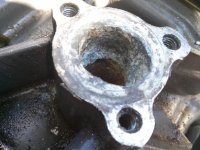
StarbSideThermo.jpgPortSideThermo.jpg
Thermo openings prior to cleanup, not too bad, Port Side Top Pic, Starboard Side Bottom pic

Replaced them and ran, both exhaust manifolds started to heat up to the touch. I did not have the Laptop connected so I was unsure of the Temperature. So it was getting late (had a Little league game to attend), I shut down motor get back at it tomorrow. Proper flow is still in question, Next, Check the water check valves for obstructions, water flush through Thermo ports., Inspect impeller etc.

Is there any special connections to flush out through the Thermostat ports? Is it simply put garden hose down Thermostat port and flush? Do I created vacuum tight connection then flush?
 
Last edited:
I assumed that you cleaned up t-stat seats really well and replaced the O rings. Given the state of those t-stats, I'll bet that your water relief valves are also clogged up. I've never had to pull those, so I don't know the procedure or the level of difficulty.

Straight flush, I use a shop rag and duct tape to try top seal the area around the t-stat seat and the water hose in order to get as much pressure as possible. I also drop the lower leg to do that. You still need to inspect the water pump and impeller anyway.

You may want to consider pouring a jug of vinegar, or better yet, a bottle of CLR, down the t-stat openings and let it sit overnight before flushing in order to break up the corrosion.
 
Re: Honda BF225 Overheat situation

I assumed that you cleaned up t-stat seats really well and replaced the O rings. Given the state of those t-stats, I'll bet that your water relief valves are also clogged up. I've never had to pull those, so I don't know the procedure or the level of difficulty.

Straight flush, I use a shop rag and duct tape to try top seal the area around the t-stat seat and the water hose in order to get as much pressure as possible. I also drop the lower leg to do that. You still need to inspect the water pump and impeller anyway.

You may want to consider pouring a jug of vinegar, or better yet, a bottle of CLR, down the t-stat openings and let it sit overnight before flushing in order to break up the corrosion.


Local Honda service only had one in stock. The T-Stat that was stuck open had to be replaced, the hat kept catching in the little post, it had some corrosion. And, the one that was stuck closed was cleaned up and tested fine. I'll replace that one soon though.

Replaced with new o-rings, also I added some silicon grease not sure if that was necessary?
 
Last edited:
Re: Honda 2004 BF225 running hot issue

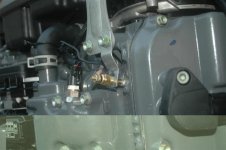
I just ran the motor today; the "Tell Tale" stream was pretty strong. Using my IR temperature gun, I took various temperature measures on the both Exhaust Manifolds, very similar values. The motor ran 2 times each time for about 10 minutes mostly idling. A few times I ran it up to 1500 RPMs. See Attached Pic.

ExhMainfold4.JPG

I never saw the point at the temperature gauge go over 135 Degrees Fahrenheit. The 110, 85 and 75 degrees were average values on both manifolds.

Are these typically for a normal function motor?

I did not do anything else to the motor since yesterday. The ambient air temperature here is around 99 degrees, too hot for me to start other motor activity.
 
Last edited:
Those temps seem a little cool. However, running at idle or a little higher, it takes at least 15 minutes for that engine to get to operating temp where the water jackets should be reading about 160 F.

Not long after I got my BF 225 in 2008 I fabricated and attached heat sensors to each head and ran those to matching gauges on the helm console. They have never gone above 160 F. Interestingly, whenever I get above 4000 rpm's, the starboard temp drops to about 145 F while the port side stays a steady 160 F. No one has ever been able to explain why. I suspect it has to do with simply how the water flows through the heads.

DSC_0113 (Large).jpgDSC_0114 (Large).jpg
 
Your Mods: That's awesome! I may have to do this too. I like it, did you use standard gauges? Digital or analog? Along with the brackets are they just epoxied in, no drilling?

When I did my readings at the temp sensors, I did notice my port side slightly higher in temp than the starboard side too.
 
Seachaser,

I wrote up the whole method for doing that. And now, there are even more options. Send me an e-mail at [email protected] and I will send you the process I developed, as well as some alternatives. It's really rather simple as long as you have the console space for two analog gauges. In a pinch, you can get away with just one gauge.
 
Just a follow up on my initial rough running issue. After I replaced every filter, mesh, associated O-Ring, screens, having the Fuel Injector service, cleaning the VST etc. etc. which needed to be done. Still running rough and running out of time sent it to the Honda Service tech to work on it. He swapped out the high Pressure fuel pump(1717 hours), the fuel pressure regulator (only 2 years old), and spark plugs <200 hours on them. And says there was a partially crimped air or vent line going to the VST. It's Running OK now, I think after my work the main root issue was probably was a combination of the crimped air line and the HP fuel pump.

He said it was a bear to finally get it running smooth and mention during his trouble shooting he had to remove the VST many (actually said 25 times) times.

Also note: The new HP Fuel Pump fuel pressure tested at the normal 40 PSI spec, he put back the original HP Pump it was at 50 PSI, just outside of the spec of 48 PSI. I think it would have ran OK with that but was probably due to be replaced anyway.
 
Scooter - it's been quite a while since I looked at my VST, but I only recall the two fuel lines - one in and one out, and the two water lines, one in and one out. I don't recall any air lines into or out of the VST, except possibly the drain line for purging it.

There are air lines to the vacuum tank near by. Is that what he's talking about?
 
Sorry for the wrong info.

It was the fuel return line that was crimped. When I discussed it earlier with him he thought it might have been a vent issue.

Again it was a crimped fuel return line contributing to the rough running.
 
Seachaser, Thanks for the followup and explanation. Do you have any idea how it got crimped. That's normally pretty difficult to do at the VST.
 
Back
Top