Logo

Evinrude 115hp Turbojet - No Spark unless Black/Yellow wire is disconnected. Help?

waterboy01

New member
Firstoff, forgive me, I am a newbie, but I am trying to learn as much as I can. I really hope someone can help me out. I have a 1994 Evinrude 115hp Turbojet that has been running great until today. I found a thread that suggested to disconnect the Black/Yellow striped wire, so I did. With the black/yellow stripe disconnected from where it comes into the Power Pack/Ignition Module the engine starts right up with no problem, when its time to kill the engine, the key will not kill obviously, so I re-connect the black/yellow striped wire and the engine kills. Can someone tell me where to look to correct this...Do I need to replace the Power Pack/Ignition Module??? Or is it a Regulator/Rectifier issue? Thank you in advance for any help. (P.S when I tested this I started the engine with black/yellow wire diconnected and drove the boat at an idle / low speed around the lake for about 10-15min and then docked and killed the engine be re-connecting the black/yellow wire. )
 
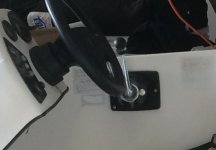
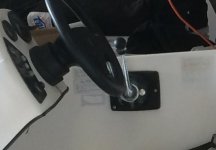
ThrottleControl.jpgSee my picture....I dont have safety laynard or anything that I am aware of, all I have is a key that goes into the ingition left of steering wheel....as far as the gear shift it is just black that moves forward or backward, it has no markings and doesnt look anything like the item in your ebay link. Also, if it helps, i dont ever hear any bells or whistles at anytime so I am assuming the guy I bought this from bypassed all of that or it is just not working.
 
Last edited:
I don't see it but pretty much anything with an outboard produced after the 70's has a safety lanyard in it. Often people take the lanyard off and you will just have a little toggle switch (the toggle holds the lanyard, but you can pull the lanyard out and then re-set the toggle).

If you take a look at your ignition switch wiring and/or the harness that those wires come out of, you may find there is a wire going to the safety switch.

Also a possibility as has been stated is your switch is bad.
 
Be real careful messing with wires under the dash. Allways disconnect the battery before putting a tool up there. It only takes a split second shorting the kill wire to battery pos to destroy the ignition pack.


I will disconnect battery tomorrow and check under the dash. From day one I never had any lanyard or safety toggle that I was aware of, I just simply turned the key and drove.

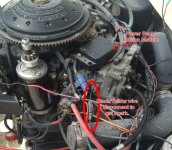
KIMCRWBR1, if the instance occurred where the ignition pack was destroyed would the engine still run? I only ask because the Yellow/Black wire I disconnect from the ignition pack causes the engine to start and run...Pic.jpg
 
To kill the motor you ground the black yellow wire through the ignition switch normally two M terminals. The ignition runs independent of the charging system and the motor will run with a dead battery. Disconnect the black yellow wire from the ignition switch and isolate the wire and see if the motor runs. If so the ignition switch needs replaced. Sometimes a kill button is added to the motor for a fishing application follow the kill wire from the pack to wherever it goes you will find where it is shorted to ground.
http://www.maxrules.com/graphics/omc/wiring/V4_1973.jpg
This shows your basic kill circuit


Thank you, I will follow the black/yellow and look for where it is grounding out. Also THANK YOU for the wiring diagram, I was looking everywhere for that, now I have an idea of what Im looking for.
 
Your powerpack is obviously okay, otherwise the engine would not run in the first place. The kill circuit of the engine is as follows. In your first (#1) post, you mention "the key will not kill" which indicates that your rig does incoporate a ignition switch... and no doubt a "Kill Switch" that would have a lantard attached that would be yanked off which would effectively also kill the ignition.

The problem is that either the ignition switch has shorted out... OR... the lanyard cap is not plugged onto the kill switch... OR... the kill switch is shorted out.

(Ignition Kill Circuit)
(J. Reeves)

A Black wire (ground) should lead from the powerhead to the powerpack. There will also be a Black/Yellow wire leading from the powerpack to a raised "M" terminal of the ignition switch. To complete the circuit, there will be a Black wire from the other "M" terminal of the ignition switch to ground.

When the key is in the OFF position = The two "M" terminals are connected,. effectively shorting/killing the ignition.

When the key in ON position = The two "M" terminals are not connected and the ignition is engaged.
 
Thanks everyone for working with me. So far, I have now determined that when I disconnect the Black/Yellow kill wire from the ignition key switch the engine starts right up. So now I ask one last dumb question...Does this mean my ignition key switch is bad? I assume yes, so now where do I find a replacement?

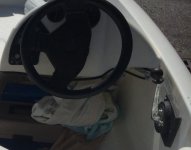
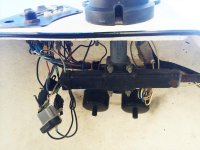
Also, Here is a photo of what Im looking at underneath the dash. (Attached)dashwires.jpg {you may notice that little grey box hanging near the bottom left of the picture, I assume that is an alarm/horn that is supposed to beep however it has been disconnected since I got the boat.}
 
Last edited:
I would want the warning buzzer working. That can save you alot of money especially if you are running with a VRO. That schematic I showed you was for the kill circuit only. I couldnt find one for you engine. Are you premixing your fuel?

I am premixing 50:1. I will replace the buzzer just to be safe now that my other issue is resolved.
 
http://www.marineengine.com/newparts/part_details.php?pnum=OMC0584592
Are you still using the VRO for a fuel pump? I would check to see if that buzzer is still working. There are two temp switches one on each head. The switches provide ground to the buzzer and hot is accy on the ignition switch. Turn the key on and check for power at the temp switches on the heads. If it has power just short the wire to ground and see if the buzzer sounds. If so then your already set to go.

Thanks, yes I am still using the VRO for the fuel pump, however I have the plug/wires disconnected. Am I safe to reconnect the plug/wires to the VRO even through I am only using it for fuel and have the oil lines cut?
 
Waterboy01..... Even though you are pre-mixing your fuel/oil, you still need the warning horn to be operative for the possible problem of "overheating" and "fuel restriction", both of which unfortunately give forth the same warning... a constant steady "beeeeeppping", however that warning is enough to stop the engine to figure out which problem exists at the time. The alternatiuve to "No Warning" is to discover that the engine is overheating right after the engine comes to a sudden screeching halt and seizes up with smoke pouring off of it! The following may be of some use to you.

(Testing Warning Horn)
(J. Reeves)

On VRO equipped engines where the VRO automatic fuel/oil setup is still being used, make sure that all components are connected as required. This would include the VRO pump wiring harness itself, the oil tank wiring, the overheat sensor(s), and if so equipped.... the vacuum switch that is standard to many V6 & V8 engines.

If the VRO automatic setup has been eliminated and has been disconnected properly, and the fuel and oil is being premixed, make sure that the overheat sensors are still connected, and the vacuum switch if the engine is so equipped.

On engines prior to 1984 which have no VRO setup, ignore the instructions pertaining to the VRO components, etc above.

Turn the key to the ON position (Engine Not Running). Find the TAN wire at the cylinder head(s), then ground out the portion of that wire that is part of the engine wiring harness. If that Tan wire connector has the knife type connector where as it is exposed simply by sliding the rubber insulator back, it does not need to be disconnected.

Grounding that TAN wire should cause the horn to sound. If it does not, find out why as that's the only warning you'll receive should the engine overheat or have some portion of the VRO system fail, or have the engine encounter a fuel restriction if it is equipped with a vacuum switch.

********************
(VRO Horn Warnings)
(J. Reeves)

NOTE: I retired around 1991/92. Possibly some of the later V4 engines and others may also incorporate a fuel vacuum switch that would enable a fuel restriction warning to sound as mentioned below, an unknown factor to myself.

1 - A steady constant beep = Overheating - The V/6 engines, possibly some others, have a fuel restriction warning which is also a steady constant beep.


2 - A beep every 20 or 40 seconds = oil level has dropped to 1/4 tank. (Late model engine = Every 40 seconds)


3 - A beep every other second = VRO failure, air leak in oil line, oil restriction, (anything that would result in a lack of oil being supplied to the engine).

NOTE - If the warning horn is the black plastic (overpriced) three wire type horn, the warning horn should beep once when the ignition key is turned to the ON position. If it does not, it is either faulty or someone has disconnected it (a stupid move!). At any rate, if it does not beep which indicates that the horn is non functional, find out why and do not run the engine until the problem is corrected.

********************


(VRO Pump Conversion To Straight Fuel Pump)
(J. Reeves)

You can convert the VRO pump into a straight fuel pump, eliminating the oil tank and VRO pump warning system, but retain the overheat warning setup (and fuel restriction warning if so equipped) by doing the following:

1 - Cut and plug the oil line at the engine so that the oil side of the VRO pump will not draw air into its system. Trace the wires from the back of the VRO to its rubber plug (electrical plug) and disconnect it.

2 - Trace the two wires from the oil tank to the engine, disconnect those two wires, then remove them and the oil tank.

3 - Mix the 50/1 oil in the proper amount with whatever quantity fuel you have. Disconnect the fuel line at the engine. Pump the fuel primer bulb until fuel exits that hose with the tint of whatever oil you used. Reconnect the fuel hose.

That's it. If you want to test the heat warning system to ease your mind, have the key in the on position, then ground out the tan heat sensor wire that you'll find protruding from the cylinder head. The warning horn should sound off.

 
Back
Top