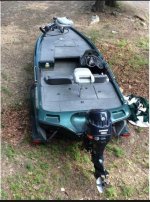
I'm not really a performance junkie, but I want to be sure my boat is setup properly. There are times on smooth water when the boat feels stuck down but when there's a little chop it gets free and I can feel it gliding on the pad.
Here's my set up:
1997 Ranger 461vs
1996 Evinrude Intruder 150 (E150ELDGB) with an Evinrude lightning gear case.
13 1/4 X 25, 4 Blade SS prop
Measurements:
Hull has a built-in setback of 19".
The engine is currently in the lowest set of mounting holes (max height) on the transom bracket.
Prop shaft measures 5-1/2" below the lowest point on the hull.
Antiventilation Plate measures 3-1/2" above the lowest point on the hull.
Performance:
I can usually get a max 5,000 RPM and about 50 MPH @ WOT. Holeshot is decent, but I don't have a great idea for comparison and I've never used a stopwatch for time-to-plane. Water pressure is usually about 18 PSI or higher when on-plane.
I'm a little lost when it comes to bass boats so I'd like to hear some guidance. Previously Faztbullet warned me the Lightning gear case might not perform well on hulls designed for slower speeds so it is possible my issue is the gear case. But until I'm certain I'm at the right height I won't know for sure what the issue might be. I've searched quite a bit and it seems a common setup is having the prop shaft 3-1/2" below the pad. If that's the case my engine is 2" too low.
I'd like to hear opinions on what the correct prop-shaft to hull difference should be. At this point if I want to raise the engine any more I'd have to install a jack plate. I don't think I want to bother with the cost of a hydraulic jack plate. I know there are situations where they can be nice, but most likely I would a manual jack plate like the one below to set the engine at the proper height then leave it alone.
https://www.vancemfg.com/product-p/jpl4400.htm
Thanks.
Here's my set up:
1997 Ranger 461vs
1996 Evinrude Intruder 150 (E150ELDGB) with an Evinrude lightning gear case.
13 1/4 X 25, 4 Blade SS prop
Measurements:
Hull has a built-in setback of 19".
The engine is currently in the lowest set of mounting holes (max height) on the transom bracket.
Prop shaft measures 5-1/2" below the lowest point on the hull.
Antiventilation Plate measures 3-1/2" above the lowest point on the hull.
Performance:
I can usually get a max 5,000 RPM and about 50 MPH @ WOT. Holeshot is decent, but I don't have a great idea for comparison and I've never used a stopwatch for time-to-plane. Water pressure is usually about 18 PSI or higher when on-plane.
I'm a little lost when it comes to bass boats so I'd like to hear some guidance. Previously Faztbullet warned me the Lightning gear case might not perform well on hulls designed for slower speeds so it is possible my issue is the gear case. But until I'm certain I'm at the right height I won't know for sure what the issue might be. I've searched quite a bit and it seems a common setup is having the prop shaft 3-1/2" below the pad. If that's the case my engine is 2" too low.
I'd like to hear opinions on what the correct prop-shaft to hull difference should be. At this point if I want to raise the engine any more I'd have to install a jack plate. I don't think I want to bother with the cost of a hydraulic jack plate. I know there are situations where they can be nice, but most likely I would a manual jack plate like the one below to set the engine at the proper height then leave it alone.
https://www.vancemfg.com/product-p/jpl4400.htm
Thanks.
Last edited:

 Are they really that much better or do they just have a bigger following? I can see the advantages of hydraulic plates but I kind of think I'd be okay with getting it set and leaving it alone. But, is that being short sighted and one day I'll want hydraulic?? So many choices, so little money