Logo

AQ130C heading to the workbench

teg1928

Member
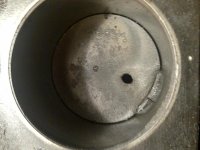
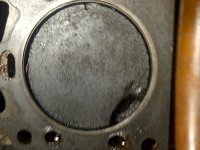
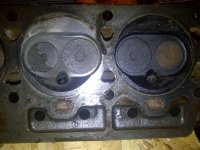
Well, On Saturday I did a compression test on each cylinder to get a feel for what might be going on inside. I got 30, 0, 80, 15, psi respectively. The pics tell the story though. Need a piston and ring job. Getting pricing on parts. Anyone know the easiest way to get an AQ130 out of the engine bay??? Now I'm heading into project 2. Neverr rebuilt carburators before and successfully accomplished that. Now tackling an engine rebuild! :rolleyes: what fun! Well, setting a goal, try to have this done and in the water by Memorial day weekend. I'm betting the previuos owner had the timing advanced too far. Will make sure that isn't repeated after I get this motor back together. At least the cylinder walls aren't damaged and the head doesn't look hurt at all. Can you guess which pic is of cylindre number 2??
IMG-20120429-00039.jpgIMG-20120429-00040.jpgIMG-20120429-00042.jpg
 
Luckily, there isn't a lot to disconnect to pull the engine. The wiring harness just unplugs and the fuel and throttle are pretty self explanatory. After you remove the gearbox, you'll see that there are 6 bolts holding the clamping ring to the flywheel housing. Support the engine, remove the bolts, and pull out the engine with the flywheel cover attached - it's that easy.
 
Thanks again for the input Joe. Let ya know how it goes. Looks like I am going to have to connect my log chains across some high tree branches so I can winch it out maybe get that done this week if weather permits. No overhead room in the garage to do it in there. Got parts on the way. I have a friend who rebuild racing engines who said I could bring the head and parts over for cleaning. That will save me another $200. And maybe pick up a few more tips. And hopefully tools!

So - "Remove the gearbox"? Does that mean the out-drive has to come off first? was hoping I could just unbolt the engine from the bell housing.
 
Glad to hear you've got a tree, I actually had to hire a wrecker to lift my engine high enough :D.

It's best and a lot easier to remove the gearbox. You don't need to remove the whole outdrive. An absolute must is to replace the drive shaft bearings that are in the flywheel cover. It's much easier to do that with the flywheel cover sitting on the floor or workbench. Great time to replace the u-joints and bellows too. You'd feel very foolish if you don't do these now.

For more information on the bearings, just search the forum for "PDS bearing replacement". You'll see that Rick is the expert on these and has very good information on all aspects of this maintenance item.

Just thought of something else with the head. Most machine shops will start out with shaving the head. You don't want any more material off of that head than absolutely necessary. You're probably looking at burning high octane fuel allready but you don't want to be forced into using avgas!
 
Last edited:
I looked up most of the other parts you mentioned and cost isn't that much more so i'll egt them but are the bearings you mentioned the roller bearings-(183247 & 183668)? I want to make sure I order the right ones.

Also I have talked with an old timer about some leaks I had and repaired in the stern and that we noticed the front of the motor not having any motor mounts on my boat. So saw in the suspension schematic that there is a brace with rubber cusion and brackets available. found all the pieces but the engine block brackets. If anyone knows of a dead aq130 that doesnt need them anymore I'l like to get them so i don't have to fabricate any. Part number was 820269but not available anywhere including ebay that I could see today.

Tg
 
This may or may not be feasbile in your boat, but I'll throw it out there. The bilge just below the engine (AQ130C) in my boat is just barely wider than the engine itself, so what I have done on my boat is to lay a fairly thick piece of flat steel about 2" wide x 2' long across the bilge under the engine where the true motor mounts would be. Then I have some thick rubber blocks that are zip-tied around the flat steel piece spanning the bilge and thru the motor mount holes in the engine block. I cut the rubber blocks so that they fit snugly between the bottom of the motor and the steel piece. They support the front of the engine very nicely and it was very cheap to build.
 
Main PDS (Primary Drive Shaft) bearing is 11013, replaced by 3851019 (under transmission, connecting components). Pilot bearing that sits in the flywheel is 11009 (crankshaft and related parts). The PDS is inside the flywheel cover. You'll need the seals also. I think the bearings that you're talking about are the main bearings in the gearbox. let's hope you don't need to replace those.

The front motor mounts aren't necessary. These engines (as well as the OHC engines) are cantilever hung from the transom shield. Some manufacturers did use front mounts but IMHO are just one more thing to align and get in the way. If you've got transom leaks and integrity is in question, you really need to make sure that the transom and stringers are solid before you spend another penny on the engine. I've been there, and that little "detour" to gut the hull to replace transom, stringers, and deck can be a little time (and cash) consuming.
 
Teg, IMO, there's no need to remove the flywheel cover with the engine. Just separate the engine from the flywheel cover, and pull the engine only.

If you pull the flywheel cover also, you'll want to replace the two rubber cushion rings, and you'll need to re-align the flywheel cover to the transom shield. This also involves the engine torque button (if cantilever hung) and aligning the exhaust manifold with the exhaust down tube....... which is no big deal, just not necessary unless there's a reason for doing so.

The PDS can be removed for bearing replacement while the flywheel cover is still attached to the transom shield.
This PDS is a single bearing, and it will come out AFT following the removal of the two large snap rings (baring no rust at the drive coupler splines, or pilot bearing).
No offense, Joe.... just a different approach that has worked well for me for over 20+ years.

The transmission will need to be removed as Joe suggests.

So - "Remove the gearbox"? Does that mean the out-drive has to come off first? was hoping I could just unbolt the engine from the bell housing.
Yes... what you are calling a bell housing is a "flywheel cover" in the marine world.
I'd leave it attached to the transom shield, and separate the engine from it.
Unless you'll be doing work to the reverse latch unit, or suspension fork bushing, etc., there is no need to remove the entire drive.
Ditto Joe on that!
Fact is, it's much easier to remove the transmission only.... even if you end up removing the remainder of the drive.
Re-install transmission last!

Ditto Joe in post #7.
The single bearing will be an industry standard bearing that can be purchased from a major bearing supplier.
It's likely a 6206.
The seals are also an industry standard seal. The bearing supplier can bring these in for you.

If the transmission requires the main drive gear bearings, these are also an industry standard 30207 and 31307 bearing. This gets tricky when replacing these, as there is a rolling torque value that is shim controlled, and must be maintained.
It typically involves a gear contact/back-lash adjustment as well.

I offer this service, and Joe may also. These transmissions ship in a USPS flat rate box for $16 or so.

Teg, your piston damage is highly suggestive of detonation damage, and most likely from ignition induce detonation.
I'll suggest that you NOT go back together without first having your ignition distributor tested for the correct advance curve and limit.
Rusty and/or weak flyweight springs can and will cause an early advance, and will cause detonation.
A good shop with an old school distributor machine can correct this for you.
No need to repeat this damage on a fresh engine.


.

 
+1 on makeing sure the dizzy is working correct, .......
It's not uncommon to see these engines damaged from detonation, simply due to a malfunctioning ignition distributor that could have been corrected for $75.
Sadly, many owners... and even mechanics....., do not pay close enough attention to our progressive ignition advance and TA.
They set BASE advance....., and they're on their merry way! :mad:

I sometimes get chastized for mentioning ignition timing as often as I do.... but this is a good thread that helps explain why.


.
 
any photos of your homemade mount.

This may or may not be feasbile in your boat, but I'll throw it out there. The bilge just below the engine (AQ130C) in my boat is just barely wider than the engine itself, so what I have done on my boat is to lay a fairly thick piece of flat steel about 2" wide x 2' long across the bilge under the engine where the true motor mounts would be. Then I have some thick rubber blocks that are zip-tied around the flat steel piece spanning the bilge and thru the motor mount holes in the engine block. I cut the rubber blocks so that they fit snugly between the bottom of the motor and the steel piece. They support the front of the engine very nicely and it was very cheap to build.
 
Thanks Rick and everyone for your input. I need all the help I can get as this is my first run at an engine overhaul. Stayed dry long enough last night to get the log chain and hoist in place. Will try an get the engine out by Sunday evening. Been getting lots of rain here with more predicted through Sat evening. Got a feeling the GF isnt going to like the looks of the front yard nor the garage for awhile! still shootin for getting done by Memorial day.
IMG-20120502-00045.jpg
 
Last edited:
As for the carbs post from Kimcrwbr1 don't know how thick the spacer is you are referring to but the gasket kits had a D shaped one that goes between the carburator housing and the top cover. it had special cutouts for openings and was installed correctly. If there is another d shaped "spacer" I don't have it and it wasn't on either carburator that I'm aware of.
 
any photos of your homemade mount.

mount.jpg

It's more of a support than a typical motor mount. The blue support block on the left side is actually a very dense and strong piece of styrofoam like material and despite it looking so in the pic, the alternator is not resting on it. The right side has a rubber block. I've replaced the support blocks a few times but other than that this method has worked perfectly for the past 40 years to support the front of this engine.
 
Last edited:
While you're at it...., tighten all six transom shield mounting bolt nuts. These are the six nuts that will be visible from inside the engine bay.
As you pull these tight, you may see the shield become closer to the transom.
You may also see these large washers pull themselves into the transom core a bit if the core is soft... particulary the lower ones.
Snug these up regardless!

This will also tell you something about the condition of your transom core.
If the two lower nuts/washers pull themselves deeply into the core, you can add two large plate washers behind the OEM washers, and grab more material.
It's not the ultimate fix..... but it may get you by for a while.

.
 
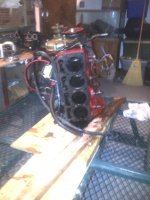
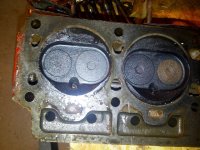
Thanks Rick. While I have the engine out I'm going to beef the transom, clean out the engine bay, rebuild the battery box and see about some type of support or engine mount for the front. I do appreciate all the input from everyone. I'll attempt to add some current pics. Engine is out, partly disassembled, Piston #2 was difficult to remove as it deposited some ring or piston material onto the cylinder wall near the top of the cylinder. had to spend some time with a polishing stone to finally get it out being very careful not to damage the cylinder wall. valves don't appear to be damaged that I can tell. next will be spending time taking apart the head and cleaning everything up. Try to keep some updates coming.


Taking it apart.jpgHead 1.jpgHead 2.jpgLoose.jpg
 
5/16/12 Update. Have the engine cleaned up now. A few parts are ready to be repainted. Figured I'd make it look decent again after putting all the time & $$ into rebuilding it. Also bought a front engine mount assy to install to help reduce the torque forces on the transom as a precaution. Lucked out and found all the pieces on ebay for $65 that included shipping! :) Took the cylinder head to my buddys engine shop and cleaned it up and after his inspection recommended that I replace all of the exhaust valves. May need one valve seat replaced. After reading several forum posts decided on the auto version of the valves as they cound be had for $13 each vs $88 from the marine suppliers. But I'll verify the sizes before installation. The distributor came back as OK from the expert on Gasoline Alley. So just might be able to start reassembly this weekend if i'm lucky.

Teg
 
No problem -I happen to live near Indianapolis Indiana. Gasoline Alley is a street not that far from the Indianapolis 500 race track. On it are MANY racing teams and supporting businesses of all types for the auto racingg industry. A college buddy of mine worked for Penske Racing for 10 years on their engine developement team and he has his engine shop located there. He recommended for me have the distributor checked out at one of the supporting services shops down the street from him.
 
Ok Gents, need alittle guidance again... How do I get the Primary drive shaft bearing out of the housing? looks like a grease cap down in there and the schematic shows two snap rings behind it. How does the grease cap come out without tearing anything up?

- Oh by the way the motor is all back together now just waiting on me to get the PDS bearing and u-joints replaced and slip the new bellows on and bolt it all back together. Will post some new pics soon. hope to get these items completed and install the motor Friday evening!

TEG
 
It sounds like the rear seal you're talking about. Use a punch or screwdriver to punch through it and bend it until you can get it out. If you look at the new seal, you'll notice that it's a metal washer in there so use force as necessary.

The instructions for replacing the bearing are attached. Pay particular attention to the way the seals are set in place and be sure to completely fill the bearing cavity with grease. It's best to fill the cavity while turning the shaft and fill it until grease comes through the bearing cage.
 

Attachments

  • Flywheel cover bearings.pdf
    50.5 KB · Views: 107
Thanks Joe- I appreciate the pointers. Don't have the new seals yet . They are on the way, hope they arrive by Wed. Didn't know how thick the seal was ..yet. So didn't want to damage anything. Thanks for the instruction sheet and graphics that info definatly helps alot.

Teg
 
Back
Top