Logo

454 fuel pump question

ok folks...riddle me this please. Again thinking old school and trying my best to understand. I finally talked to a highly reputable marine parts shop in Long Beach Ca, and questioned an old timer there about this fuel pump and carb overflow (fuel return) situation I've been dealing with. For your consideration, here is what I was told..."the reason an overflow port that runs to the carb is NOT to prevent spillage into the bilge, but to prevent fuel escaping from a ruptured diaphragm into the crankcase and thinning the oil.. " He explained that with the old , non vented pump that currently resides on port engine, if the pump fails, the engine is simply going to stop running and while that diaphragm is in early stages of failure, the crankcase could become full of gas, but it would not go to bilge. He further stated that on the starboard side which DOES have a pump with overflow (return) vent port, I should, as MakoMark has repeatedly advised me, drill and tap a 1/8" npt fitting into a convenient location on the carb below the arrestor so that any fuel pumped up that line will all drip into the primary barrels. In fact, he went on to say that from a safety standpoint , the port side pump that is currently on the boat and with NO overflow port is actually safer than the starboard side WITH the port. He reiterated that failure of the diaphragm is NOT going to result in fuel in the bilge, as was my panic driven concern.
I then went to uscg regs under fuel pumps section 183.524, and found language that says (paraphrasing...."a sealed housing, open to crankcase only, or with a stripper tube to the carberator"). The pump on the port side is a sealed housing simply bolted on to the block.
So I'm wondering, if we only need a "sealed housing open to the crankcase only" what is the advantage of the airtex 60502 that I have in my hand with an overflow port?
 
Are you reading the actual CFR or someone else's interpretation.....??? I don't think you will find a new 'sealed housing' fuel pump unless it is marine and it will come with a double diaphragm and the sight tube port.....and auto pumps usually don't have a sealed housing....and, the way the factory rep explained it decades ago, if the pump is 'sealed' it cant leak anywhere, even the crankcase...

I can tell you that a ruptured diaphragm can liberate lot of fuel in a short period of time and you don't want it to accumulate in the crankcase over accumulating in the primary bore and hopefully flooding out the engine in short order. one case will trash the engine and the other can allow a return to port....

I'd be willing to bet that a seasoned marine insurance rep could provide a full history on this topic...
 
Are you reading the actual CFR or someone else's interpretation.....??? I don't think you will find a new 'sealed housing' fuel pump unless it is marine and it will come with a double diaphragm and the sight tube port.....and auto pumps usually don't have a sealed housing....and, the way the factory rep explained it decades ago, if the pump is 'sealed' it cant leak anywhere, even the crankcase...

I can tell you that a ruptured diaphragm can liberate lot of fuel in a short period of time and you don't want it to accumulate in the crankcase over accumulating in the primary bore and hopefully flooding out the engine in short order. one case will trash the engine and the other can allow a return to port....

I'd be willing to bet that a seasoned marine insurance rep could provide a full history on this topic...
I was reading actual cfr . Mark, you know me, I'm not being argumentative
Just trying to understand. If I'm looking at the pump that's on the port side now, and looking just lije the airtex 60502 with the overflow barb except without that barb, I still don't see how fuel escapes into bilge or on ground if the diaphragm ruptures. It's gaskets and bolted together, right? If it ruptures internally wouldn't the engine stop running due to lack of fuel, and won't any fuel leaking past the rupture go into the oil? I know that's not a good thing, but it's better than a vapor explosion. Anyway, I intend to do the new pump and fix the carb barbs
 
what I get as the latest from the GPO is this:
§ 183.524 Fuel pumps.
(a) Each diaphragm pump must not
leak fuel from the pump if the primary
diaphragm fails.
(b) Each electrically operated fuel
pump must not operate except when
the engine is operating or when the engine
is started.
(c) If tested under § 183.590, each fuel
pump, as installed in the boat, must
not leak more than five ounces of fuel
in 2 1⁄2 minutes, inclusive of leaks from
fuel line, fuel filter and strainer.
and the context refers to (a) - and this is where the second diaphragm comes in.....so if it has both pieces of rubber, it has a chance of satisfying (a). I think if you put liquid fuel into the crankcase of a running engine, there will be fuel vapor expelled from the crankcase....and that will sink into the bilge and we know the rest of that story.
Now the coast guard has a boat builders guide and the same material also shows up in a PDF file attributed to the AB&YC.....and that makes reference to a stripper tube and a sight glass....where the actual text of the CFR omits the same....and the both have the same typo - 'hosing' vs 'housing'....so I'm a bit skeptical - these are interpretations/expansions vs the CFR (which is cited in 'box'). I'm sure there are many ways to satisfy the requirement - all I'm saying is everything I've seen in the past few decades (marine mechanical fuel pumps) have the double diaphragm and the hose barb scheme....I recall a couple 1960-ish I/O's, when I was pre-teen, that has glass bowls on the pumps but I don't recall the details....
 
what I get as the latest from the GPO is this:
§ 183.524 Fuel pumps.
(a) Each diaphragm pump must not
leak fuel from the pump if the primary
diaphragm fails.
(b) Each electrically operated fuel
pump must not operate except when
the engine is operating or when the engine
is started.
(c) If tested under § 183.590, each fuel
pump, as installed in the boat, must
not leak more than five ounces of fuel
in 2 1⁄2 minutes, inclusive of leaks from
fuel line, fuel filter and strainer.
and the context refers to (a) - and this is where the second diaphragm comes in.....so if it has both pieces of rubber, it has a chance of satisfying (a). I think if you put liquid fuel into the crankcase of a running engine, there will be fuel vapor expelled from the crankcase....and that will sink into the bilge and we know the rest of that story.
Now the coast guard has a boat builders guide and the same material also shows up in a PDF file attributed to the AB&YC.....and that makes reference to a stripper tube and a sight glass....where the actual text of the CFR omits the same....and the both have the same typo - 'hosing' vs 'housing'....so I'm a bit skeptical - these are interpretations/expansions vs the CFR (which is cited in 'box'). I'm sure there are many ways to satisfy the requirement - all I'm saying is everything I've seen in the past few decades (marine mechanical fuel pumps) have the double diaphragm and the hose barb scheme....I recall a couple 1960-ish I/O's, when I was pre-teen, that has glass bowls on the pumps but I don't recall the details....

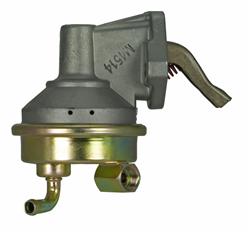
Mark...Don't dispute anything you have relayed here. Yes the boatbuilders guide excerpt is what I saw. I have a new airtex to install on that port side and the 2 barbed fittings to install on both carbs to satisfy the regs once and for all. I'm just that kind of nuisance who needs to understand why I'm doing something rather than just because "that's what it says". You know I appreciate all your help and everybody else on the forum. I will be at boat tomorrow and don't plan on pulling that pump for a few days but I'm gonna take a picture of it to see if you all can identify it as auto or a vintage marine.
 
no problem here....

Most pumps have a part number stamped into the edge of the mounting flange.....and that's usually definitive...
 
FYI...... the link that Diver Dave posted leads us to an automotive fuel pump!

Carter Muscle Car Mechanical Fuel Pumps M4530


CRT-M4530_BK_ml.jpg
 
Last edited:
FYI...... the link that Diver Dave posted leads us to an automotive fuel pump!

Carter Muscle Car Mechanical Fuel Pumps M4530


CRT-M4530_BK_ml.jpg

Yes I know it is automotive
Mine does not look like that. It's old so maybe pre-regulation changes, but in any event I am changing it out to an airtex 60502 marine pump. Now to determine if I do myself or pay somebody. I have changed out old car pumps I'm the past with no problems but now getting cold feet after seeing posts about holding up a push rod or cranking engine to position it??? I never did that before. I just unbolted 2 bolts pulled off old and bolted on new. Maybe i just got lucky in the past and too dumb to know it
 
I've used grease to keep the rod in place. If the cam is positioned at an unfortunate angle, there will be forces acting against you. :cool:
 
I've used grease to keep the rod in place. If the cam is positioned at an unfortunate angle, there will be forces acting against you. :cool:

Thanks Dave. I had a mechanic come down to the boat today that I have used in the past, for the purpose of finding out how much he would charge me to install this pump. He immediately noticed that due to the insulet installation of the engine is Straight Shaft pump up against the fuel tank it would be one of the more intensive fuel pump change out that he has done and he would charge me $260 labor to install the pump that I have in my hand. He is a good guy and there is no reason for me to miss trust him or think he's taking advantage in fact he spent 20 minutes with me going over the engines and offering me various tidbits of information but overall he thought my engines were in excellent condition. He did comment that if the pump is not malfunctioning why do I want to change it. When my response was simply to put a Marine pump on the boat, his response was the same as the vendor at the marine parts store that I talk to a day or two ago who reaffirmed that in the event that the diaphragm failed the engine performance would be immediately noticeable and any fuel would go into the. So here I have a bunch of I have friends here on this forum advising me to get the pump changed out ASAP and I have a trusted marine mechanic and adjusted vendor telling me not to panic about it in essence telling me if it ain't broke don't fix it. So I'm sort of leaning towards going ahead and paying the man $260 to change out this pump
 
update on this....digging deep on research and re-examination of existing port side pump.....I believe the pump I've been concerned about is a marine fuel pump, but with the return line (or sight glass fitting) plugged. I believe the original Crusader pt number was 97039, and I BELIEVE the original pump in those days was an AC Delco part, now discontinued. I have found a few aftermarket parts that closely resemble what's in there now as in Sierra part 18-7272, which bears the same diagonally placed fitting between the 2 diaphragms, and on most retailer sites listed with note "requires sight glass".

So ....guys...if I indeed have a marine fuel pump with a plugged return/sight glass fitting, is it as simple as unplugging it and routing a return line up to the carb? BTW..don't forget I have already purchased the new airtex 60502 in hand, but I could keep that on hand as a spare, if the existing operational pump is still good, with the return line installed as I have queried.
 
I think this getting too complicated. The Airtex style pump with barb is the currently accepted way to do it in the boating world, and approved by USCG. As far as the installation, I am able to change one in a matter of minutes. So perhaps you have access problems, but it is extremely easy to do. Someone charging $260 is looking to take you to lunch with you footing the bill, IMHO. As far as I know, all the MK IV and Gen 5 engines used the "long shaft" rod to connect the fuel pump to the cam lobe. But you have to take a hacksaw blade and bend it slightly, maybe 45 deg.or so, and use that to hold the shaft up against the cam. That allows easy insertion of the pump, and voila, its all over except the bolting and fuel line part.
 
If you are sure its a properly rated pump, it would be prudent to do what you suggest or find a sight glass (distant #2 choice in my book)...
 
Sfrdude and Mark...

It's about access to this pump. I HATE admitting it, but not being as nimble as I used to be, this space is extremely tight, even for a 20 year old. The pump is on outboard side of port engine, blocked by the exhaust hoses and muffler, but more so by oil cooler and related hoses. You can't even see one of the two mounting bolts. I could probably reach over the engine and across and eventually remove the old pump, but the prospect of positioning the push rod completely blind while simultaneously starting the new pump seems like an impossible feat
Removal of stuff that is in the way and rhe difficulty of installation will pribably make this a 5 hour job for a skilled guy with all the tools. Do I want to spend $260?...no. but I'm thinking I want to correct a safety issue and if I pay him to do it, I can hold him responsible for making sure nothing leaks when reconnected. This is why this thread has grown so lengthy. I would love to know that I have a functioning marine pump that I could easily correct with a length if clear hose and a fitting.
 
Ah, you must have V-Drives. Didn't see that or maybe I missed it. That does make access difficult. Good luck.
Yes sir...the v drives make access to port side nearly impossible to even change spark plugs. Starboard side fuel pump would be easy peasy but unfortunately the one in question is port side.
 
I'm getting another flashback on the pump install. I converted the hex bolts to allen cap bolts, to make the assy easier. And, grease is the trick to keep the rod out of the way. You should inspect the rod for wear, though.
 
I'm getting another flashback on the pump install. I converted the hex bolts to allen cap bolts, to make the assy easier. And, grease is the trick to keep the rod out of the way. You should inspect the rod for wear, though.

Thanks Dave...I COULD go ahead and disassemble this thing to try to do the pump myself
I realize it is or should be a simple part to replace, and I hate that I'm leaning toward paying someone to do it but......I know I'm not gonna even be able to see the rod, perhaps not be able to touch it, from trying to do this job from leaning over the top of the engine. The guy I plan on using is someone I trust, and when he saw mine, he said "Oh boy". He did another crusader pump recently that he deemed difficult to reach and rated mine as worse. But he is a competent mechanic and like said, once it's done I want it leakproof. By paying him, I feel I have more awareness of that
 
NOTES:
In this video clip they are showing a SBC..... not a BBC. However, I believe that some of earlier BB's also offered this feature.
Look only at :54 to 1:08 in to this video clip.

https://youtu.be/yd6mAvsWMeg?t=54

At :54 into this video, look at the longer bolt that is being installed on the face of this engine.
During some years, GM offered this threaded hole that leads into the push rod bore.
When a longer bolt is installed, it will touch and hold the push rod preventing gravity from causing it to drop.
Look to see if your block offers this threaded hole.

If it does, simply find the low point of the push rod cam (the forward most cam lobe on the camshaft), push the rod back up against it's cam, and let the bolt hold the rod from falling.

Be sure to re-install the original short bolt to prevent oil from leaking!


If your cylinder block does NOT have this threaded hole...... here is another idea (@ 1:21 into this video) that I have used myself.
https://youtu.be/v6UGEpgOUqg


Good luck.


.
 
Last edited:
Update on this topic....upon close examination with my experienced marine mechanic, we determined that the port side fuel pump IS a marine unit but the return line/sight glass fitting was capped off with an allen head screw inserted. The mechanic arrived today fully prepared to get into replacing this pump with the new airtex I have, and would have taken my money, but he did project that in this particular engine configuration, it was going to amount to a significant teardown. Oil cooler and hoses definitely, seawater pump and hoses probably, and manifold possibly..."was I sure I wanted to tear down a running boat to thst extent?" So....because the existing pump is a double diaphragm unit with a "vent" fitting between the 2 diaphragm, I decided to remove the plug and insert a hose barb fitting. From there, I ran Tyson to arrestor and drilled a hole just big enough to jam/thread another 90* barb fitting into the top of the arrestor. This results in any expelled fuel pumped up the return line directly down primary side of carb. Then I modified the starboard arrestor likewise, so that now both atrrstors/ carbs are hard connected to the pump return line in the event of fuel pump failure. I'm thinking this should be good.
 
FYI: these are not “return” lines. They are fuel pump diaphragm burst protection dump lines.

.

Hi Rick. Yes I know they are quote dump in quote lines, but everybody keeps calling them something different. I have seen them referred to as overflow lines return lines and now dump lines. But I know what the purpose is for if the primary diaphragm fails the fuel is evacuated up to the car
 
Ron:

Based on your description, I'd say you are mostly good to go...not sure how you got the fittings into the flame arrestors; just make sure they are secure (backup nut on the inside?)...
 
......................, but everybody keeps calling them something different. ...................

I know, I know........... Engines are being called motors, Elbows are being called risers, Flywheel Covers are being called bellhousings, etc.


I sure hope that my surgeon uses the correct terms if I end up on the operating table!

Surgeon: "hey you, hand me that sharp looking thing over there, and get that thing-a-ma-jig machine going!" LOL
 
Ron:

Based on your description, I'd say you are mostly good to go...not sure how you got the fittings into the flame arrestors; just make sure they are secure (backup nut on the inside?)...

Hi Mark...imagine a 90* threaded barb fitting threaded into a hole a bit too small. It is very very snug. I didnt want to put a nut on the back for fear of it vibrating loose and going down the intake. It is tight. Can't pull it out at all. Trying to upload a pic but not sure of success.
 
I know, I know........... Engines are being called motors, Elbows are being called risers, Flywheel Covers are being called bellhousings, etc.


I sure hope that my surgeon uses the correct terms if I end up on the operating table!


Surgeon: "hey you, hand me that sharp looking thing over there, and get that thing-a-ma-jig machine going!" LOL
see this pic
 
Back
Top