Logo

20 hp mercury full throttle issue

hit440

New member
I will try to explain this the best possible way. I have a 2009 Mercury 20 hp F20E outboard. I just had it out of the barn yesterday and hooked up to garden hose to do my pre river checks. Its been an issue, When the motor gets to operating temperature it will start cutting out when you either give it full throttle or fast idle. If the engine is cold you can give it full throttle no issues. When it is at operating temp, i can idle all day long with no issues. I checked the fuel pump yesterday and replaced all hoses. Every winter i run seafoam and stabil and run all gas out of it for lay up. A buddy of mine thinks its the stator or the ignition pack? I read on some other forums about the high speed jets in the carb could be clogged while i respect that i dont believe that is the issue since i can run high speed/idle when the engine is cold just fine.
 
Try checking the spark when it is warm and acting up. Spark must jump 7/16" minimum, creating a blue/white "lightning like" snap.
 
Try checking the spark when it is warm and acting up. Spark must jump 7/16" minimum, creating a blue/white "lightning like" snap.

i replaced the plugs last year, i pulled them out yesterday and checked gap was correct, i did not check spark though. if this spark is not jumping 7/16" is that the coil or the plugs?
 
Did you check the spark for 7/16" crackle blue/white, "lightning like" performance?

i tested it this afternoon, by putting the plug up against one of the bolts on the motor, there is very little spark, nothing like a 7/16" as you describe, unless there is a different way i should be testing this
 
You should really put a screwdriver in the spark plug boot and then hold that approximately a half inch away from a bolt.
 
Okay, that is the right way to test. The problem here, however, is that it acts up once it reaches operating temperature, so that is telling me that we have to try to do this same test when it is acting up. Typically, the most temperature sensitive component in an electronic ignition system is the capacitor discharge unit and in this case Mercury calls them a switch box. So take a hair dryer and heat the switch box to about 120 degrees and then do your test......or you could do the test while running on the lake, but, once you pull the cowling, remove the plugs and try it.......the box has already cooled down perhaps good enough to provide adequate spark again. So you could be "chasing the wind". Others may argue, but a hairdryer has helped me diagnose many an electronic ignition problem. Switch boxes, and as Johnson Evinrude calls them a power pack, are not easily tested with standard equipment like a DVA multi meter. In most cases they can be diagnosed only through the process of eliminating OTHER components as being the culprit.
 
Last edited:
Okay, that is the right way to test. The problem here, however, is that it acts up once it reaches operating temperature, so that is telling me that we have to try to do this same test when it is acting up. Typically, the most temperature sensitive component in an electronic ignition system is the capacitor discharge unit and in this case Mercury calls them a switch box. So take a hair dryer and heat the switch box to about 120 degrees and then do your test......or you could do the test while running on the lake, but, once you pull the cowling, remove the plugs and try it.......the box has already cooled down perhaps good enough to provide adequate spark again. So you could be "chasing the wind". Others may argue, but a hairdryer has helped me diagnose many an electronic ignition problem. Switch boxes, and as Johnson Evinrude calls them a power pack, are not easily tested with standard equipment like a DVA multi meter. In most cases they can be diagnosed only through the process of eliminating OTHER components as being the culprit.

ok i have a heat gun i can use to heat up this "switch box" so where is this located on the motor?


Last edited:
Geez the Photobucket images are smaller than the post images! I will make a guess and say that the finned object under the colored wires is it.
 
Pappy, why not synthetic?
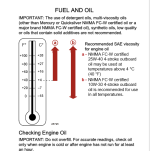
I was told long time ago by Rep that motors under 40HP don't need synthetic oil as the internal crankcase temps are high and oil thins out..paste from the operating manual
oil.PNG
 
That explanation is the opposite of why you use synthetics, regular oils thin out and cook at high temps.4strokeoil.jpgAmsoil is rated for Mercury and others and if you live in the U.S. your warranty is good even when you use off brand oils. I don't know why Mercury resists synthetic oils Amsoil is "just down the road" from them in Wisconsin.
 
Back
Top