Logo

1986 Cobra OMC Outdrive Shift Tool

kim1349

New member
Greetings,
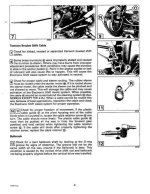
Ok, this may sound silly but I see a margin for error here. I am working on a lower unit that someone, definitely not me, has tweaked without knowing what they were doing. So I am adjusting the shift rod height with the tool. Should the base of the tool rest on the top of the housing or on top of the machined surface immediately around the rod hole entrance?
Thanks
Sparks
 
Ok. Thought so Jerry. Thanks for the reply. Another simple question. What's with the "special tool" then. If all it takes is the measurement from the top of the gear case to the top of the "fork", why can't a good steel ruler be used? But, maybe that's why I am having an issue with this 86 Cobra. We got it in and it had a badly corroded shift cable from the engine to the outdrive. It was rusted clean open. The owner also said it would shift into reverse but not forward. So we purchase a new cable. We then pulled the outdrive and replaced the cable screwing the brass fitting in the housing and tightening it to spec. We reassemble the outdrive and when we pull or push directly on the cable end from the outdrive in the engine compartment while turning the propeller shaft, it will still only go in reverse. So we pull the outdrive again and check the measurement on the shift shaft and adjust it to 7 13/64" and reassemble the unit. It still will not shift into forward. We can easily pull the "fork" up or down and make it shift. We checked and the plastic cable guide that the cable end attaches to is easily pulled by the cable and is going all the way into the housing so that the rotating lever that pushes the fork up and down is moving full travel. The plastic guide actually can be pulled by the cable so that it hits flush inside the housing so that's the maximum travel it can possibly have in that direction which lifts the rotating lever up pulling the fork up. (Am I saying this right, maybe it's going into forward and not reverse, can't remember at the moment, but it's the direction where the fork has to be lifted up.) Someone before us has definitely had the lower unit apart. We pulled the propeller shaft carrier out and dont' see anything obviously wrong. There was a bit of in and out play on the propeller shaft before we pulled it. Could this be it? Any ideas would be greatly appreciated.
Thanks
Sparks
 
All you need to set the lower shift cable and the bellcrank is a ruler and a triangle. Don't spend more than a dollar on them at the drug store school supplies section. When you have the bellcrank set, the cable should be sticking into the plastic thingy that attaches to the engine mounted bell crank pin. You have to cut the cable andfit it into this thing so that the set screws firmly attach it. The shift lever at the helm must be in neutral. This will gie you the correct neutral position for both the upper and lower cable. Unless there is a serious problem in the lower, this should correct any shifting issues.
All this is covered in the manual or you can dig it up on the hastings site.
 
Take a look at Number 12 on here. This was my issue except I couldn't shift into reverse. When I got the new one and ensured all of the other adjustments were accurate, my shifting is as slick as butter now.
Bellcrank.jpg
 
Kim, you can forego using the tool if you want to.
Here's a tried and proven alternate procedure for a Dog Clutch drive.


This is a copy/paste from an earlier response of mine regarding adjusting this lower cable. This works for both the Merc A drive and the Cobra drive.
This is geared towards the OMC Cobra drives, but the principle is very similar for the Merc A drives.


The OEM engineers had to choose an initial cable adjustment dimension for average Joe mechanic and average Joe user. Hence the initial adjustment "Tool".
This gets us close ONLY.... and perhaps may be subject to further adjustment.

The whole idea is to center the Dog Clutch "sliding sleeve" equally between the two driven gear Dog Teeth while in neutral. The pre-determined dimension (the tool) gets you close ONLY, since each scenario may be slightly different.

Here is my unorthodox method for a Dog Clutch drive, if you care to try it.
You can either begin with the suggested OEM dimension, or toss it out the window and begin from scratch.... your call:


1. With the drive fully down (to counter gravity against the sliding sleeve), have a helper swing the propeller back and forth (right and left) quickly, and in an even pattern and rhythm.

2. You will be at the engine with the lower shift cable disconnected at the linkage arm.

3. As you bring the cable towards a FWD gear engagement, note where you just begin to hear the "ratcheting" sound as the sliding sleeve contacts the FWD gear Dog Teeth.
Note where the cable is in it's travel, and find a way to mark it.

4. Now move the cable towards a REV gear engagement. The helper will still be swinging the prop back/forth.
Again, note where you just begin to hear the sliding sleeve contact the REV gear Dog Teeth.
Note once again where the cable is in it's travel, and find a way to mark it.

5. When you divide this travel equally, you will have located theoretical Neutral regarding where the sliding sleeve is in relationship to the two "driven" gears.
This is the goal..... "neutral".

6. Now connect your lower shift cable up to the rest of the linkage so that this "Neutral" travel adjustment is maintained.
The spring loaded cam arm will have maintained it's neutral position.

You may find that the new measurement is slightly different from that of the OEM (or Stuart Hastings dimension for the OMC Cobra drives).
None-the-less, the sliding sleeve will now be at center of travel while in Neutral on the splines of the propeller shaft.
Again, this is the goal!

7. Make your SI or ESA adjustments after first doing the above.


NOTE: this method works well if all is in good condition.
If you have a bad cable, bent shifting rod, or any other items that are not working correctly, it will prevent most any method from working as it could.


 
Back
Top