Logo

198?? 115 Johnson

bill_w

Advanced Contributor
Is there anywhere on the power head of this motor that would give the year? I've looked for freeze plugs/swage plugs with numbers, but couldn't find anything. This motor started out as a 1982, but the powerhead was swapped out. I was told it was an 89 powerhead, but from looking at parts diagrams, I don't think so.
thanks, Bill
 
OK...I get some tomorrow, and post them Monday. Its from Florida, I think, and a lot of the wiring wasn't the same, so things are joined /spliced to make it work.
 
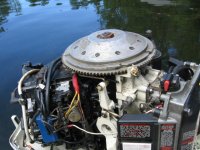
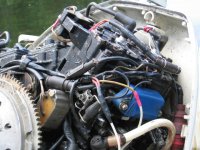
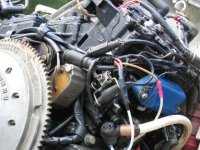
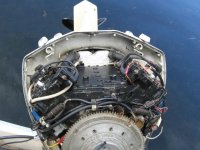
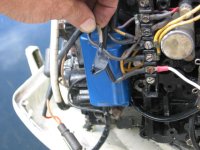
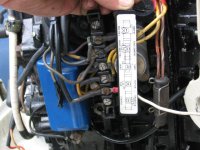
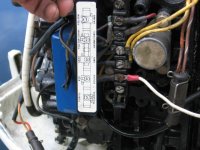
Ok, got pics...here they are: IMG_0536.JPGIMG_0537.JPGIMG_0538.JPGIMG_0539.JPGIMG_0540.JPGIMG_0541.JPGI've got a couple of more below. This engine is a total nightmare of wiring. Colours are mismatched, some componenets are not connected at all. I don't know how it runs. The large electrial component behind the flywheel is not present on the old powerhead, the lifting hook is there. I don't know what it is, but it obviously doesn't work.
 
Heres the last of the pics. IMG_0545.JPGIMG_0544.JPGIMG_0543.JPGIMG_0542.JPG I found out this weekend that it's not charging. The tach doesn't work either, but I understand that if its not charging, there's nothing to "feed" the tach. In one of the pics you can see a grey wire that was taped up, and just tucked away. None of the colour codes on the terminal strip match the actual wire colours. Now, instead of just trying to find out what year it is, I'm more concerned with trying to get it to charge the battery (working tach would be nice too). Could it be as simple as a blown rectifier? Not sure how to test, or even where to test on this mess. The white wire shown on the first three pics feeds the electric choke, thats about the only one I'm sure of. Where the hell do I start???
Bill
 
One rectifier (the round on the side) and two regulators (In block under/behind flywheel and one on port side top), no wonder it is messy!!
A black cylinder and crank case from late 80's? and a white intake from early 80??
Start by finding the two yellow cables coming from the stator under the flywheel. They should go the the connection rail on stb side where the rectifier is?
I guess the regulator in the block under/behind the flywheel is not connected, but just used to cover the opening in the block. The top clipper rectifier/regulator on stb side a mystery why it is there?
 
The white intake and carbs are original 1982 (or the intake is anyways). If the big black thing with all the epoxy or whatever sealant was in there melted out, and the wires cut off it is the regulator behind/under the flywheel, yeah its safe to say it doesn't work. The regulator/rectifier on the starboard side is a mystery to me too. I don't even know if it is connected to anything. I know that the stator was changed, but I don't know which one is in there. I have one in a box, and I think the trigger was changed too (not sure if thats the right word), thats in the same box. Again, don't know if its original 82 or from the new block. I was told that all of this work was done by a marine mechanic....starting to wonder where he went to school???
 
I would have thrown away both the rectifier (stb side) as it does not regulate and may lead to overcharging, and even the clipper regulator on top Port side.
Then installed a new regulator replacing the melted out one behind/under the flywheel.
 
Found out more today. The powerhead is an 89. The stator/trigger is from the 82. It was set up with the 89 electrical system, but started smoking, and had a meltdown. So, they put the 82 stuff back into it. I'm not an expert, or even a beginner at electrical work. I understand the basics, that the stator produces AC, which runs thru the rectifier/regulator to produce DC charge the battery. Since it runs, obviously the ignition system works. How do I get this mess of wires to charge the battery? Where do I start testing components?
 
If the engine has power trim, you need a regulator.
As mentioned above, replace the burned out unit behind/under the flywheel.
Go into 'engine parts' on top of the page, year 89 and you will find one. Throw away the rectifier and the other regulator.
 
Yes, it has trim/tilt. If it has been restored to the 82 electrics, and the regulator/rectifier behind the flywheel wasn't on the 82, how does that affect things? Or does that unit take the place of the other regulator(s) and rectifier?
 
Looked thru the parts listings. If its an 89, there is no rectifier. On the 88's, there is. The regulator is different also. So, if I run with a 89 regulator, I don't need the rectifier? Also, from what I see, its a 110 horse. The 120 looks totally different to me. OH, my head hurts. Anyone got a decent 150 Merc??
 
All engines with trim had regulator and not only the round rectifier. You only have one or the other, never both.
The early 80's had the one on your top port side, later they got water cooled and was put in top of the block behind/under the flywheel.
 
I'll see whats connected and whats not. All I want is it to run and charge the battery. Hmmmm....easy way. Hook up a solar trickle charger to the battery, throw every thing else away.:D
 
The round rectifier will burn out if used and the 'old' 82 regulator costs a lot more than the 89 regulator not to mention a solar set up with charger. It will be a 'plug and play' installation, except that you have to remove the flywheel to change.
 
The only question that might arise is if the regulator holds the AMP charge and the 89 will! Both 89 and earlier uses a 2 wire input from the stator, so that will not be a problem either. The 'old' regulator however will not hold the charging amp from a 89 stator, if that is to be used, and the round rectifier will blow anyway whatever stator is used intended for a TNT engine.
 
OK, I'm confused. The motor has the 82 stator in it. It has the 82 regulator. It has the 82 rectifier. After the 89 regulator melted down, all of the 82 parts were installed on the 89 powerhead. From what I've figured out, the 82 stator puts out about 6 amp, the 89 about 10 amp. I have the 89 stator, but don't know if its good. It has continuity. I can't measure amps, but I did measure ac volts. At fast idle, I'm getting about 30 vac, from the two yellow stator wires. No DC output. For the hell of it, I changed the round rectifier with one that I know is good. Still no DC output. Now, correct me if I'm wrong.(please!!!!) Two yellow stator wires, putting out AC volts. These go to the round rectifier, which is grounded to the block. One wire out of rectifier. This should be unregulated DC voltage. From here, it goes to the regulator to prevent overcharging the battery. Am I on the right track?
 
I said earlier - rectifier OR regulator, but not both.
Rectifier:
Yellow and Yellow/grey from stator to corresponding on rectifier - red to B+ on starter solenoid. (to connector strip and from strip to solenoid)
Regulator:
Yellow and yellow/gray from stator to corresponding on regulator. Red to B+.
Tach:
Grey in harness to yellow/grey on strip (from stator).
 
I understand..one or the other. But why did OMC put both on this motor? When the 89 reg melted down, all they did was reinstall the 82 parts. They didn't add the rect., just replaced it. When connected as you wrote, to the rect, I should have charging voltage at the terminal strip, red bat +, correct? I only get battery voltage, 12.3, not charging voltage. Is 30vac from the stator ok?
 
So, the tach works off AC? Pulses/rev = ac cycles/rev? With tach wired direct to yellow/grey from stator, nothing. Tach has battery voltage to it.
 
What happens if yellow and yellow/grey leads are reversed? If its putting out ac volts, does it matter?
 
Yes, tach works off the AC frequency, but Tach will not work if regulator or rectifier is defective.
If no charging, no tach.
 
Yup, got that. Looking at parts listing on here for 82..it shows rectifier used on all engines, regulator (not reg/rect as on 89) used on power TnT models only. Is there a way to test stator off motor. I have the 89 stator, it looks a bit blackend, but shows 1.3 ohms resistance. OR, can the 82 stator be used with the 89 reg/rectifier? Big difference in price between replacing the 82 vs the 89 units. In short, can I rip off whats there, replace the fried 89 reg/rect with a new one, and if still not charging (should, 82 stator on there shows 30 vac at idle), re-install the 89 stator?

Or, go back to the solar panel, and install a tiny tach? Or, look for a good 150hp? Found an 87 150 merc, on a 16' sidewinder for $1,000. Just don't need the sidewinder, that's what the 115 is on.

 
go to the CDI Electronics website and check out the installation and troubleshooting. Look at the powerpack part number and match it up with the stator
and rectifier /or rectifier .It would be ideal to get to the stator by removing the flywheel and cross referencing the stator part number.You have to many mix matched parts, and also would be able to check and see if it is melted or burnt. You will see dc voltage charge off the red wire at your starter switch but you also need a DVA adapter to your multimeter and compare it on the DVA Chart
 
Your charging system is no high-tech, as simple as a T-Ford.
Just some coils and magnets giving out a 2-phase AC.
Any regulator and rectifier able to handle the AMP will do.
The original rating for engines with TNT was 10Amp in 82 and in 89 9 AMP.
Replacement stators are normally rated 6/9 Amp.
The later introduce regulators needed at least 3 Amp to work properly and are rated 3-9 Amps.
For price reasons and simplicity I always replaced the 'old' systems with the 'in-block' water cooled rectifier and regulators and never had any problems, except that the old engines lost their lifting eye!
What kills them is running without battery cables and bad cooling creating an air pocket on top of the cylinder.
What most likely burned out yours was a missing connection between the red from regulator to battery B+ (starter solenoid).
You may even play around a lot with power packs as long as you watch out for rpm limiters, silicone plug leads and NGK 'R' plugs!!
 
I think I've got it figured out Haff. I'm ordering the new reg tomorrow, the 89 style. I wondered what the 3-9 stood for in the part no., now I know. I'll rip off all the old stuff, and go simple. One question though..if the old (82) stator is rated at 10 amps, will it kill the new reg. rated at only 9 amps? Maybe I'll wait to order it til I find out that answer. Whats up with the power packs..don't start me on something else..or are you telling me that they are interchangeable? Rpm limiters I get, silicone plugs wires definately, but whats wrong with NGK resistor plugs? I'm guessing thats what the 'R' stands for.

Yeah, from what I've been told, mine went up with a real show. He was running wide open, and could smell the smoke, so he stopped, pulled the cowl, and had flames. And pardon me for being dumb, but what is a DVA adapter? For that matter, what is DVA?
 
Stay with the 82 stator. The charge and ignition are two separate functions in the stator, and the 89 has a bit higher output than the 82 which may lead to blown power packs if used. Further the 89 used single power pack.
Change your spark plug wires, but stay with the original ones!!!! When getting old, they start leaking and sparks starts jumping where they should not jump!! The 'R' plugs builds up the voltage and increases the risk of having sparks jumping as well. If unlucky they blow the packs as well. If using NGK, use the standard ones without 'R'. DVA adapter makes it possible to read the max of an AC curve
 
OK..run with an 89 regulator, will order tomorrow. Stay with 82 stator. Stay with solid core wires (I will install new ones). No resistor plugs (will have to check, it may have them in there..previous owner changed them just before I took it). If R plugs in there, get rid of them. Take off old reg and rect., add to parts box. Question 1...since ignition works, is it safe to say stator is good? If I have to replace stator, whole motor is going in the parts box!!! I doubt if I'll have the new reg this week, so it may be a week before I find out if it works. I'll keep you posted. Question 2...Everyone and everything I've read says do NOT use automotive type wires...why not??? I've never gotten a reason, but I've never used them.

thanks for all your help,
Bill
 
Back
Top