Logo

Low Power

douglasronald

New member
I have a 2007 BF30D that has 2 problems. One problem is the overheat alarm. It sounds after about 5 minutes of running. If I turn off the motor for a few seconds and restart all is good for the rest of the time it's running. The telltale is strong, I have replaced the stat (the old one was plugged with salt crust) to no avail. This summer I ran with no stat and it worked fine. Any thoughts? The other problem is a lack of power. The motor starts easily, idles well and runs smoothly to red line. If there is more than 2 of us in the dinghy (a 12' AB RIB with smart tabs and a fin on the motor) it will not get up on plane. With 2 of us it runs at 20+ knots. Am I expecting too much from this boat/motor combo? The boat is rated for a max 30HP. I purchased the motor new and this has been an ongoing problem.

Thanks

Doug
 
Well, if I understand your post, you took out the old stat and the alarm didn't sound. But, when you replaced it with a new one, the alarm issue returned, correct? If that's the case, then that salt "crud" has probably really "choked" down the pathways that the water takes during warm up and hot water is being trapped up in the head (where the overtemp switch is) after the thermostat opens and is setting off the alarm. When you shut the engine down briefly, the water pressure from the pump subsides and allows that trapped, overheated water to drain away and cooler water is allowed to take it's place after the pump starts working again because the thermostat is still warm and open. Then the alarm stays off.

Stated a bit more simply, the passages need to be flushed. Not so easy on an outboard because of the open nature of the cooling system. I don't deal with salt issues so I haven't had to develop an effective flush procedure. But there should be a few guys here on the forum that should have some good suggestions as to how they go about it.

As far as your power complaint goes, I would think that outboard should be MORE than adequate to do the job on that RIB. I'm assuming that you don't have a tachometer since you didn't mention RPMs. If the motor isn't propped correctly for the load, she may just not be reaching the best RPMs for doing the work. I would suspect that you would need to see around 5500 + to push that baby with a full load. If it's not getting there, then it is more than likely a prop pitch/diameter thing. Sometimes experimentation with different props is the only way to achieve the goal but getting props to "play" with can be difficult and/or expensive. Sometimes shops will have some "loaners" on hand for you to try hoping you will buy a prop from them if you find one you like. It never hurts to ask. You should list your prop pitch and diameter here so that the guys on the forum can do some "cipherin" and try to help you come up with a solution.

 
Well, if I understand your post, you took out the old stat and the alarm didn't sound. But, when you replaced it with a new one, the alarm issue returned, correct? If that's the case, then that salt "crud" has probably really "choked" down the pathways that the water takes during warm up and hot water is being trapped up in the head (where the overtemp switch is) after the thermostat opens and is setting off the alarm. When you shut the engine down briefly, the water pressure from the pump subsides and allows that trapped, overheated water to drain away and cooler water is allowed to take it's place after the pump starts working again because the thermostat is still warm and open. Then the alarm stays off.

Stated a bit more simply, the passages need to be flushed. Not so easy on an outboard because of the open nature of the cooling system. I don't deal with salt issues so I haven't had to develop an effective flush procedure. But there should be a few guys here on the forum that should have some good suggestions as to how they go about it.

As far as your power complaint goes, I would think that outboard should be MORE than adequate to do the job on that RIB. I'm assuming that you don't have a tachometer since you didn't mention RPMs. If the motor isn't propped correctly for the load, she may just not be reaching the best RPMs for doing the work. I would suspect that you would need to see around 5500 + to push that baby with a full load. If it's not getting there, then it is more than likely a prop pitch/diameter thing. Sometimes experimentation with different props is the only way to achieve the goal but getting props to "play" with can be difficult and/or expensive. Sometimes shops will have some "loaners" on hand for you to try hoping you will buy a prop from them if you find one you like. It never hurts to ask. You should list your prop pitch and diameter here so that the guys on the forum can do some "cipherin" and try to help you come up with a solution.


Thanks for the reply jgmo, I agree with your idea that salt buildup is the problem. I use a product called "salt away" to flush the engine a couple times a year. I don't like running with no stat as I use the boat in cold water (British Columbia south coast) and worry about running cold at high revs. The boat has a tach and revs to "red line" with 2 people on board. I added a 1/2" of pitch to the prop to increase cruising speed - the boat rides better at 17 knots+. I think I'll take it to a different shop for service and see if they have any ideas.

Another thought I've had is the installation height. Where are the measurements taken from? Maybe the motor is too high or low for proper operation?

Doug
 
Ditto to what Jimmy says...

Your thought to go back to basics is good.

Motor antiventilation plate should be about even with the bottom of the boat. Generally, on inflatables, I try to put it a little higher (up to an inch). You do have the hydrofoil and smart tabs that should help overcome most planing issues. If you go too high, there will be cavitation.

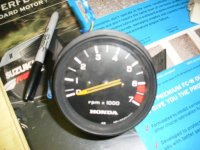
Also check to be sure that your tachometer is the correct tachometer and set correctly for that engine. I know of only one tach that has the Honda brand on it and has an actual "red line" area. That is a tach only for older 35 hp - 50 hp engines. And looks like this.

If this is what you have (it has no settings on the back), then it is not reading the rpms correctly.

Mike
 

Attachments

  • tach 002.jpg
    tach 002.jpg
    84.8 KB · Views: 64
Thanks Mike,

I'll look at the heights of things on the boat. By "red line" I meant that the motor spools up to close to 6 grand when trimmed out. The Tach and Trim gauge came with the motor from the dealer (who did the install).

Doug
 
That is good...just wanted to get the tach straight.

The other questions are....how big is that third person and where is that person in the boat?

....and what are your tach reading with the third person? That may be enough to need to change your prop to a slightly lower pitch.

One other item....not having rigged an AB....some of the inflatables do not have a lot of negative angle on the transom. I have had to use wedges between the engine and the boat to create more negative tilt.

Also...check the weight capacity of the boat to be sure that it is not overloaded.

Mike
 
Well, gee, strange, but, once again,....I find myself agreeing with Mike. Imagine that!

Yes douglasronald, it could just come down to load and/or trim angle. The height of the outboard is important so that you don't have any more "wetted" portion of the motor in the water than needed to prevent drag.

Another part of the equation is angle. If you are turning and burning with the engine, the boat will still tend to "wallow" if you can't tuck the prop up under the hull to push the nose down. This is stuff you probably already know and have considered but it never hurts to chew on the subject to see if something useful pops out.

And, lastly, load. When I first read your post, I saw "2 of us" and not the "more than. As Mike correctly points out, that 3rd body can make a huge difference in a 12' boat, no matter what the hull design. As the load increases, then distribution of equipment and crew weight becomes fairly critical. Three guys in a 12 footer sitting nose to tail, 3 in a row style, facing forward will have the hull planing much better than all three in a triangle huddled together toward the stern. Again, not rocket science but something to consider.
 
Back
Top