Logo

who Knows about Reversion?

stang32

Regular Contributor
i have a new engine with new manifolds, spacers and risers. i am getting water in the oil and i traced it to the exhaust. the manifolds are wet inside the jackets at the point where the maifolds bolt up to the heads. when i run the engine on a stand with just the risers, boots and elbows in place i am getting water. i ran the wngine yesterday with the boots and elbows removed and it appears there is water coming out of the large center exhoust port hole.

my understanding was that the just exhaust comes out of that hole and the water exits from the holes above and below that center hole. and they all combine in the boot/elbow and exit through the y pipe etc...
am i correct with that?

so if my understanding is right then there must be someplace inside the manifolds/spacers/riser area where there is water intrusion, does that sound right or is the exhaust operating as it should?

i know that due to the cam profile(standard Marine cam) the exhaust port is open momentarily on the downward stroke of the piston and it could suck water in if it is close enough on the manifold but i am trying to figure out if this issue is reversion or if ther is a problem in the exhaust, BTW, i did the acetone terst and it passed.

i feel like i am chasing ghosts with this engine and i am no closer to a resolution than i was 2 weeks ago.
 
................
i have a new engine with new manifolds, spacers and risers. i am getting water in the oil and i traced it to the exhaust. the manifolds are wet inside the jackets at the point where the maifolds bolt up to the heads. when i run the engine on a stand with just the risers, boots and elbows in place i am getting water. i ran the wngine yesterday with the boots and elbows removed and it appears there is water coming out of the large center exhoust port hole.

my understanding was that the just exhaust comes out of that hole and the water exits from the holes above and below that center hole. and they all combine in the boot/elbow and exit through the y pipe etc...
am i correct with that?
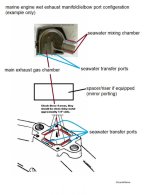
When these are good and working correctly, exhaust gasses ONLY will be within the main exhaust gas chambers.
The seawater will be captive within the cooling jackets, seawater transfer ports and up to the point of the mixing chamber..... of which will be down-stream of the elbow.
Once past the mixing chamber, the seawater and the exhaust gasses will have been joined.

marine wet exhaust system porting.jpg

so if my understanding is right then there must be someplace inside the manifolds/spacers/riser area where there is water intrusion, does that sound right or is the exhaust operating as it should?
Not if you are getting water near/in an exhaust port.

i know that due to the cam profile(standard Marine cam) the exhaust port is open momentarily on the downward stroke of the piston and it could suck water in if it is close enough on the manifold but i am trying to figure out if this issue is reversion or if ther is a problem in the exhaust,
There is a point at which each cylinder will create a negative exhaust gas flow due to the camshaft profile. This occurs as the piston begins it's next intake stroke, yet the exhaust valve is still slightly open some.
However, since the main chamber is shared with the other 3 cylinders, it is typically not an issue.

Watch this video.
Pause it at 1:30 and look at the exhaust valve position.
You will notice that it has not closed completely at the point whereby the intake stroke begins.
Both intake and exhaust valves are slightly open during this phase of the stroke.
This is the "over-lap"!


https://www.youtube.com/watch?v=OIcEnAYLFmY

The over-lap will be unfavorable if the camshaft is NOT indexed correctly!


BTW, i did the acetone terst and it passed.

i feel like i am chasing ghosts with this engine and i am no closer to a resolution than i was 2 weeks ago.
Understood.
 
Last edited:
Since the engine is still on a pallet, Pull the water hoses off the exhaust manifolds and run the engine letting the water run on the ground. If water is still coming out of the exhaust port on the elbow, You have a problem with your engine. If there is no water, you have a problem with the exhaust.
 
When you say new engine, is it new factory or built by a "builder"?

In Stag's other thread, he mentions:

THE engine was built by a rebuilder in maine who "BUILDS 30 5.7 sbc engines a week,

I followed that with a thought that 30 per week may increase the likelihood of a mistake having been made.
 
Slowly down and letting the boat SLOWLY settle back down off plane prevents water getting blasted up the exhaust system.


I'm stunned at how many people just chop the throttle and let the wake slam into the transom!

Jeff
 
Ummmm in his two videos he has NO exhaust tubing connected to the elbows....(the other thread)

My opinion reversion is not the issue.

And the "overlap" on that cam if the same as the OEM specs i posted in the other thread is also a NON issue.
Running at 23* btdc base timing could create that condition although dont quote me on that.

As i suggested a gasket issue or as Chris suggests readjust rockers and see if 8* at idle works better.

Worst case remove manifolds from enging and grab a set of car eaxhaust manifolds, install and test.
If water still getting in then its a engine only issue and not exhaust related.

You dont need water through a car manifold as you do with a marine.
The water is mostly to cool the rubber exhaust tubes connected to the elbows so the rubber doesnt melt. So for testing out of the water just supply water to engine as you are doing now and let it all simply flow out of the hoses that are no longer attached to the manifolds/elbows....
 
Since the engine is still on a pallet, Pull the water hoses off the exhaust manifolds and run the engine letting the water run on the ground. If water is still coming out of the exhaust port on the elbow, You have a problem with your engine. If there is no water, you have a problem with the exhaust.
so the hoses connected to the risers should stay connected but disconnect the hoses from the bottoms of the manifolds. also there is a 5/16 hose frm the block to the manifolds. i guess that should be removed as well.
 
so the hoses connected to the risers should stay connected but disconnect the hoses from the bottoms of the manifolds. also there is a 5/16 hose frm the block to the manifolds. i guess that should be removed as well.

In looking at your video, you do not have any hoses connected to your risers/spacers. I do see hoses connected to your Elbows.
What is not clearly visible, would be how you have the hoses connected to the manifolds.

I believe that Chris is suggesting to remove any hoses to the manifolds, risers/spacers and elbows.
In other words, he is suggesting that you run the engine for a short while with NO water going to the exhaust system.


.
 
Last edited:
so the hoses connected to the risers should stay connected but disconnect the hoses from the bottoms of the manifolds. also there is a 5/16 hose frm the block to the manifolds. i guess that should be removed as well.

What 5/16 hose from where to where???

The answer to your question is, yes.
remove all cold water supply hoses at manifolds/elbows and allow all water to flow out to floor.

you can run the engine like that but remember the manifolds and elbows will get HOT with no water flowing through them so watch how long you run it.


If you have water in the oil, how many times have you changed the oil and filter?

It can take 3+ oil filter changes between running to get all the water out...
 
so the hoses connected to the risers should stay connected but disconnect the hoses from the bottoms of the manifolds. also there is a 5/16 hose frm the block to the manifolds. i guess that should be removed as well.

Remove all hoses from the manifolds and the elbows and run the engine. The Iron will get hot but will not hurt anything...since you will get your results pretty quick.


Oppps I did not see that Jack Answered you already.
 
Interesting idea.


When I see these race boats with headers going up and over the transom (dry), I wish I could get away with that. Lots less problems.

Jeff
 
In Stag's other thread, he mentions:

THE engine was built by a rebuilder in maine who "BUILDS 30 5.7 sbc engines a week,

I followed that with a thought that 30 per week may increase the likelihood of a mistake having been made.

I've reengined two of my boats. Both times I did the whole long block/rebuilt off brand builder vs OEM factory new analysis. I never thought it was worth the price difference, if you amortize the cost over your expected ownership of the boat to buy anything but OEM factory new. The first time I bought a Chrysler marine LM318 @ 220HP (circa 1984), the second time a Mercruiser MIE5.7 (2007)...both with closed cooling systems. Well worth the extra dollars.
 
ok, so i put long bolts on the manifolds and pulled them about 4" away from the heads, i have the water running through the engine/manifolds using a garden hose without the engine running. the upper riser hoses and the engine block to manifold hose has been plugged. the manifold is being fed water through the lower hose on the manifolds. after running for several minutes i see water seeping from the 2 center exhaust ports on each manifold. i broke the manifolds down, removing the risers, then spacers, i can see a puddle in each of the center ports of the manifolds. the gaskets look fine, although they are destroyed now, they were not blown out, off set, cut, torn etc...
the manifolds are leaking from 1 of the 3 sections.. i am so tired of spending good money and getting garbage parts. now i have to take all the pieces to a machine shop and have them plane the decks, put them all back together with new gaskets and re-test them all over again.
i called my vendor and of course, he is giving me a hard time about returning them.
 
What 5/16 hose from where to where???

The answer to your question is, yes.
remove all cold water supply hoses at manifolds/elbows and allow all water to flow out to floor.

you can run the engine like that but remember the manifolds and elbows will get HOT with no water flowing through them so watch how long you run it.


If you have water in the oil, how many times have you changed the oil and filter?

It can take 3+ oil filter changes between running to get all the water out...

yhes Jack, i will be changing the oil in the next day or 2, i usually run 2 qts of diesel fuel in with three qts of oil at idle until warmed up then change the oil and filter at least 2 times, looking at the results each time.
 
ok, so i put long bolts on the manifolds and pulled them about 4" away from the heads, i have the water running through the engine/manifolds using a garden hose without the engine running. the upper riser hoses and the engine block to manifold hose has been plugged. the manifold is being fed water through the lower hose on the manifolds. after running for several minutes i see water seeping from the 2 center exhaust ports on each manifold. i broke the manifolds down, removing the risers, then spacers, i can see a puddle in each of the center ports of the manifolds. the gaskets look fine, although they are destroyed now, they were not blown out, off set, cut, torn etc...
the manifolds are leaking from 1 of the 3 sections.. i am so tired of spending good money and getting garbage parts. now i have to take all the pieces to a machine shop and have them plane the decks, put them all back together with new gaskets and re-test them all over again.
i called my vendor and of course, he is giving me a hard time about returning them.
What brand Iron did you buy?
 
My suggestion would be to take the manifolds, block off the surface the elbows/spacer mounts to.

use a 1/4 flat steel with 4 mounting holes. Make a good gasket to match 4 mounting holes only. Use RTV if you want and seal the manifold off.

You can either adapt air fitting thru the plate (drill and tap fopr air fitting) and block off bottom water inlet or adapt a hose to air fitting at the water inlet port at the bottom of the manifold. Connect air (30 PSI max) and see if you can hear/find the leak.


It common practice to pressure check manifolds and elbows this way.

For engine blocks fully assembled its better to use smoke.
 
.......................
ok, so i put long bolts on the manifolds and pulled them about 4" away from the heads, i have the water running through the engine/manifolds using a garden hose without the engine running. the upper riser hoses and the engine block to manifold hose has been plugged.
Stang, when I look at your video, I do not see any hoses going to the risers/spacers!

stang exhaust system.jpg

the manifold is being fed water through the lower hose on the manifolds. after running for several minutes i see water seeping from the 2 center exhaust ports on each manifold. i broke the manifolds down, removing the risers, then spacers, i can see a puddle in each of the center ports of the manifolds.
Did you drain these prior to breaking them down?

the gaskets look fine, although they are destroyed now, they were not blown out, off set, cut, torn etc...
the manifolds are leaking from 1 of the 3 sections.. i am so tired of spending good money and getting garbage parts. now i have to take all the pieces to a machine shop and have them plane the decks, put them all back together with new gaskets and re-test them all over again.
i called my vendor and of course, he is giving me a hard time about returning them.

Suggestion:
See if you can borrow a set of known-to-be-good manifolds for test purposes. This will be a part of your P of E.
 
ricardo, what you are calling an elbow, i have always known as a riser, if you search risers on the internet, that is what it comes up with. the block is called a spacer. the hose , as seen in the photo is connected to the Riser. the elbow is the section of pipe that turns downward and connects to the y pipe.


https://www.go2marine.com/product/82354F/manifold-riser-18-1976-1.html

https://www.ebay.com/p/Pair-of-Merc...-5-7l-350/27014188157?iid=142617772325&chn=ps


moving on, yes i drained the manifolds before breaking them down. , no i do not have access to a spare set.

yesterday i had a machine shop plane the surfaces true and flat. i reassembled them with quicksilver gaskets from merc. i have an endoscope i sent down the riser through the 3/8" plugged hole on top of the riser and i see the water entering through the outlet hole of the exhaust, the large center hole. this has to be normal operation. i can't see this being a problem, i hope im right about this.

please can anyone concur that there will always be a slight amount of water entering the manifolds when it is running due to the suck/blow action of the exhaust valves?


in the photos below yo ucan see the water track marks as well as the tiny puddle at hte bottom of the center 3 manifold ports.

https://photos.app.goo.gl/5KznTELpvtczCD9s9

photos 1& 2 show puddles or drops of water on the bottom of the manifolds,
3 & 5 show the trace of water coming from the top section
& 4 shows the bend of the riser from were it goes from verticle to horizontal.
both manifolds look like this.
is this SOP?


BTW, THESE ARE SIERRA MANIFOLDS
 
Sierra is Junk. So is GLM

If your engine is huffing water back in, you have a problem. Did you reset the rockers?

This is not my opinion.
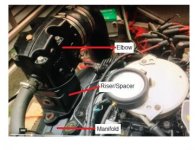
Names of exhaust parts...

Manifold: bolts to cylinder head.
Riser: The spacer used to raise the elbow to compensate for a deep riding boat hull.
Elbow: Its on top. Mixes water into the exhaust.
 
Since the engine is still on a pallet, Pull the water hoses off the exhaust manifolds and run the engine letting the water run on the ground. If water is still coming out of the exhaust port on the elbow, You have a problem with your engine. If there is no water, you have a problem with the exhaust.


HUH?

"If water is still coming out of the exhaust port on the elbow, You have a problem with your engine"
if the manifolds are disconnected from the engine, how would water coming out of the elbow be a problem with the engine?
 
....................
ricardo, what you are calling an elbow, i have always known as a riser, if you search risers on the internet, that is what it comes up with.
Yes, and it is a common misnomer. You will also see engines being called motors!
Trust me...... that center section is a riser/spacer, and the part above that area is an Elbow!

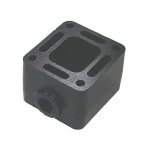
Marine exhaust elbow.
exaust elbow.jpg

This is also an elbow.
exaust elbow 2 .jpg

Marine exhaust spacer/riser.
exaust spacer riser.jpg

As per Chris:
Manifold: bolts to cylinder head.
Riser: The spacer used to raise the elbow to compensate for a deep riding boat hull.
Elbow: Its on top. Mixes water into the exhaust.

As per Jack (from your other thread):
what do you have for manifold to elbow gaskets?
What is connected to the elbows where the exhaust and water come OUT?
One thing to question, you have riser spacers??? WHY?

Like said..... it's a common misnomer!


moving on, yes i drained the manifolds before breaking them down. , no i do not have access to a spare set.

yesterday i had a machine shop plane the surfaces true and flat. i reassembled them with quicksilver gaskets from merc. i have an endoscope i sent down the riser through the 3/8" plugged hole on top of the riser and i see the water entering through the outlet hole of the exhaust, the large center hole. this has to be normal operation. i can't see this being a problem, i hope im right about this.

please can anyone concur that there will always be a slight amount of water entering the manifolds when it is running due to the suck/blow action of the exhaust valves?
At low speed, and if the cam lobe over-lap is excessive, it may be possible!


in the photos below yo ucan see the water track marks as well as the tiny puddle at hte bottom of the center 3 manifold ports.

https://photos.app.goo.gl/5KznTELpvtczCD9s9

photos 1& 2 show puddles or drops of water on the bottom of the manifolds,
3 & 5 show the trace of water coming from the top section
& 4 shows the bend of the riser from were it goes from verticle to horizontal.
both manifolds look like this.
is this SOP?
Suggestion:
If you have not already done this, contact your exhaust system supplier and show them these photos!


BTW, THESE ARE SIERRA MANIFOLDS
I highly doubt that Sierra would want a negative review being publicized.
Perhaps if they knew that your issue was being discussed on a large and popular boating forum, they may be inclined to authorize a replacement!
 
Last edited:
I read your post about water flow test of manifolds when extended off the engine. Sounds like a cracked manifold to me! Try the test suggested by kghost in post #19.

I've owned/operated an I/O Powered boat since 1964. When I look at the cost savings of aftermarket parts related to the expected life of the part and the total annual operating/ownership cost of a boat,
I never find them worthwhile. The same analysis applies to OEM factory crate engine repowers vs "independent" manufacturers.
 
Last edited:
HUH?

"If water is still coming out of the exhaust port on the elbow, You have a problem with your engine"
if the manifolds are disconnected from the engine, how would water coming out of the elbow be a problem with the engine?
Read it again...
I explained this before you did your test.

Since the engine is still on a pallet,

Pull the water hoses off the exhaust manifolds and run the engine letting the water run on the ground. (I didn't suggest that you unbolt the manifolds from the head.)

If water is still coming out of the exhaust port on the elbow, You have a problem with your engine.

If there is no water, you have a problem with the exhaust.
 
Last edited:
Stang your explanations are tough sometimes.

look at this picture. If your system is working the same please let us know.

Your pictures, to me anyway, are tough to decipher...

You are seeing water.........not sure why.

One other test would be to remove spacer and bolt elbow to manifold and retest...see if issue goes away, then spacer could be issue.

Oh and follow Chris's test..............ya should have done so early on...

With NO water supplied to exhaust manifolds and elbows and raw water still present problem is in engine. Head/intake Gasket, crack etc. Not cam/overlap issue as said.
If no water in engine after test problem in manifold or elbows or spacer.

Have you pulled valve covers off while running and if so was there any raw water present.
I have seen around the center head bolts, the head casting has cracked and water comes up out under the bolt. Usually due to over tightening or weak/thin castings.
 
Last edited:
guys, 1st off, i appreciate all the posts and your time trying to resolve this issue . that being said, i dont understand why what i am saying is so difficult to comprehend.
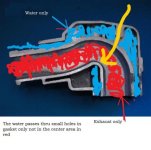
i sent an endoscope down the hole that is on the top of the riser. the hole that has a 1/4" NPT plug in it. i removed the plug and sent the scope down, that is where i got the photos. there is clearly a water trace from the top of the riser running down to the bottom of the manifold and the riser is very wet on top of the riser, where the manifold turns from vertical to horizontal. my depiction below shows the location wher the scope was inserted and the arrow points to were the waaster was seen on the photo i linked in the post above

elbow .jpg
this was done, after i oriiginally found water coming out of the exhaust ports on the manifolds when i pulled them away from the heads. when i saw the water, i broke them down, refurfaced the mating surfaces and re-installed the 3 sections with new merc gaskets. '
now, i have run the engine several times for over 20 minutes each time, i did this to circulate the oil with a qt of diesel fuel in it to clean out the water contaminant. i changed the oil 3 times. now the oil is clean and i scoped the risers and i foud water in that area as noted.
the water is not coming from the engine. the water is coming in from the manifolds being sucked in from the top were the exhaust gases meet the water.

after i ran the clean oil through the engine i pulled the valve covers to clean up the milky foam from under them. there is no fresh water in the valley's.


as for chris's test, i get it now, i think that is not necessary right now as i know the water is coming in from the top, not from the bottom(engine)

tomorrow i will disconnect the hoses (again) and run the engine with no water entering the manifolds. there is no need for this since there is no water coming into the manifolds, there wil be no water to drip to the bottom but ill see what tomorrow brings.
 
If you are getting water at the 90 degree turn of the elbow with NO exhaust hose connected at the exit/output of the elbow and exhaust is just flowing out unrestricted or diverted then based on your yellow arrow, that says the ELBOW has an issue and water is getting into the exhaust.

The only final check would be to pressure check the ELBOW.

Get some plumbers putty and seal off the water out of the ELBOW (blue), make an adapter for an air connection at the water in to the ELBOW. (water hose connection)
Seal off the mounting surface of the elbow.


Apply air pressure (30 psi max) and confirm leak into exhaust port.

I have to be honest, I didnt quite get the pictures. The removal of the pipe plug used to put in the scope, could have induce a small amount of water into the exhaust port...but I am not sure...
 
...........................
guys, 1st off, i appreciate all the posts and your time trying to resolve this issue . that being said, i dont understand why what i am saying is so difficult to comprehend.
Stang, not all of us are having difficulty understanding you.
I will say that since this appears to be unfamiliar territory for you, an occasional clarification may be asked for.
Take no offense!


i sent an endoscope down the hole that is on the top of the riser. the hole that has a 1/4" NPT plug in it. i removed the plug and sent the scope down, that is where i got the photos. there is clearly a water trace from the top of the riser running down to the bottom of the manifold and the riser is very wet on top of the riser, where the manifold turns from vertical to horizontal. my depiction below shows the location where the scope was inserted and the arrow points to were the water was seen on the photo i linked in the post above

View attachment 18863
this was done, after i oriiginally found water coming out of the exhaust ports on the manifolds when i pulled them away from the heads. when i saw the water, i broke them down, refurfaced the mating surfaces and re-installed the 3 sections with new merc gaskets. '
now, i have run the engine several times for over 20 minutes each time, i did this to circulate the oil with a qt of diesel fuel in it to clean out the water contaminant. i changed the oil 3 times. now the oil is clean and i scoped the risers and i foud water in that area as noted.
the water is not coming from the engine. the water is coming in from the manifolds being sucked in from the top were the exhaust gases meet the water.
If so, it may indicate that the cam is indexed incorrectly, and may explain why it runs better with the 22* BASE advance.

Stang, as said earlier, the tried and proven P of E will get you where you want to be.


after i ran the clean oil through the engine i pulled the valve covers to clean up the milky foam from under them. there is no fresh water in the valley's.


as for chris's test, i get it now, i think that is not necessary right now as i know the water is coming in from the top, not from the bottom(engine)
tomorrow i will disconnect the hoses (again) and run the engine with no water entering the manifolds. there is no need for this since there is no water coming into the manifolds, there wil be no water to drip to the bottom but ill see what tomorrow brings.
What Chris suggests can actually become part of your P of E.
When you do it, you will have either found the problem or will have eliminated the exhaust.


,
 
Last edited:
Back
Top