Logo

Water in Fuel - Clogged Vent Hose?

randomguy

New member
Hey all:

I've got a 2002 Tracker Targa that I've had for a few years. Periodically, I seem to have trouble with water in my fuel. I put a separator on it and try to be diligent about emptying it. But this past week we were out on the water on vacation and made a lot of wakes, just cruising, tubing, skiing, etc. and at one point, I was dead in the water. I got gas from multiple different locations and times, so I don't think I can blame it on the gas I'm buying. I had a long screw driver and managed to get the carb bowl drained enough that we got it back going once I got some clean gas pushed through the separator.

But a guy stopped and we were talking and he said that he bets my vent line is clogged, so condensation is gathering up in the tank with nowhere to go. There's a buikhead style vent fitting on the passenger side of the hull and then there's an access panel in the floor board that looks to be the other end of that hose, but I haven't taken it off yet. It may or may not have a clog in it. He suggested just hitting it with compressed air, but I really don't want to be pushing any potential clogs INTO my fuel tank. So I think I'm going to try to access it from the floor board and blow outward. Supposedly people say that they build a kink in that hose to avoid lake water coming into the tank, but I'm not sure that I understand how this would help. Eventually, if there's enough water, it's got to go somewhere.

Thoughts on whether I'm seeing condensation, lake water, or both? Thanks in advance!
 
i would make the bet....if the vent line was clogged you wouldn't have ran the engine for any period of time...and there couldn't have been any recurring condensation because a clogged vent = sealed tank...

The vent hose, for the fuel tank, should have a loop in it but it isn't essential...I prefer solutions where the water never enters the vent fitting bolted thru the hull.

Check the O-ring on the fuel tank filler port- could be dry rotted, crack, or missing...replace it with a high quality one if needed. You can get them at a good hardware store, plumbing supply house, or a hydraulic shop.

And, if needed, make sure you have the proper key for the filler (and use it) to keep it tight. A little silicone grease will keep it lubricated for many months.
 
i would make the bet....if the vent line was clogged you wouldn't have ran the engine for any period of time...and there couldn't have been any recurring condensation because a clogged vent = sealed tank...

The vent hose, for the fuel tank, should have a loop in it but it isn't essential...I prefer solutions where the water never enters the vent fitting bolted thru the hull.

Check the O-ring on the fuel tank filler port- could be dry rotted, crack, or missing...replace it with a high quality one if needed. You can get them at a good hardware store, plumbing supply house, or a hydraulic shop.

And, if needed, make sure you have the proper key for the filler (and use it) to keep it tight. A little silicone grease will keep it lubricated for many months.
Interesting idea on the filler cap seal. I’ll check that out. It’s not a locking cap, just snaps down as I recall.

I should have also mentioned that when I unscrewed the screen/cap on the vent line from the outside of the hull, it was clean, like, really clean. I really don’t expect to find a clog in that vent line.
 
If the cap's seal is intact and functioning, it is possible for water to get splashed onto the vent fitting (on the outside of the hull). if the engine is running, the water could be sucked into the fitting and wind up in your tank...so, next time you are out on the boat, have somebody else many the helm (if ncessary) and get a good look at what is happening at the vent fitting...if its getting wet, there are a couple option.

It would also be a good idea to see how the vent hose is routed, from the fitting down to the tank (phone cameras are great for this). If the hose has a constant downward slope to the tank and the vent fitting is getting frequent splashed, then rerouting the vent hose to get a loop would be prudent...
 
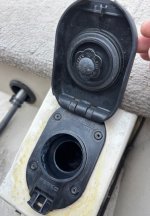
The seal on the fill cap looks good. I took off the surge plug and looked at the screen on the other side and it also looks clear. The lid snaps closed and feels like it’s compressing the seal nicely because there is no play in it. Hard to see water getting in here at the level that I’m seeing in the separator.
 

Attachments

  • IMG_0151.jpeg
    IMG_0151.jpeg
    137.2 KB · Views: 41
I recorded a video a few years ago when I had the deck all taken apart to solve some other unrelated issues. Here’s a screen shot of the tube coming onto a 90° elbow at the top of the tank. If there’s a bend in it, it’s obviously up inside the cowling that’s on the side of the hull, which I never took off. I think I’m gonna take the screen off of the hull side and then try to get this tube off that fitting and blow air from the inside out and see if anything comes out. But I don’t have a whole lot of faith that this is the smoking gun that I’m looking for.
 

Attachments

  • IMG_0153.jpeg
    IMG_0153.jpeg
    59.3 KB · Views: 32
The attachment should give you an idea of what good vent hose installs look like...you don't want a loop that creates a dip in the line.

My guess is that yours is a straight drop...
 

Attachments

  • vent hose orientation.pdf
    43 KB · Views: 54
The attachment should give you an idea of what good vent hose installs look like...you don't want a loop that creates a dip in the line.

My guess is that yours is a straight drop...
I took the cover off the floorboard in the center of the boat. There are two hose clamps on the hose and one of them is off to the side and not accessible through the hole. So there’s no way I’m going to be able to get access through the deck on the tank side and blow outward. So I opened the cap on the hull side and opened the filler tube. I blew air into there and had my wife hold her hand over the filler neck and make sure she fell air coming out which she did. So I do not believe that my vent is clogged. It appears that the plastic fitting has a 90° orientation and it is pointed downward on the side of the hull. Is there a possibility that water could splash upward and then make its way down the tube? Yes. But it would have to get through the vent screen, then travel at an upward angle two or 3 inches in order to get to the drain spot before it finds a downward path. I just don’t see that really being plausible. May have to see if I can find somebody that can plug the vent lines and pressurize the tank and see if there’s a leak.
 
water will go thru the vent screen readily...the screen is there to stop any flame front that may occur...it is also pretty good at keeping the mud wasps from finding a home.

"... It appears that the plastic fitting has a 90° orientation and it is pointed downward on the side of the hull..." - which fitting?

what are you referring to as "... the drain spot." ??
 
Hey man, thanks for keeping track of my posts and trying to help out. I appreciate it.

It looks to me like the hull wall bulkhead fitting is a basic “L” shape. There’s the flange that goes up against the inside wall of the hull and the male threaded portion sticks thru and the outer cap screws on. Then there’s the 90 degree angle that comes down and must have a hose barb type of shape where the tubing slips on with a hose clamp.

Seems like it sits probably at like a 30 degree angle to the horizon. So if you were a drop of water searching for gasoline, you’d have to get thru the screen cap, then travel uphill thru the fitting until you meet the drop off to go downward. This is the “drain spot” I was talking about.

Is it possible that water is coming in there? Sure. Anything is possible. I just have a hard time seeing it happen on the scale that I was seeing. The bowl on the bottom of the separator is semi clear. Once I got her running again and we were tooling around, there was a short period where I was watching the water level rise in the bottom in real time.
 
Back
Top