Logo

Volvo Penta 5.7 OSXi series pumping water into the boat!

GeoBW

New member
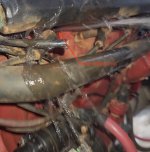
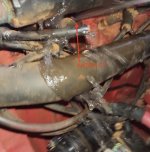
I'm pretty sure that my engine should not be pumping water from outside the boat to inside - it kinda defeats the concept of 'boat' - but that's what it's doing. Visibility is poor, but it's coming out of the STBD side of the water jacket on the STBD engine, above the starter motor, just above the line of the spark plugs. In fact, it's caused the starter motor to fail, which is how I discovered it.

Visibility is poor, can only remote view. See attached images. I would appreciate any insights into what is likely to have failed here, before I start pulling it apart?

I apologise if there is a thread on this (please direct me to it), but my searches have not shown a recent thread. Thanks in advance.
 

Attachments
  • Water leak 1.jpg
    Water leak 1.jpg
    520.2 KB · Views: 80
  • Water leak 2.jpg
    Water leak 2.jpg
    493.9 KB · Views: 78
Last edited:
Ayuh,.... What motor is it,..??..??
my 1st guess is, it was frozen, 'n busted the block,.....
 
I'm thinking exhaust manifold...the water is being sourced from a location above that shown in either pic...
 
Ayuh,.... What motor is it,..??..??
my 1st guess is, it was frozen, 'n busted the block,.....
No chance of that here in Australia 😄 think San Diego maybe ... It's a Volvo Penta 5.7 litre OSXi V8 - I think they're 350ci GM blocks.
 
I'm thinking exhaust manifold...the water is being sourced from a location above that shown in either pic...
Yes, it looks like it's leaking from around there. I presume the cooling water at some point runs into the exhaust as it obviously exits with it, I'm wondering if anyone has pulled one of these apart and can explain the design?
 
The manifold is cast iron with a water jacket...as is the elbow...there is a gssket between them that keeps the passages separate. Each also has drain plugs.

If the water isn't leaking from the drain plus or the gasket, it could be from the big exhaust bellows at the outlet of the elbow..

Otherwise something could be cracked..
 
From digging deeper, I'm wondering if the petcock has rusted out - it's in the right position - has anyone replaced this?
 
From digging deeper, I'm wondering if the petcock has rusted out - it's in the right position - has anyone replaced this?
Ayuh,....... yer pictures suck, it appears this leak is well above the drain cocks,.....
 
after taking another look at the pictures, it is very possible the pipe plug in the cylinder head is damaged or missing - I'd suspect missing.

Its also pretty obvious that this has been going on for a while...do yourself a favor and stop using the boat until you get it fixed...it will save you many headaches in the future...
 
after taking another look at the pictures, it is very possible the pipe plug in the cylinder head is damaged or missing - I'd suspect missing.

Its also pretty obvious that this has been going on for a while...do yourself a favor and stop using the boat until you get it fixed...it will save you many headaches in the future...
Aaah yes, don't worry boat has not been used since discovering this problem - it is not lost on me how serious it could get. And yes my research is suggesting the pipeplug in the head is the culprit. Can't find what this part looks like so I know what I'm replacing - do you have any images of one, part number/name or a link to replacing one?
 
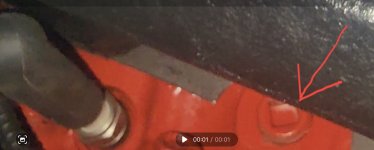
This is what it looks like on the Port engine - attached - does anyone know which tool removes this?
 

Attachments

  • Cylinder Head plug.jpg
    Cylinder Head plug.jpg
    902.8 KB · Views: 48
maybe the 3/8" extension....if that doesn't fit, there are square male bits of various sizes.

They are also made with hex sockets, for install and removal.

You aren't likely to find them at the VP parts counter...I would go to the local hardware store once you figure out the thread size (could be 3/8" NPT). Next choice would be the local machine shop...
 
maybe the 3/8" extension....if that doesn't fit, there are square male bits of various sizes.

They are also made with hex sockets, for install and removal.

You aren't likely to find them at the VP parts counter...I would go to the local hardware store once you figure out the thread size (could be 3/8" NPT). Next choice would be the local machine shop...
Yes, I meant I need to find the replacement water jacket drain plug - from which I'll be able to work out the exact tool to pull out the old one.
 
you may want to take your 'camera' and see if you can get a pic of the 'leak' to see what is left...its possible that there is no plug in the existing hole.

If there is a plug in the hole, it may have deteriorated and it won't come out easy due to the corrosion. you may have to run a tap thru it to clean up the threads.

It may be worth the gasket (and time) to remove the exhaust manifold from that side - it will make life easier to do the needed work.
 
my buddy called me back...he checked an older pair of SBC heads and said that port is 1/2" NPT threaded...
 
4.3 reman cyl head 1.JPG

this is a Chevrolet V6 head but it's basically the same, these are remans that came with these plugs but with a hex head.
 
you may want to take your 'camera' and see if you can get a pic of the 'leak' to see what is left...its possible that there is no plug in the existing hole.

If there is a plug in the hole, it may have deteriorated and it won't come out easy due to the corrosion. you may have to run a tap thru it to clean up the threads.

It may be worth the gasket (and time) to remove the exhaust manifold from that side - it will make life easier to do the needed work.
Yes, I was thinking I would remove the exhaust manifold to get better access after I get a clear shot of the leak with a camera while the engine is running - because I won't be able to do this obviously after I remove the manifold. Any idea how long it takes? What's involved with removing the manifold? I haven't done this before, but I have taken an exhaust manifold of cars so I imagine it's a similar principle.
 
I would take the picture of the hole with the engine off...no need to see the leak and no reason to pump more water over the starter and whatever else is in that area of the bilge..

If the plug just fell out, removing the manifold may not be necessary.. if it turns out it has to be removed, how long it will take depends on access and how many corroded fasteners you run onto..Easy access and the right tools, it shouldn't take an hour...corroded bolts and limited access could have you wishing the engine was pulled out..
 
With those fittings you have to be careful with the threads in the cyl head. If they are corroded then you may have to chase the threads with an appropriate size thread chaser. Since they are NPT threads you might need an NPT thread chaser set.
 
With those fittings you have to be careful with the threads in the cyl head. If they are corroded then you may have to chase the threads with an appropriate size thread chaser. Since they are NPT threads you might need an NPT thread chaser set.
Understood Louc
 
Have seen them cast iron rot out leaving the hole thru the middle
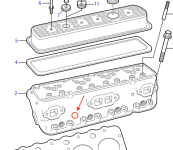
Aaah Thanks Bt Doctur! That's exactly what it looks like - see attached image where I've marked roughlly where it is - does that look right?

Do you normally need to remove the manifold for access to remove it? It looks like a 3/8 rachet drive would do it?

The other problem is that Volvo Penta Australia do not list the part - they sent me that image that does not show it - maybe because here in Oz we don't need to winterize our engines! Do you have any listing over there (I presume you're in the USA) for this part?

Help with these issues much appreciated.

With Thanks
 

Attachments

  • Cylinder Head.png
    Cylinder Head.png
    91.4 KB · Views: 42
FWIW, the cylinder head on the other bank likely is in the same condition...may be a big time saver to get a pair of replacement plugs
 
It’s odd that it would rot out, I had the original heads on my engine for approximately 15 years of salt water use and that didn’t happen. I’m not sure they even come out of a head used in salt water…due to corrosion…
 
"thin" cast plugs - the 4 or 6 point socket types are much more prone to being thin than the square or hex head types...
 
Back
Top