Logo

Volvo Penta 290A Overheating

triplesea

New member
Overheated out on the water and didn't want to risk running her hot so I got a tow back

Once back on land doing some troubleshooting I wasn't getting any suction. So I changed the impeller, that seemed to do the trick. But figured it was a good time to check elbows/manifolds so took those off, they looked solid so put back on with new gaskets. Took off all the hoses and didn't find any obstructions. Figured I was good to go as she was running cool while at idle on land.

Take boat back out..... overheats when up on plane. Sit idle and she will cool back down. So I cruise back in slowly and do some more reading/troubleshooting. I come to the conclusion it must be the hose connector/gasket(part Volvo Penta 832846-0) on outdrive(280). So I take that all apart and replace that part.

So I take her out once again thinking I should be good to go right? Wrong. I seem to be getting a good circulation of water as the elbows stay cool. But the valve covers are very hot and am getting steam from the starboard side valve cover. I'm guessing from the multiple overheats that the gaskets are now bad. Is that what is causing me to still overheat? Not sure where to go from here

fresh water cooled 290A
280 Outdrive
 
Overheated out on the water and didn't want to risk running her hot so I got a tow back

Once back on land doing some troubleshooting I wasn't getting any suction. So I changed the impeller, that seemed to do the trick. But figured it was a good time to check elbows/manifolds so took those off, they looked solid so put back on with new gaskets. Took off all the hoses and didn't find any obstructions. Figured I was good to go as she was running cool while at idle on land.

Take boat back out..... overheats when up on plane. Sit idle and she will cool back down. So I cruise back in slowly and do some more reading/troubleshooting. I come to the conclusion it must be the hose connector/gasket(part Volvo Penta 832846-0) on outdrive(280). So I take that all apart and replace that part.

So I take her out once again thinking I should be good to go right? Wrong. I seem to be getting a good circulation of water as the elbows stay cool. But the valve covers are very hot and am getting steam from the starboard side valve cover. I'm guessing from the multiple overheats that the gaskets are now bad. Is that what is causing me to still overheat? Not sure where to go from here

fresh water cooled 290A
280 Outdrive

re: fresh water cooled... as in has a heat exchanger???? IFSO, check level of antifreeze in the exchanger. You could have lost antifreeze when you overheated the first time. IF antifreeze not an issue, check compression on the engine.
 
re: fresh water cooled... as in has a heat exchanger???? IFSO, check level of antifreeze in the exchanger. You could have lost antifreeze when you overheated the first time. IF antifreeze not an issue, check compression on the engine.

Sorry meant raw water cooled. No heat exchanger
 
Re: "I seem to be getting a good circulation of water as the elbows stay cool.".... NO!

Water flow to the elbows is the excess water , by design, from the T'stat. AS most raw water cooled engines work, water flows ALL the time to the elbows. Raw water flows into the block and heads until they are full and then T'stat bypasses excess water to the elbows until the T'stat gets hot, then T'stat lets more raw water into the block (and some hot water out thru the elbows) until it cools...repeat.
 
Re: "I seem to be getting a good circulation of water as the elbows stay cool.".... NO!

Water flow to the elbows is the excess water , by design, from the T'stat. AS most raw water cooled engines work, water flows ALL the time to the elbows. Raw water flows into the block and heads until they are full and then T'stat bypasses excess water to the elbows until the T'stat gets hot, then T'stat lets more raw water into the block (and some hot water out thru the elbows) until it cools...repeat.

So sounds like I should replace the thermostat.
 
sandkicker said:
Water flow to the elbows is the excess water , by design, from the T'stat. AS most raw water cooled engines work, water flows ALL the time to the elbows. Raw water flows into the block and heads until they are full and then T'stat bypasses excess water to the elbows until the T'stat gets hot, then T'stat lets more raw water into the block (and some hot water out thru the elbows) until it cools...repeat.

So sounds like I should replace the thermostat.

You may have misunderstood.

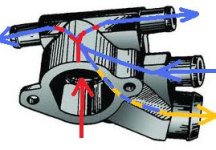
With the Raw Water Cooled GM V-8 engine, most seawater (river, lake or ocean water) by-passes engine cooling needs.
The actual thermostat does not cause the "by-pass". The T-Stat housing creates the by-pass via it's internal porting.
In other words, this seawater that is by-passing engine demands is a result of the path that the T-Stat housing provides.
(see image below)

On a "as required" basis, the thermostat then progressively opens allowing the necessary cooling of the engine.
The seawater that has removed engine heat now joins the by-passing seawater that is being directed to the exhaust system.


Example:

Blue arrow = incoming seawater from seawater pump
Yellow = seawater path to engine circulating pump (thermostat holds this back until temperature dictates)
Red = heated seawater that the thermostat allows to exit and re-enter the exhaust seawater
 

Attachments

  • RWC T Stat housing.jpg
    RWC T Stat housing.jpg
    14.4 KB · Views: 109
You may have misunderstood.

With the Raw Water Cooled GM V-8 engine, most seawater (river, lake or ocean water) by-passes engine cooling needs.
The actual thermostat does not cause the "by-pass". The T-Stat housing creates the by-pass via it's internal porting.
In other words, this seawater that is by-passing engine demands is a result of the path that the T-Stat housing provides.
(see image below)

On a "as required" basis, the thermostat then progressively opens allowing the necessary cooling of the engine.
The seawater that has removed engine heat now joins the by-passing seawater that is being directed to the exhaust system.


Example:

Blue arrow = incoming seawater from seawater pump
Yellow = seawater path to engine circulating pump (thermostat holds this back until temperature dictates)
Red = heated seawater that the thermostat allows to exit and re-enter the exhaust seawater

The yellow hose is also very warm to the touch.

So where should I from here?
 
The yellow hose is also very warm to the touch.

So where should I go from here?


Check list:

install a new seawater pump impeller. Make sure that the new impeller sits "proud" of the pump body by .010" or so.
inspect the seawater pump thrust surfaces...... (the cover surface and the opposite surface within the pump body)
make sure that the seawater pump impeller "cam" is good. (these are a wear item and should be routinely replaced)
replace the water neck fitting and the special beaded gasket.
examine the S hose.
check/clear the exhaust manifold-to-elbow seawater transfer ports. (these must be clear and free flowing)
look for any interior de-lamination of the exhaust system seawater supply hoses.
check the 90* fittings at the front of the exhaust manifolds.
look for rust build up at/in the T-stat housing outlets.
make sure that the suction hose is not leaking against vacuum at the chrome tube and/or at the pump connection.
perhaps remove the engine circulating pump and remove the rear cover. This will expose the metal impeller. If an automotive circ pump was used, the impeller may be bad.


.
 
Check list:

install a new seawater pump impeller. Make sure that the new impeller sits "proud" of the pump body by .010" or so.
inspect the seawater pump thrust surfaces...... (the cover surface and the opposite surface within the pump body)
make sure that the seawater pump impeller "cam" is good. (these are a wear item and should be routinely replaced)
replace the water neck fitting and the special beaded gasket.
examine the S hose.
check/clear the exhaust manifold-to-elbow seawater transfer ports. (these must be clear and free flowing)
look for any interior de-lamination of the exhaust system seawater supply hoses.
check the 90* fittings at the front of the exhaust manifolds.
look for rust build up at/in the T-stat housing outlets.
make sure that the suction hose is not leaking against vacuum at the chrome tube and/or at the pump connection.
perhaps remove the engine circulating pump and remove the rear cover. This will expose the metal impeller. If an automotive circ pump was used, the impeller may be bad.


.

Sounds like all of those have been checked off. Hrmmmmm.. maybe I'm just being over concerned since the first overheat. Will likely change the gaskets on the valve covers as seeing the steam was concerning. I've never felt them in the past so maybe the valve covers are supposed to be hot to the touch? And the yellow hose warm?
 
Should not see any steam from anywhere from an marine engine... sometimes in cool damp weather, some will come out the exhaust . When you say hot valve covers, how hot? With a raw water cooled engine, usually have a 140 degree t'stat and no part of the engine, except for the short stubs between the exhaust ports and the exhaust manifold should ever get hotter that the t'stat setting or too hot to keep your hand on.
 
Should not see any steam from anywhere from an marine engine... sometimes in cool damp weather, some will come out the exhaust . When you say hot valve covers, how hot? With a raw water cooled engine, usually have a 140 degree t'stat and no part of the engine, except for the short stubs between the exhaust ports and the exhaust manifold should ever get hotter that the t'stat setting or too hot to keep your hand on.
elbows/manifolds were cool to the touch. Valve cover was uncomfortable while touching, wouldn't leave my hand on for more than a few seconds, but I don't think it would have burned me. Like I said just uncomfortable.. Just bought a infrared temp gun so will be able to get a better idea of temps next time I take the boat out.
 
Last edited:
Your stamped steel valve covers receive hot splashed engine oil that has been pumped up through the push rods to the rocker arms.
They will usually feel hot to the touch.
 
Back
Top