Logo

Volvo PDS Bearing ?'s

boatboy97

New member
I am in the process of replacing the PDS bearings on my 290 DP drive. Prior to obtaining the new bearings I reviewed a lot of online forums related to their replacement. The general consensus for this was the I was going to need a 6007 and 6206 bearing along with a couple of new seals. I brought the old shaft and bearings to the bearing shop and told him that I needed a 6206 and a 6007 bearing, but he told me I was wrong. I ended up leaving there with a 32007 and 30206A (both are taper roller bearings). Please note that this is the same style that was originally installed.

Now that I am in the process of reassembling the PDS I have been doing some more research online and found that the taper roller bearings are usually not installed for this application. I see that there is only mention of using a radial contact bearing for this... but I did find an instance of someone else that looked up a volvo part # for their PDS bearings and found that taper roller bearings were used.
Here is the post related to that:
http://www.baylinerownersclub.org/index.php/forum/technical-discussion/54117-vp-dp-a-pds-bearings

My questions are:

If taper roller bearings were previously used, then wouldn't it be best to use them again.
What would be the advantage of used taper roller vs. radial contact.
When installing the bearings, there is a nut on the shaft which is used to pre-load the bearings. What should I torque this to?

Thanks
 
I am in the process of replacing the PDS bearings on my 290 DP drive. Prior to obtaining the new bearings I reviewed a lot of online forums related to their replacement. The general consensus for this was the I was going to need a 6007 and 6206 bearing along with a couple of new seals. I brought the old shaft and bearings to the bearing shop and told him that I needed a 6206 and a 6007 bearing, but he told me I was wrong. I ended up leaving there with a 32007 and 30206A (both are taper roller bearings). Please note that this is the same style that was originally installed.
I'm a bit confused here.

The above quote refers to your 290 DP drive, yet you say that you took the "old shaft and bearings to a bearing shop".... "thought you needed a 6007/6206"..... "were told that you were wrong"....... and "you left with tapered roller bearings"!

Just an FYI:
PDS (primary drive shaft) bearings are within your flywheel cover.... not within the out drive.

So my first questions are:
1....
are you replacing the out drive transmission main drive gear bearings???? (tapered roller bearings)
2.... or are you replacing PDS bearings??? (radial contact ball bearings)


The only tapered roller bearings that you'll have, will be in your 290 transmission at the main drive gear, of which would be a 30207 and a 31307. Tapered roller bearings are used in sets of two (not necessarily the same p/n), and require a pre-load against them.

Your double bearing PDS will require two caged ball bearings (aka radial contact bearings) and do not require a pre-load, per 'se.

*****************
My response the RMR1 (over at the BOC), was in reference to an AQ41A diesel engine and PDS.
If you have a gasoline AQ engine w/ the 290 drive, your PDS will likely be a double bearing unit (i.e., 6007 and 6206 bearings)

If your flywheel cover has a grease port on it at the 12:00 O'clock position, the PDS will be double bearing.
If it's been replaced with a later charcoal gray F/C and w/ no grease port, the PDS will be a single bearing.

****************

Whether you're asking about PDS bearings or main drive gear bearings........ the simplest thing for you to do, would be to remove them and take the two bearings in to be matched up.
These will be industry standard bearings, so most any good bearing supplier should have them.

Here are the hyperlinks that I used on the BOC site.
For the Gasoline engines.... go here ... and for the Diesel engines.... go here ..... and look up your components via engine model number


NOTE: if double bearing PDS, the engine must be removed in order to change these bearings.

Pull the side engine mount lag bolts, and do not change the height of the stud adjusting nuts (unless need be).
Separate the engine from the flywheel cover, leaving the flywheel cover attached to the transom shield, and you will not disturb the two large rubber cushion rings.


.
 
Last edited:
Rick,

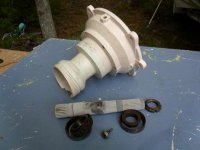
Thank you for the quick reply and sorry for any confusion that I created. Hopefully the attached picture will clear up things a bit.
SAM_0305.jpg

I am definitely replacing the PDS bearings. It is a double bearing type. I did exactly what you said and took the old bearings to the shop and had them match them up. (The old ones can be seen in the picture). They are tapered roller bearings. This engine configuration does not have a flywheel cover, but instead has the engine mounted in the center of the boat with a jack shaft connecting it to the transom assembly.

The engine is a TAMD41A diesel. (I realize now that I posted this in the gas engine forum by mistake in the late hour that I started this thread)

Seeing that the tapered roller bearings were removed that was what I now have and was planning to replace with. During reassembly of the shaft, there is a nut (see attached picture) that holds the smaller bearing in place. Knowing that tapered roller bearings need a pre-load, what should I torque that to? Tight, then back off a half turn?
 
Me in blue text.


Rick,
Thank you for the quick reply and sorry for any confusion that I created. Hopefully the attached picture will clear up things a bit.
View attachment 9358

That is what we call a "Borg Warner --- slash ---Volvo Penta PDS adapter housing". Very common during the early years.
If mates to a Borg Warner pattern flywheel cover using the Borg Warner drive coupler.
The standard I/O version will use the 6206 and 6007 bearings, same as the red 1 pc GM V-8 flywheel covers.

I am definitely replacing the PDS bearings.
I can now see that!

It is a double bearing type. I did exactly what you said and took the old bearings to the shop and had them match them up. (The old ones can be seen in the picture). They are tapered roller bearings.
Yes... agreed!

This engine configuration does not have a flywheel cover,
I'm sure that it does use a flywheel cover, but not a conventional I/O cover.


but instead has the engine mounted in the center of the boat with a jack shaft connecting it to the transom assembly.
OK.... this is what separates this engine arrangement from a conventional stern drive application... although from your stern drive back, it is conventional.
Had you mentioned that earlier, I'd have understood what you were talking about!


The engine is a TAMD41A diesel. (I realize now that I posted this in the gas engine forum by mistake in the late hour that I started this thread)

Seeing that the tapered roller bearings were removed that was what I now have and was planning to replace with. During reassembly of the shaft, there is a nut (see attached picture) that holds the smaller bearing in place. Knowing that tapered roller bearings need a pre-load, what should I torque that to? Tight, then back off a half turn?

The reason for what is actually a PDS "tapered roller bearing box" is due to the forward engine and jack shaft arrangement.
And yes.... you do need to load these bearings.

Torque at the nut is not your answer. Rolling torque is what you're after..... very similar to that of an auto/truck rear differential pinion gear.

During this year range, it was fairly common to see these values given in a spring scale measurement, rather than in inch pounds torque.
I can't tell you what that rolling torque value would be, but I'm sure that you can find it in your OEM Volvo Penta work shop service manual, along with the procedure.

Inch pounds torque is acquired via center rotational force, whereas spring scale uses a string line at a prescribed radius. The pull is then measured in pounds and/or fractions of pounds.
These do not cross over without extensive engineering calculations.


BTW... you'll probably be adjusting the rolling torque with oil only on the bearings. Not sure.... your manual will tell you.
Once set..... be sure to pre-fill the grease cavity before installing the seals.
Just as with the ball bearing set up..... apply grease until you see it exit the roller cage.
Now install the seals.

Glue or stake the FWD seal in place as to prevent future excessive grease force to push it out of position.
If we loose the FWD seal, no future grease will reach the AFT bearing.

AFT seal installs in the non-conventional direction as to not hydro lock. (we want this seal to leak pressure)

For future.... lube with the engine running.... dynamic -vs- static!


Back
Top