Logo

Timing Nightmare

Orion

New member
Not certain where to post this question.

We have a big block Chevy in an HTM 24. The harmonic balancer has no timing marks and the reference pointer is gone also. We have timing tape to mark the balancer but do not know how to determine where to put it on the balancer, nor do we know at what degree to set it. It has been modified. Any help will be greatly appreciated.
 
Last edited:
The best way to find #1 TDC is to get a "positive stop". Most not be a factory balancer; maybe aftermarket?

You can buy a "pointer" at any good auto parts store. Not too hard to improvise if one isn't readily available.

Once you find TDC with the stop, use the pointer to reference the tape. Most balancers have their key aligned (angularly) with the 'timing mark". I'd be inclined to etch the mark back into the balancer.

AS far as initial timing, 8-10 deg BTDC should allow it to idle. I'd adjust the timing based on full advance and live with the resultant initial value as long as it starts when at temperature.
 
Thanks Mark. The engine is a 502 + not a 454 as I stated earlier. Sorry.

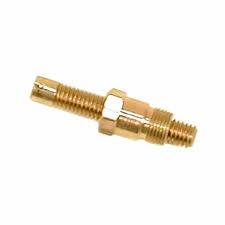
We drilled an old spark plug out and inserted the blank plug into #1. All others removed. Inserted a smooth 3/8" rod through number one plug until it touched the piston top. (Dome Pistons.) Had to hold it while we tried to determine TDC as the dome tended to move the rod to the side as it came up causing mild binding. Turned by hand until rod was out full. Moved it in and out to check several times. Engine started. Not running perfect at idle and still fouling plugs, but quite an improvement. No way to place a load until launching.

Thank you again Marc for your interest in my problem!
 
now you know why the positive stop was suggested. rotate crank until it stops. mark damper. rotate crank opposite direction until it stops. mark damper. TDC is in between the two marks. no "guessing" required. You can make one from an old plug & some 'spare' rod.
 
Orion, Yes..... Mark is exactly correct!

I'll say this in my words, as it may help further explain this:

Note that the Positive Piston Stop method requires the use of a crankshaft mounted degree wheel so that you can stop the piston travel from two (2) directions @ approx 30* BTDC (again, from either direction.... and it does not need to be 30* exactly)
images


Using a temporary wire pointer, adjust the pointer to show equal distance (in degrees) as you roll the crank from one direction to the other until it gently comes to rest against the piston stop!
(again, it need not be 30* exactly.... but somewhere in that range)
It may require several to many attempts.... no matter the level of experience.

Once this CW stop and CCW stop determined, the piston stop is then removed (without touching the degree wheel or pointer), then you roll the crankshaft over until the pointer aligns with ZERO.

There is your TDC as closely as you're going to get it!
As Mark suggests, you are basically splitting this!
Basically, it's finding an unknown value via two known values!
It's just geometry!

NOTE: You may want to look at your flywheel cover (aka bell housing in the auto world) to see if there is a timing port for use with a flywheel that has been marked off in degrees!
Some engines are ignition timed via the flywheel!

Don't forget that TAT is more critical than BASE.... if you were to fudge between the two.
 
Last edited:
Back
Top