Logo

Strange Problem With Vintage 65hp Evinrude

Recker81

New member
Hey guys, question regarding a 1973 65hp Evinrude Triumph. The engine starts and runs perfectly. Runs like a top at all rpm's. If I shut it off and restart it, it still works perfectly. The weird stuff happens when I shut it off once warm and let it sit for about 10+ min. After sitting for any period of time (10 min or more), it has a lot of trouble restarting. I don't think it's gas as the fuel bulb is still very hard during this. It just turns over and won't fire. If I choke it and turn the warm up lever all the way up, it usually will catch but it takes a while. Smokes a bit too ones it gets refired. Then runs perfectly again.

Again, all the problems start if I let it sit for several minutes after running.

Any ideas?

Thanks for any help!
Andy
 
On that model, there are three large black coils, spaced evenly, imbedded in the stator under the flywheel. This stator is the beginning of both the ignition and charging system.

Those large black coils provide AC voltage to the powerpack, needed to engage the ignition. Should any of those coils start to melt down, a AC voltage drop to the powerpack will exist which will result in weak, erratic, and eventually no ignition.

When this meltdown takes place, at first the stator may act normally when cold BUT when hot, the faulty ignition scenario creeps in. Of course in time, the stator fails completely.

Carefully inspect that stator visually. If there is a sticky looking substance dripping down on the powerhead, replace the stator. Should it come to this, when replacing the flywheel nut... that nut must be torqued to 105 foot pounds, otherwise the flywheel key will shear.
 
On that model, there are three large black coils, spaced evenly, imbedded in the stator under the flywheel. This stator is the beginning of both the ignition and charging system.

Those large black coils provide AC voltage to the powerpack, needed to engage the ignition. Should any of those coils start to melt down, a AC voltage drop to the powerpack will exist which will result in weak, erratic, and eventually no ignition.

When this meltdown takes place, at first the stator may act normally when cold BUT when hot, the faulty ignition scenario creeps in. Of course in time, the stator fails completely.

Carefully inspect that stator visually. If there is a sticky looking substance dripping down on the powerhead, replace the stator. Should it come to this, when replacing the flywheel nut... that nut must be torqued to 105 foot pounds, otherwise the flywheel key will shear.

Thank you!! So, do I need to remove the flywheel to inspect the stator?

Is this what the stator looks like?
http://www.regulatorrectifier.com/catalog/1973-1977-Johnson-Evinrude-Stator-3-cylinder-65HP-to-75HP
 
Has the choke been modified per the service bulletin dealing with such problems?
 

Attachments

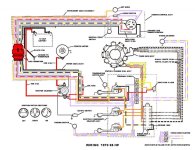
  • Wiring 1973 65hp.jpg
    Wiring 1973 65hp.jpg
    92.6 KB · Views: 304
Thank you!! So, do I need to remove the flywheel to inspect the stator? Also, do I need replace stator and rectifier or can I get away with just stator?

Usually, with a strong flashlight, one can inspect the stator simply by peering under the flywheel with a close inspection.

If the battery is being kept charged, then obviously the charging system and the rectifier has been working okay, and if so... there will be no need to replace the rectifier. If you have a tachometer and it has been functioning properly, that proves that the rectifier is okay due to the fact that the tachometer operates off of the engine's charging system.

Just in case, you want to test the rectifier...............................

(Small Rectifier Description & Location)
(J. Reeves)

On most 2,3,4,6 cylinder engines, the small rectifier is located on the starboard (right) side of the engine just in front of the engines electrical wiring strip. There are a few older V4 engines that have the wiring strip on the rear portion of the engine and the rectifier would be located just under that terminal strip. The smaller horsepower engines usually have the rectifier located on the starboard side of the powerhead close to the carburetor area.

The rectifier appears to be a round object approximately one inch (1") in diameter and also about one inch (1") high.

The base of it is sort of triangular in appearance and is attached to the engine with two (2) screws/bolts..... usually one screw/bolt is larger than the other. The rectifier, depending on which one your engine uses, will have either:

One Red wire, one Yellow wire, and one Yellow/Gray wire, or One Red wire, and two Yellow wires.

Note that either of the above rectifiers could have a fourth wire which would be Yellow/Blue

Thousands of parts in my remaining stock. Not able to list them all. Let me know what you need and I'll look it up for you. Visit my eBay auction at:

http://shop.ebay.com/Joe_OMC32/m.html?_dmd=1&_ipg=50&_sop=12&_rdc=1

********************
(Small Rectifier Test)
(J. Reeves)

Remove the rectifier wires from the terminal block. Using a ohm meter, connect the black lead of the ohm meter to the rectifier base (ground), then one by one, connect the red lead of the ohm meter to the yellow, yellow/gray, then the red wire (some rectifiers may also have a fourth yellow/blue wire. If so connect to that also). Now, reverse the ohm meter leads and check those same wires again. You should get a reading in one direction, and none at all in the other direction.

Now, connect the black lead of the ohm meter to the red wire. One by one, connect the red lead of the ohm meter to the yellow, yellow/gray, and if present, the yellow/blue wire. Then reverse the leads, checking the wires again. Once more, you should get a reading in one direction and none in the other.

Note that the reading obtained from the red rectifier wire will be lower then what is obtained from the other wires.

Any deviation from the "Reading", "No Reading" as above indicates a faulty rectifier. Note that a rectifier will not tolerate reverse polarity. Simply touching the battery with the cables in the reverse order or hooking up a battery charger backwards will blow the diodes in the rectifier assy immediately.

Thousands of parts in my remaining stock. Not able to list them all. Let me know what you need and I'll look it up for you. Visit my eBay auction at:


http://shop.ebay.com/Joe_OMC32/m.html?_dmd=1&_ipg=50&_sop=12&_rdc=1

 
Did the problem come on slowly over a period of time, or did it happen over winter storage? Maybe it happened after a water pump, or overheating issue.
 
Did the problem come on slowly over a period of time, or did it happen over winter storage? Maybe it happened after a water pump, or overheating issue.

It started happening suddenly but seems to be getting worse (harder to start) each time I have it out and run it around for a bit. The last time I ran it around, it took about 3 minutes of cranking it and choking, unchoking, to get it going again. Once it's on and I give it gas, it runs perfectly again. It's just getting it restarted once warm that is a pain in the a**.
 
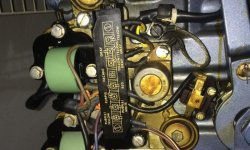
Thanks for this tip. The weird thing with mine (see pic) is that it looks like the purple/yellowwire is in a blank spot instead of in #8 where it is supposed to be. That diagram says to move the purple/yellow up to #7 with the puple white but it looks like purple/white is in #8?
Choke.jpg
 
Just for information.
I have the same exact engine. My stator melted as Joe described.
Replacement was fairly straight forward. I changed my rectifier at the same time due to corroded wiring.
I have not done the choke mod pictured above. Should I?
I had similar restarting issues like you for a couple of years. They all went away after a starter rebuild.
 
I have to lean towards a stator problem too. It will only get worse. Do a continuity test cold, then again when heated up, the readings should move well outside recommended parameters. Even your cold test will be outside I would guess. By choking it and trying to start it, that helps cool down the motor a bit faster, thus bringing some spark back at low RPM's.......enough to fire it up. CDI makes a great stator. Order through this site. Good luck. Tim
 
Back
Top