Logo

Starter Solenoid Check

Klink

Regular Contributor
I was doing the Joe Reeves Maximum Spark Advance technique on my 1993 Johnson 25hp, and before I could double check the completed timing adjustment, the starter stopped working. It looked like it was the solenoid, so I did the test on it. Here is the page for the Solenoid test from the manual for my 1993 Johnson 25hp:

Solenoid Test 25hp Johnson.jpg

I did the tests and got infinity, 0.L for test #1, and for test #2 the solenoid clicked and the reading was infinity 0.L. I got the same for two other old solenoids that came with a spare 115hp engine I bought 2 years.

I bench tested for continuity on the two small studs and got continuity. I tested for continuity on the two large studs, the battery and starter lugs, with the two small lugs hooked up to battery, and the ohmmeter hooked up to the large lugs, and the solenoid clicked and I got continuity at the large lugs. Again, all three solenoids gave the same results.

With the ignition switch key off, I took the battery cable end that normally hooks up to the solenoid, and touched it to the short cable that goes to the starter and the starter turned over.

It looks like the starter is OK, however, are all three solenoids bad? On test #2, if I'm reading the manual correctly (it says: "If the ohmmeter reading is a high reading, replace the solenoid"), the result of 0.L, infinity, on all three says that the solenoids are all no good and must be replaced?

Any advice would be welcomed.
 
Last edited:
Why are you checking the timing on this motor ?-----------The only way that timing goes out of spec is when the key shears or someone tampers with the factory settings.
 
Why are you checking the timing on this motor ?-----------The only way that timing goes out of spec is when the key shears or someone tampers with the factory settings.

I was doing the Synch and Link described in the manual, and then it goes on the Maximum Spark Advance instructions, which call for using a test wheel in a tank, which I don't have, so I did the Joe Reeves Maximum Spark Advance Method. Before I did it, I noticed that the timing adjustment screw was about 3/8" from touching anything at full throttle in forward gear. The specs call for 30 degrees, so to do the JR method I have to set it to 26 and had to screw in the timing screw as far as it will go to get the 26 degrees. If I screw it back out, it is doing nothing and I think the timing in the Joe Reeves method will be around 30. Right now I had set it at 26, but have not run the engine because I don't have a good solenoid ( I think). I thought it was odd that I had to set the timing screw all the way in to get near the 26. It was running great as it was. Should I just move it away again to the way it was?
 
Last edited:
on the solenoid problem....put the original back in and wire everything back to normal...make sure your control arm is in neutral...turn the key to start...do you hear the solenoid pick?if not jiggle the control arm to make sure it is seated in neutral while turning the key to start.f it is still not picking hook the negative lead of the meter to a good ground with no paint on it on the motor....hook the positive to the pick of the solenoid...turn the key to start and you should have 12volts...at that point 12volts should feed between the 2 big wires(now shorted) on the solenoid to the starter..get nack to us with the results..

you may have an inline fuse in the wiring harness under the cowl...
 
Meanwhile, I have an observation.

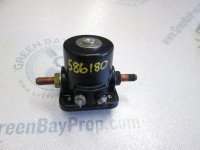
The OEM 0586180 selenoid that came off the engine has an all plastic exterior like this (also the spare solenoid that came from the 115hp has the same part number and also is identically all plastic). They are made in the USA:

Selenoid 0560180.jpg

Now, the new OEM part 0586180, looks like this in many links from OEM dealers:

Selenoid 0560180 with metal top.jpg

The change is the metal top on the newer version. That metal top looks like a grounding plate that it did not have before. Does anyone know why the change? That metal top if not mounted with protection will touch the engine. Is it a ground plate? This part number 0586180 is used in a ton of Johnson and Evinrudes, I know it is the OEM part for my 25hp and my 115hp.

P.S.- the two aftermarket substitutes offered by Marineengine.com , from Sierra and Arco, also have the metal top. I suspect the new OEM 0586180 and the aftermarket equivalents are no longer made in USA, I hope they are not all coming from China.
 
Last edited:
The second I question a solenoid I just buy a new one and replace it. Even if you mickey-mouse it with something at a local auto-parts store, it will eliminate any question until you can get the factory matched part (be aware of the difference in grounding and make changes to accommodate).
 
I found the solenoid test that Joe Reeves recommended in another thread, and realized that it was the same test #2 that from my manual, see page above. I realized that the manual was not as clear as Joe Reeves and I had done it wrong the first time, as I needed to hook up the ohmmeter to the two large solenoid terminals. I did it and all three solenoids passed. Here are Joe Reeves instructions with my notes/additions in parenthesis:

"all wires/cables disconnected.... solenoid being bench tested. Set up a ohm meter so that connecting the meter leads together obtains a full reading (both ohmmeter leads connected together should have no resistance, should be 0.00 ohms resistance). Connect ohm meter leads to the large solenoid terminals (to solenoid battery and starter motor terminals). Connect battery jumper wires to the small 3/8" nut terminals. If solenoid clicks in hard and the ohm meter gives a full reading (same as if they were connected together), the solenoid is okay". END

TEST RESULT for all three solenoids (two OMC 0586180, one Unipoint SNLS-135M) were the same, the ohmmeter connected to itself varied from 0.00 to 0.05 ohms according to how they were connected together, when hooked them up to big terminals on the solenoid and tested the result was the same in all three 0.07-0.09 ohms. So it looks like they all pass. I installed the Unipoint solenoid because it clicked the hardest and loudest and it looks new.

I went ahead and double checked the Joe Reeves Maximum spark advance and left it at 27 ( the specs call for 30 +-1), which should be fine, as it was at over 30 when I started adjusting it.
 
Last edited:
The Unpoint SNLS-135M looks identical in every detail to the aftermarket Sierra 18-5808, likely Unipoint makes the part for Sierra. Unipoint is from Taiwan, and I've had good experience with Taiwan made parts, however, Unipoint now has a plant in China. I hope mine was not made in China. Anyhow it was free, and is easy to replace.

END OF STORY. Thanks for your help everybody.
 
End of story NOT!

Turned the engine on with the flusher and it turned on with the same hesitation then started. I was trying to install a Tiny Tach and it was not working right, so I had to turn the engine off and on like 12 times (the battery is still at 12.54 volts). Then it did the same thing again, it just clicks and does not start. This time I assumed the solenoid is not the problem and tried something from kimcrwbr1 from this link: http://www.marineengine.com/boat-fo...-Testing-1973-65-HP-Evinrude-Starter-Solenoid :

"Some other things you can try is just hook the jumper cable from the battery neg directly to the engine ground and see if it starts, if so the neg circuit is faulty somewhere."

I did that, and the motor started at a touch of the key switch. I will replace all the battery cables (they were #8, and I always thought they were thin, it is like an 11' run at least.)
 
I went to replace all the battery cables and found that that cables are composed of two parts, the duplex black cable from the engine is an OMC cable, they go to the Battery Disconnect Switch, and the red and black cables from the battery to the Battery Disconnect Switch which are marine size 8 AWG and 7’ long each. I connected the jumper cable to the negative black connection at the Battery Disconnect Switch, and the motor started right up. So, I assume the problem was not from there to the engine. The cables from OMC appear bigger that the AWG 8. I will buy AWG 4 cables with battery terminals (which should make a more solid connection than the lugs on the old battery cables.)

Meanwhile I'll use the rope start and keep fishing.
 
P.S.- the two aftermarket substitutes offered by Marineengine.com , from Sierra and Arco, also have the metal top. I suspect the new OEM 0586180 and the aftermarket equivalents are no longer made in USA, I hope they are not all coming from China.

The OEM part from BRP arrived last night, Made in China! That's only the second part I've bought from BRP that was made in China, bad news.
 
Back
Top