Logo

Sparks and Stuff....

willow

Regular Contributor
Evening gents,:eek:

I was on a long cruise this summer, had a fellow in a 27 foot Rinker following me and normally he docked right behind me. He mentioned many times that when I started the stbd engine it seemed to be a real sluggish crank. The engine always started but I had to admit it did seem like a slower crank. Anyhow, the summer passed and the boat is on the hard....I had my mechanical guy come on-board and he put his magic meters on the wiring from the battery to the starter and advised me that I was drawing just over 300 amps when I cranked the engine and suggested a rebuild on the starter. The battery, according to the mechanic, is OK.

I have no idea what a start on the engine should draw as far as amps go so am looking for confirmation that a rebuild of the starter sounds like the proper course of action.

The engine is a 350 cubic inch Crusader, circa 1991 and has never had anything done to it...runs beautifully.

Thanks for your time.:)
 
Don,
I would take it to your local rebuilder and have him look it over and he can tell you pretty quickly if it needs replacing. If he is like the guy we have in town up here he probably won't charge you to test it.
 
Thank you...yup, a couple of bolts a couple of wires and it is off. Will take it to the fellow that is the expert in this small town ...let him test it first.
 
Don, this day and age, I'd not spend one dime on an OEM starter motor over-haul.
But let me clarify that.

Being a 1991, you are right in the range where we began to see the OEM starter motors become HTGR/MPGR motors (I.E., High Torque Gear Reduction...... aka Permanent Magnet Gear Reduction).

If you now have a HTGR/PMGR motor, then an over-haul may be prudent.

However, if your starter motors are the Delco non gear reduction, I'd toss them in the recycle bin. These are not worth the cost of an over-haul, IMO.

Instead, find the correct OEM replacement in a HTGR/MPGR and don't look back.

The armatures on these turns at approximated 3 X's the speed of the old school armature.
With the gear reduction, these generate more torque against the flywheel ring gear.
While the armature is undergoing less work load, but at a much higher RPM, the result is a faster cranking speed.

Some claims state that the cranking Amperage is less also.

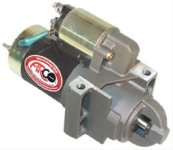
Whether you have the InBoard flywheel cover mount starter motors.........
(shown here in a HTGR/PMGR)
images


or the conventional GM engine mount starter motors........
(also shown here in a HTGR/PMGR)

Starter-Motors-marine-191162_image.jpg

starter-motor.jpg

............. either is availabe in a HTGR/PMGR style.

With these, you should see faster cranking speeds, and a somewhat lower Amp draw.


.
 
Thanks Rick...I'll wait until I get the test results and also find out what kind of starter I have.
 
Thanks Rick...I'll wait until I get the test results and also find out what kind of starter I have.
Don, are these engine block mounted, or are these flywheel cover mounted?

What is the tooth count of your flywheel ring gear?
We'll see two sizes for the GM engines; 153 tooth (straight across bolt pattern), and we'll see 168 tooth (staggered bolt pattern).

The engine block mounted motors will generally be in the range of $80 to $110 or so. All new everything!
Compare this to the cost of an over-haul.


The Inboard flywheel cover mounted motors will cost a bit more.
The HTGR units are easily identifiable by the smaller armature housing.
The inboard motors will look similar to this one but may have only two mounting holes as shown with this GM Borg Warner flywheel cover.
140.jpg
images

If the armature and the pinion shaft are on the same axis, they be using a planetary reduction system like the one above.
Some of these use a nylon outer ring gear... but you can find an all steel system.


If the armature and the pinion shaft are off-set (like this one), they be using an all steel reduction system.
140.jpg
 
Hi Rick,

Mine are block mounted and look like this one.
Starter-Motors-marine-191162_image.jpg

This weekend is Canadian Thanksgiving so I won't have any results of the test for about a week or so. I will come back and let you know what I did though.....

"Tooth pattern"??? Ya got me there Rick..I don't have a clue...at this time.:confused:
 
Hi Rick,

1..... Mine are block mounted and look like this one.
View attachment 5643

This weekend is Canadian Thanksgiving so I won't have any results of the test for about a week or so. I will come back and let you know what I did though.....

2..... "Tooth pattern"??? Ya got me there Rick..I don't have a clue...at this time.:confused:


1... Ok, that one is the staggered bolt pattern, and would indicate the 168 tooth ring gear... or IOW, the larger flywheel.


2.... Not tooth pattern, Don.........., this would the starter motor bolt pattern.
The motor shown is what we call the "staggered" pattern. The other motor is the straight across pattern (153 tooth flywheel).


NOTE: if you do replace these with the HTGR, but sure to get the new bolts with them... or at least check the length of your bolts against the nose housing.
Not all nose housings are the same today, and if the wrong bolts are used, they may bottom out prior to clamping the nose housing to the engine block.
Then we start snapping bolts off and need to pull an engine to properly extract the bolt fragment.
Not fun!


.
 
OK Rick......first my apologies.... I believe my starter goes on the bell housing

My starter looks like the one in your photos but the bolts that attach it to the motor are horizontal to the deck, one on either side of the main starter body.

The photo below was taken when we had to replace a motor, is the back end and the red arrow shows where the starter would be.

350.jpg


Sorry for the mix up:(
 
That's OK. At least we now know what to look for.
What you have are inboard style starter motors that rear mount to your Borg Warner pattern flywheel covers.

One will be for standard LH rotation, and one will be for Reverse RH rotation.

It's quite common to see the old Prestolite or _____ Non-Reduction starter motors being used in these applications.
If so, this is the style that I would not recommend over-hauling when the other types are available today.

I think that if you want the HTGR motor, it's going to look similar to this one.


.
 
Last edited:
Back
Top