Logo

Reverse gear needle bearing....Direction sensitive?

cjbrill715

Regular Contributor
I'm reassembling a lower unit on an 84 evinrude. The reverse gear has a needle bearing assembly that rides on the machined surface on the back of the gear, and is sandwiched by a precision plate and bearing carrier. I lost track of which way it was oriented when it came out, but I believe it'll work either way....am I correct?...or is there a hidden danger in doing this?
 
There is no orientation, but good idea to think about it as it's always turning the same direction.
 
Needle bearing assemblies are usually a pressed fit. One end is rounded, the other end is flat.

The pressure needed to install it is to be applied to the flat portion.
 
I believe the question is about the thin , needle thrust bearing on the back of reverse gear.-----A loose item and not pressed in at all.
 
I believe the question is about the thin , needle thrust bearing on the back of reverse gear.-----A loose item and not pressed in at all.

Correct...it is this one....Does it work properly in both directions?...i can't see why not, but I don't want to assume.
 
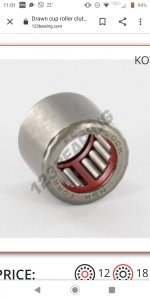
Right, helical gears used in these transmissions still provide substantial forces away from each other. This thrust bearing has to be in mint shape....as well as both surfaces that it rides on. If clearance is excessive between the pinion gear and it's driven gears....then it's not going to lead to good results. Joe is thinking the std. needle bearing (I often call a "Torrington"). Why? It's kinda like all snowmobiles being called a "Ski Doo". Torrington has been a leader in needle bearing technology for years and years....still a US company. Here is what I call a "Torrington" bearing. Picked up the term from my years of auto trany work.
 

Attachments

  • Screenshot_20210102-110102.jpg
    Screenshot_20210102-110102.jpg
    103.2 KB · Views: 47
Last edited:
These " shell type " needle bearings are typically pushed on the strongest end ( numbered ) into a housing.-----Heating the housing ( boiling water ) makes installation easier.
 
Good trick, Racer. Regards to Joe too. My manual transmission work exposed me to "free" needle bearings, often used in countergears/shafts.....in other words there is no "cage". The inner race being the shaft....and the outer race being the countergear assembly. Have you seen that setup on outboards? Maybe wrist pin needles? How about the rod bearings on that "Speedifour"? I'm thinking turn down the crank, bore a tiny hair off rods....and add larger needles? We can get them almost any size, eh? Like to get it running again....hang it on my old Lone Star. Think I could get anyone to pay attention? Ha! Probably throw me in jail.
 
Last edited:
There are lots of examples of loose needle bearings with no cage on outboard motors -----Pinion bearings on 1960's 40 HP and V-6 OMC outboards.----Crank journal bearings on 10 HP in the 1950's.----Crank journal on the 5.5 / 6 HP from 1961 to today.----Reverse gear bearing on Electramatics from the 1960's .------And on an on.----Lawnboy power mowers and others 2 strokes too.
 
Right, helical gears used in these transmissions still provide substantial forces away from each other. This thrust bearing has to be in mint shape....as well as both surfaces that it rides on. If clearance is excessive between the pinion gear and it's driven gears....then it's not going to lead to good results. Joe is thinking the std. needle bearing (I often call a "Torrington"). Why? It's kinda like all snowmobiles being called a "Ski Doo". Torrington has been a leader in needle bearing technology for years and years....still a US company. Here is what I call a "Torrington" bearing. Picked up the term from my years of auto trany work.

Correct Tim... Yesterday was not a good day for me and I didn't read the post properly which was about a gear "Thrust Bearing", not a Needle Bearing as we think of needle bearings. No problems on the author's part... My goof.
 
Back
Top