Logo

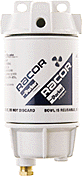
Racor Water Seperator

jake1234

New member
Hi all. I'm hoping someone can give their input on this. I'm looking to buy a Racor water separating fuel filter as a gift. I found a couple at west marine that must be on clearance or something due to their really low price. They have the Racor 110A (35 GPH max flow) and the 490R2 (90 GPH max flow). It would be going on a late 70's 33' (I think) Carver with two Crusader 350's. Would the 110A suffice on this boat or would the 490R2 be a better option? Thanks all.
 
I don't think either is a good choice for your inboard gas. Plastic bowls, and/or limited water capacity. How about a Racor S3220UL based design?
 
I have the Parker-RACOR system (twin gas 5.7L engines), and I can't say enough good about them. They bailed me out of a fuel tank issue years ago..... and I've been promoting their use since then.
Great product!

The standard so called marine filters rely on the water absorption of the element.
The RACOR true water separating type, uses an entirely different principle.


NOTE: RACOR does offer a standard type cartridge (looks like all others)...... you will want to type with the bowl.
gas_fltr05.gif


However, fuel flow capacity is important, and that the correct unit be used, as well as the Micron Media that you want.
Go to the RACOR application chart, and select the correct unit for your engine.
This link may direct you.

The plastic bowls cannot be used in an I/O or I/B gasoline engine scenario where the filter would be mounted in the engine bay..... O/B's yes!
A plastic bowl in a gasline engine bay may get you a nice fat citation from the CG.

For this, we must use the RACOR metal bowl (aluminum) with the bronze drain plug shown above. Otherwise, the principle in which they function, is the same.

I believe that all gasoline bowls interchange, and I know that they can be purchased separately. Since the correct I/O - I/B bowls are aluminum, they can be prone to internal corrosion, so keep an eye on them periodically.
(I have removed them that have been almost eaten through..... however, this is rare, and is likely due to salt water in the fuel!)


Also.... FYI, the RACOR cartridges can be retro-fit to an existing filter base, saving some cost and installation time. You must know the thread size/pitch in order to purchase the correct cartridge(s).
gas_fltr07.gif


NOTE: Sierra now offers this same filter system under the Sierra name. Likewise with GLM, and I believe Mallory. Depending on your vendor, one may be less expensive than the other.


Install the RACOR system, and you will never know what problems they will have saved you from.

And no..... I don't work for Parker-RACOR! I'm just a happy end user! :D

.
 
Thanks for the info, I didn't realize you couldn't use one with a plastic bowl on an I/B. The current fuel filters on this boat are inside a metal canister like this
cru97889steelbowl.jpg

and as far as I can tell, the retro-fit filters won't work in place of that, they screw on differently.
 
That is true. You will want the entire RACOR kit then.
Or.... check out the Sierra, GLM or Mallory. Pretty sure that these are the exact same system w/ different name.


With the new RACOR, those older OEM filters could be eliminated.
 
Jake1234 - that's what I did a few months ago. Installed the Racor S3220UL and eliminated the canister filter you have pictured. I made up a new flex line on each side and joined it to the hard line where the original filter was located.

If don't already have, and are thinking about flo-scans, now would be the time to install them and re-work all the fuel lines at the same time.


Bob
 
I tried searching for the S3220UL and it comes up as a replacement filter cartridge. Is there a different model number for the full kit?
 
Jake, the company that you are buying this through, should be willing to help you with the correct p/n's. Are you having trouble with this?

Meanwhile; since you do not have the correct base mount, you'll need either the complete RACOR kit, or the standard Sierra base (a bit cheaper), and then add the RACOR cartridge and bowl....... cartridge being of the correct thread size.

(some created their own thread size so that their OEM cartridge became proprietary)

Fortunately, many simply use the "M/C - Sierra" thread size.
Either way, the RACOR functions properly.

It's only when we retro-fit (using an existing base) that the "cartridge" number becomes an issue.

Yes, the S3220UL is a cartridge number, and apparently fits the OEM Mercruiser base...... of which (I believe) is synonymous with the Std Sierra base threads.

Example:
Racor B32020 MAM Spin-On Fuel Filter
Product ID: PR1416 MFG ID: B32020 MAM
Racor B32020 MAM spin-on gas filter maximum flow rate 60 gph, Fits 11/16"-16 Mercruiser mounting heads. S3220UL 10 micron Aquabloc media with collection metal bowl. MerCruiser inboard or outboard applications. Replaces Quicksilver #C-35-60494-1.

It will look like this (no base unit)...... The Sierra base is very common.
pr1416_L.jpg
.........................
images


I think I mentioned this, but all RACOR bottom cartridge threads are same....... top threads vary depending on the base mount.

Again....., determine the GPH and Micron media that you want (60 gph should be adequate).


Here is a cartridge and an O/B Plastic bowl being used on a Sierra or _____ base mount.
(example only)
racor_fuel_filter_1.jpg


.
 
Jake; there are 3 variants in this same style of filter. They vary by their compatibility with 3 different heads. There is a "OMC", "Mercury", and "Racor" style head, each taking their own different filter, doing exactly the same job. The S3220UL is the "Mercury" style filter, made to work with Merc OEM heads. Also, there is a filter head sold by West Marine that is cast stainless (a 30 year solution) that fits the S3220UL. The rest of the stuff is usually power coated aluminum, good for 10 years in my boat (lots of salt exposure). If you have a reasonably dry mounting area, maybe just get the Racor total system. To further complicate matters, the metal bowl and filter element each have their own part nos., each available seperately.
 
Yeah, and that too! :D
images

Just kidding you, Dave! I think we were both posting at about the same time!


BTW Jake, ........ he'll want a filter for each engine!
Not sure if you were doing that, or purchasing one filter only!

.
 
Last edited:
yes, Rick. You are correct on the simul-type! For extra credit bonus points: How do you remove the metal bowl for reuse from an old element??
 
........... For extra credit bonus points: How do you remove the metal bowl for reuse from an old element??
Dave, do we get double points for trick questions? I could use some bonus points! :D

The metal bowl removes just as the plastic bowl removes. Fact is, they too are interchangeable.
Do you have one that is stuck?
If so, you may try dunking it in very hot water.
It should expand it enough to break it loose.
You can use two oil filter removal tools.... one reversed from the other.
Blast it with air when done.

Use a little petroleum grease on the O-ring nex time.... although that doesn't always prevent this.
 
Seems like every time I try to reuse the metal drain bowl, I have to reach for special tools. I've found them very prone to developing very high release torques! Anyway, last two times I've done this in the field (Bahamas dock), a chain wrench on the element (it gets tossed anyway) and an adjustable stuffing box wrench on the metal bowl. My wrench has a little notch near the end that the bowl cast-in rib sits into real nice. Anyway, word to the wise, the removal torque is going to be much higher than the install torque!! And, if you have to do this in a far away place, come prepared.
 
I couldn't agree more! I removed mine about a week after installing it to grease the o-ring and I couldn't get the thing apart. I was so glad I was at the dock. The other word of caution is have some extra o-rings on hand. They swell up from the gas and if it pops out of the groove, you're not going to get it back in. That's exactly what happened to me and in an instant it was about an 1" too big.

I'm going to order the racor tool and some extra o-rings soon.
 
o-ring kits = racor #22313; fits their popular gasoline elements with the drain bowl. used to keep a pair on board.

When I had the elements with the metal bowls, the gent down a couple slips had a custom 'racor wrench' he made out of some alumin plate. Nothing more than a hole with 'slots' cut to match the ribs. Very slick and very efficient when used with a strap wrench.

I opted to go cheap and simple a while back. Started using pff5510 (?) elements. Same benefits with the aquablock media but no bottom bowl issues. Only drawback is draining them is a major pain if you happen to get a lot of water in the fuel tank.
 
An important note regarding the RACOR system....... these centrifugally separate water from fuel.
To my knowledge, the others (standard filters) are not capable of this.
 
In the interest of "full disclosure" on the Racor elements. Look at this little movie: http://www.youtube.com/watch?v=F_P7A3-i5nw

He is showing how successful the "Aquabloc" elements are at removing water from oil (in this case). And, I believe it. You should also know, that when the Racor filter bowl is completely filled with water, additional water WILL PASS THRU the filter into your engine. It is important both to adequately size the filter, and to monitor it often enough to prevent a problem. I had a serious gas tank issue years ago, and thru this episode had plenty of water to pass completely thru my filter system, into the carbs. yes, I had a double engine failure within 30 seconds of each other, drawing from the same tank, and using independant pickups and racors. As I recall, the S3220UL and metal bowl is good for about 1 full cup of water, before the system "bypasses".
The last item is internal rusting. Even the almighty Racors will rust internally when subjected to much water. It's pretty much bare steel inside. If you have a serious water injestion issue, the element should be replaced.
 
Dave, I fully agree..... when any filter becomes fully saturated, it stops functioning. Doesn't matter if RACOR or one of the Standard type filters.
I believe that any steel cartridge is subject to eventual rust at the interior.
Checking/Changing filters should be considered routine maintenance.

If we have an excessive amount of water in our fuel, we best start looking for points of entry.
I.E., deck fill fitting O-rings, vent fittings not being set up correctly, etc.... or possibly the fuel supply source.

A tip that most may already be aware of:
It can be pretty easy to forget when the cartridge was last replaced.
Take a permanent marker and date code/engine hour code the cartridge when installing new.
 
Thanks for the info, I didn't realize you couldn't use one with a plastic bowl on an I/B. The current fuel filters on this boat are inside a metal canister like this
cru97889steelbowl.jpg

and as far as I can tell, the retro-fit filters won't work in place of that, they screw on differently.


Hello Mates - I have question related to this style filter. If I install new larger Racors upstream of these original filters do I need to remove these copmletely or can we just remove the filters and reinstall the empty canister.
454's in a ocean 33 and the engine room is TIGHT.

Thanks and sorry about hijacking the thread.
 
well, you have to at least remove the filter element. I was going to do that and just leave the empty canister but they do rust so I just eliminated it completely. One less point of failure especially since I would have a reason to look at it with no filter inside. I would spend the 1-2 hours and just get rid of it all together.

Bob
 
Jake1234, I had these filters on my 454CIDs for the first few years of their lives. I don't recal water ever being a problem in my fuel. One day I arrived at the boat and before starting the engine, I opened the engine bilge to find gasoline all in the bottom of the boat. What a lump arose in my throat. The source was a hole in the bottom of this filter. After I rid the boat of the gasoline, I checked the other engine to find corrosion in its bottom. The final filter was on the generator. It was in the same condition. I changed all filters out and got away from this filter.

Chuck Hanson
 
well, you have to at least remove the filter element. I was going to do that and just leave the empty canister but they do rust so I just eliminated it completely. One less point of failure especially since I would have a reason to look at it with no filter inside. I would spend the 1-2 hours and just get rid of it all together.
Bob
Ditto Bob on that one!

I'm not sure if Chuck is talking about the RACOR aluminum bowls leaking, but if so....., any of these filters and/or filter bowls are prone to leaking if enough water were to remain in them and for any substantial duration.
As with anything, the key is routine maintenance.

.
 
Sorry for the ambiguity. I was replying to the message of 01-13-11 at
1:00 p.m. with the photo of a filter canister. This appears to be
the same that I replaced. It came as original equipment on my 1984 Crusaders.
The canister was steel, not aluminum. It wasn't Racor. I don’t
remember the brand. If I still have the spare on the boat I will look the
next time I go to the marina. My point should have been; I would replace
the filter in its entirety; canister, element and all.


Chuck Hanson
 
Back
Top