I did check with Crusader for a bobtail but the salesman
couldn't tell me the type piston they use. Got the "they are run at the factory before sale and have a good warranty" speech.
Not uncommon!
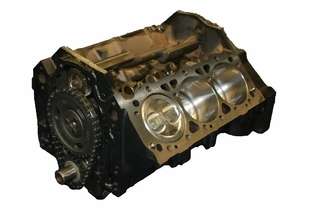
We can look at most any advertised Marine SBC engine, and we'll see that they'll list Hypereutectic pistons (example only), but will say ZERO about the piston profile.
This is a result of either NOT knowing the differences, or a result of NOT wanting to advertise the Full Dished pistons. 
I'm going to check with Michigan motors for the SBC with custom pistons.
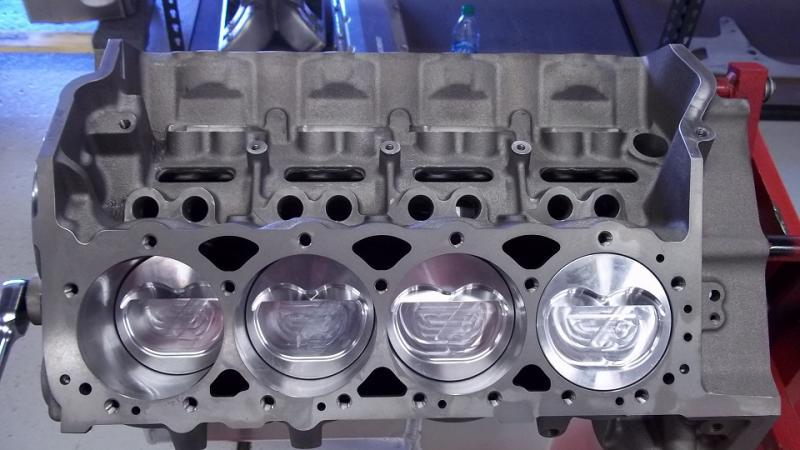
When a quench build is done, these aren't necessarily "custom" pistons.
(see ** below)
They're simply a different style piston that is extremely common among a majority of SBC enthusiast.
I guess they will know the right combination of heads and gaskets.
Yes, and you may want to speak with Phil Abejean about this since there are several approaches regarding the different cylinder head selections.
The single valve relief F/T pistons w/ 76cc chambers is only one approach.
When we use the 64cc chambers (such as the Vortec cylinder heads), a different piston profile is used (LCQ piston for example).
But here's another question. The Crusaders have been around for ages. I've seen them with over 2000 hours on them. From what I've read they all have the dished pistons in them.
True! Same with Merc, Volvo Penta and the others when the GM base engine is used.
If I go with a stock Crusader how do I avoid the piston problems?
The piston itself wont be problematic. These are good and strong pistons.
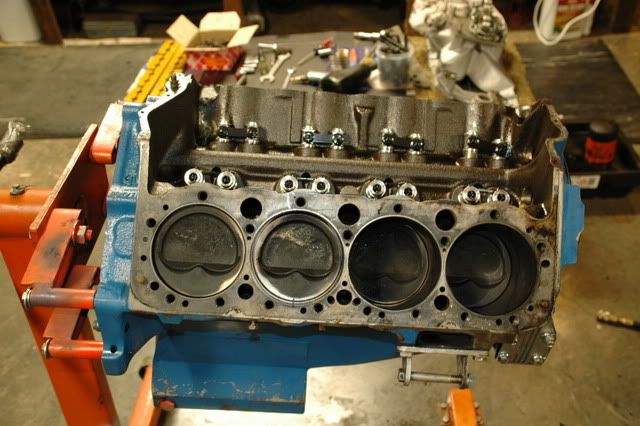
It's the full dished profile, and what this does to the combustion chamber dynamics, that is the problem.
Do I follow the factory recommend timing?
For a non-quench build..... Yes! These are typically very conservative numbers.
For a quench build..... NO! We can become a bit more aggressive.
I'm just a pleasure boater and take it pretty easy.
Same with me, but I custom built my SBC engines incorporating a Q/E into the build.
As I've said, this is not a Hot Rod nor Racing build..... it's a build that better suits our Marine Loads.
Whatcha' think Rick?
Not much that I can say here without being terribly redundant, and I've already over-stepped my boundaries. The guys are probably getting tired of hearing this!
These SBC engines that are built using the GM style piston do fair well. No real concerns here. The C/R is rather conservative, and the ignition timing (the TA portion) is held back in order to combat detonation potential.
(Pre-Ignition and Detonation are two entirely different phenomena)
These non-quench built SBC's will last for years and years when taken care of.
The quench style piston simply removes a portion of the dish from underneath the flat surface that is off to the side of the cylinder "wedge" style combustion chamber. With a good tight quench, there's no place for the a portion of the flame front to hide.
Instead, the gasses becomes squished and forced into the flame front.
This results in a much more full "burn", and detonation potential is greatly reduced.
Ignition TA can now become a bit more aggressive.
With a more aggressive TA, we now place the LPCP closer to the desired 12* to 14* ATDC, where better torque is made.
C/R can remain the same, or it can be raised a point, helping performance even more so.
I believe that I mentioned earlier that GM designed the full dished piston in the 70's for emissions control purposes. It worked well for the SBC automotive engine during this era. It's cheap to produce, one piston p/n fits all 8 bores, etc, etc.
** The irony of this is..... that we've become so acustomed to seeing the full dished piston used in the SBC, that we think of this build as being the "norm" or "standard". When a different piston profile is used, we tend to think of this as a "custom" build.
Prior to the 70's (I don't recall the exact year) the full dished piston was not used in the SBC.
The quench build can be a "hard sell" simply because GM has shoved the full dished piston down our throats for so many years. Many Re-Builders tend to follow suit!
You can bet that the GM Bean Counters had a "say-so" in the continued use of this piston, and that the GM Engineers had very little to say about it.
I'll go so far as to say that no engineer (who is worth his salt) would recommend this piston for Marine use.
As for longevity, there should be no difference between a Quench Build and a Non-Quench Build.
However, if we were to undergo detonation with the Full Dished piston SBC, we can expect a shorter life.
And just to clear and fair..... we can still detonate a quench built SBC if not careful with F/A ratio, ignition timing and/or with sustained excessive lower RPM loads.
As said, no other major changes to the build are necessary, and the assembly requires very little additional time, if any at all.
A few calculations, a phone call to their piston supplier, piston-to-rod fit requires more attention, a few additional checks, and they can move forward just as they would otherwise.
Ya see...... I warned you that this would be redundant!
If it were me, I'd have no decision to make, as it would be a Hands-Down decision towards a quench build!
Either engine will work just fine.
.