Logo

Piston Pitting

jmm4jmc

New member
Hi all,
My first post, so here goes.
I'm in the middle of repowering my boat, I bought a used engine that had about 80hrs on it and it sat in storage for about two years.

The engine specs are: 350 chevy, bored to 391, 202 iron heads with roller rockers. Edlebrock performer rpm cam and intake. And a closed cooling system.

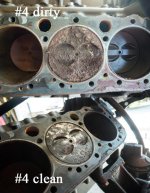
I brought the engine home and started to check compression, engine would not turn over, almost like the pistons were froze. I managed to take a screw driver and move the flywheel back and forth a bit then all started moving freely. So I started checking compression, some cylinders went straight to 170 and some wouldn't budge past 30, but after a couple hours of checking all cylinders over and over again it seemed the compression slowly build up, but some never made it past 120. And during the process of turning over the engine with all plugs out, some debris that looked like rust would shoot out of a few cylinders. So I pulled the exhaust manifolds and there was lots of flacking rusting falling out of the ports. Then I decided to pull the heads and cylinders # 2 and 6 had so much build-up of dirt, rust, not really sure. And once I scraped the pistons clean I noticed the heavy pitting. All the other pistons show normal carbon build-up but #5 shows a bit of rust looking build-up. See the attached images.

1. What was the cause of the engine not initially turning over?

2. What would cause the compression to slowly rise in some cylinders over a period of an hour of back and forth checking (while letting the started cool down)?

3. What is the cause of the pitting, pre-ignition possibly and are the pitted pistons ok to use or should they be replaced? And could there have been water sitting in the cylinder during storage that could have caused the build-up and pitting?

Thanks!

Jim cyl 5.jpgcyl 8.jpgcyl 4.jpg
 
Water will be ingested if the camshaft anything but a marine spec, with minimal overlap,
Yes! Agreed.
If you'll be running a typical wet marine exhaust system, be careful when you deviate from Marine Cam Profile specs.


A comment before responding to your photos.
jmm4jmc said:
The engine specs are: 350 chevy, bored to 391, 202 iron heads with roller rockers. Edlebrock performer rpm cam and intake. And a closed cooling system.
Jim, in order to take a 5.7L (350 ci..... 3.480" sroke X 4.000" bore) out to 391 ci (and with no change to the crankshaft stroke), the standard 4.000" bore would need to become 4.225". That's .125" off the walls. :confused:

4.030" is fairly common, and some will pull off 4.040" or even 4.060".


Also, these are Flat Top pistons.
You'll want to look up your cylinder head casting numbers, and learn what the combustion chamber volume is.
Example: if these pistons are used with 64cc chambers....... your static C/R will not be correct for Marine cruiser use.

********************************************

1. What was the cause of the engine not initially turning over?
Rust on/at the cylinder walls and around/behind the rings.

2. What would cause the compression to slowly rise in some cylinders over a period of an hour of back and forth checking (while letting the started cool down)?
The rings perhaps eventually freed themselves up some.

3. What is the cause of the pitting,
Likely corrosion from salt water.

pre-ignition possibly
Pre-ignition and detonation are two entirely different phenomena.
Detonation is one of the gasoline Marine Engine's worst enemies... but this does not look like detonation damage.

and are the pitted pistons ok to use or should they be replaced?
Definitely replace them, but first make a combustion chamber volume determination.
IOW, chose a piston that compliments the cylinder head chamber volume, or visa-versa.

(see this thread starting at post #7)

attachment.php


And could there have been water sitting in the cylinder during storage that could have caused the build-up and pitting?
Yes!

Jim, cylinder #5's piston is definitely showing signs of water reversion in the form of rusty walls and valves since aluminum doesn't give off iron oxide .... (rust).
Cylinder #4 and #8's pistons show signs of salt water corrosion pitting. Detonation damage would likely be more severe.

I'd guess that this engine was possibly run with bad exhaust manifolds, and was very likely put away "wet".


.
 
Last edited:
Ayuh,.... By the looks of it, ya bought a Junk motor, that might come back to life, with a Full Rebuild,...

I too, chuckled at the 391 cid,... Even a stroker crank, 'n .030 over bore is only 383,....
Add 6 more inches for a .060 over bore, is still short of the 391,..
 
Ayuh,.... By the looks of it, ya bought a Junk motor, that might come back to life, with a Full Rebuild,...

I too, chuckled at the 391 cid,... Even a stroker crank, 'n .030 over bore is only 383,....
Add 6 more inches for a .060 over bore, is still short of the 391,..
Bill, you are correct, and I chuckled also.
No offense, Jim.

When I saw that number, I did a quick calculation. You'd need the 3.750" stroke crankshaft to even come close to 391 ci.
If this is a stroker, I'd certainly make a different piston selection.


.
 
Last edited:
Yes! Agreed.
If you'll be running a typical wet marine exhaust system, be careful when you deviate from Marine Cam Profile specs.


A comment before responding to your photos.

Jim, in order to take a 5.7L (350 ci..... 3.480" sroke X 4.000" bore) out to 391 ci (and with no change to the crankshaft stroke), the standard 4.000" bore would need to become 4.225". That's .125" off the walls. :confused:

4.030" is fairly common, and some will pull off 4.040" or even 4.060".


Also, these are Flat Top pistons.
You'll want to look up your cylinder head casting numbers, and learn what the combustion chamber volume is.
Example: if these pistons are used with 64cc chambers....... your static C/R will not be correct for Marine cruiser use.

********************************************


Jim, cylinder #5's piston is definitely showing signs of water reversion in the form of rusty walls and valves since aluminum doesn't give off iron oxide .... (rust).
Cylinder #4 and #8's pistons show signs of salt water corrosion pitting. Detonation damage would likely be more severe.

I'd guess that this engine was possibly run with bad exhaust manifolds, and was very likely put away "wet".


.

Thanks Ricardo, Chris and Bondo for the responses, I appreciate the time.

My experience with engines etc is a back yard mechanic. Very mechanically inclined. I have swapped out many engines, cars, trucks and boats. Lots of my own trouble shooting, replaced or swapped out intakes, heads, cams. But I have never taken the time to do a full rebuild or even dismantle crank, rods, pistons etc. So bear with me. And there is no offense taken.

Some back story on this motor, I bought this complete from a guy that has had a marine surplus business for the last 35 yrs. Him and his son built the engine for there personal boat and decided to part out the boat. So the engine had about 60-80 hrs then sat in storage for a couple years and its obvious they did not prep it for storage. I have tried to get as much info as I could on the build but his aging memory seems to be failing him. He says they put about 11k into this thing.

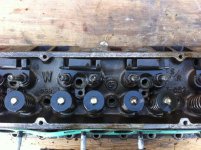
So I just measured the cylinder and it is 4.060 and then I would assume a stroke crank. And after some research the heads are World Products S/R TORQUER Iron 202 Heads, but I can't tell if the chamber size is 67 or 76cc, they offer both in this head. (see attached images for casting id's and specs).

Also the the engine has a closed cooling system including the manifolds, risers are raw water. So could the water intrusion be from sucking in raw water through exhaust? Seems to be the only explanation for the water in the cylinders. I would assume that any coolant sitting in the cylinders would not do that kind of damage/corrosion to the piston as opposed to salt water.

So I need figure out if I can salvage this motor. If this engine has such low hours, can I use the short block (they used a good block 3970010) just as it sits and just replace pistons and rings. I guess I would have to find out what crank, rods, etc it has and condition (assuming its all good with such low hours). And I'm also assuming I would have to replace cam (as I mentioned before it was built with the performer rpm cam and intake) package.

I really appreciate everyone's time and input. I need as much help and information as I can get and I like to learn.

Jim
 

Attachments

  • photo.jpg
    photo.jpg
    91.6 KB · Views: 114
  • head.jpg
    head.jpg
    102.1 KB · Views: 131
So I just measured the cylinder and it is 4.060 and then I would assume a stroke crank.

Ayuh,.... That block has been bored to the Max now,...
If there's cylinder rust, there's no more iron to over bore,...

'n,... Never assume, Anything,....
Measure the distance from Tdc to Bdc,...
A 350 will be 'bout 3, 1/2", a stroker crank will measure 3, 3/4",....
 
..............

Jim, the problem with the World Casting cylinder heads is the chamber size designation. The casting numbers do not tell us which chamber they have.
You could have the 67cc or the 76cc chambers.

Even if 76cc chambers, the Flat Top pistons w/ the 3.750" stroke, makes the Static Compression Ratio too high for Marine Cruiser use.
And if these are 67cc chambers, it's an even worse selection.... IMO.

The Flat Top piston deck is a good thing as a Quench Effect can be obtained (baring the piston deck heigth and compressed head gasket thickness are correct), the but absence of C/R controlling "dish" is what's wrong with these for this stroke dimension.

I just ran the calc's, and if these are the 76cc chambers, your Static C/R is approx 10.38:1.


Since you need to replace pistons, I'd strongly encourage you to go with a LCQ style piston w/ a dish volume that brings the SC/R back to where it needs to be if the cylinder head chambers are similar to GM's Vortec heads.

Go with a D-dish piston w/ a dish volume that brings the SC/R back to where it needs to be if the cylinder head chambers are similar to the standard SBC GM heads.

Check the piston deck height, and select the correct head gasket thickness that will give you a quench dimension of .038" or so, and you'll be in business.


Do as Bill suggests by measuring the stroke.
5.7L stroke = 3.480", and the 6.5L (400 cu in) stroke = 3.750"

If this does have the 400 crankshaft in it (making it a 383), the harmonic balancer will be different from the original 5.7L balancer.
Steer clear of the short piston skirts and the longer rods for Marine use.


Side note:
He says they put about 11k into this thing.
I think that he's blowing smoke here.

Anyone willing to spend $11k on a SBC build, certainly would not make that piston selection, and they'd certainly choose a roller cam block.
The F/T's with double valve reliefs are an ambidextrous piston.... IOW, one piston fits all 8 bores. These are very inexpensive pistons..... not to mention that they are incorrect for this stroke for a Marine build.


I put this image together for similar threads that I've posted to over the years.


attachment.php


.
 
Last edited:
Jim, there's 9 cc's difference between these two potential chamber volumes.

Since the heads are off, turn one over with the flat surface absolutely level.
Measure out 67cc of light weight oil.
Pour this into the chamber.

If it fills the chamber, they will be 67cc.
If it does not fill the chamber, they will likely be the 76cc chambers.


Post back with this info, and once you get the engine taken apart, post back with the stroke dimension and connecting rod length.


.
 
Last edited:
Jim, there's 9 cc's difference between these two potential chamber volumes.

Since the heads are off, turn one over with the flat surface absolutely level.
Measure out 67cc of light weight oil.
Pour this into the chamber.

If it fills the chamber, they will be 67cc.
If it does not fill the chamber, they will likely be the 76cc chambers.


Post back with this info, and once you get the engine taken apart, post back with the stroke dimension and connecting rod length.


.

Well here's the info I've got.

bore: 4.060
stroke: 3.48"
pistons: TRW L2256
connecting rod length: 5.7
crank casting: #3932442
cam: performer rpm
head chamber volume: 67cc
current deck clearance from piston to deck @ TDC: 0.19

I'm now finding out that some of the specs I was given by the person I bought this engine from differ then what I actually have. I do have some piece of mind now as to what I have from tearing the motor down. At this point I want to build the best motor I can and stay within a reasonable budget without breaking bank. My hull is a 26' Wilson, very light and fast hull. The boat wants to go fast, and it handles very well, especially surfing down swell. The previous motor was a 260-280 hp I'm guessing, cruised at 25 @ 2900 rpm. Would love to get something in 330-350 hp if possible, cruise at 30-35 and on pump gas, while using what parts I currently have, but replace what is necessary due to poor condition or just having the wrong parts. I hope I'm being realistic.

I really appreciate all the time, feed back and help.

Best,
Jim
 
Jim... back to you.....................


Well here's the info I've got.

bore: 4.060
To be safe, that is your last over-bore.

stroke: 3.48"
OK... this is a 5.7L crankshaft... not a 400 cu in 3.750" stroker crankshaft like you were told.
With a 4.060" bore, your cu in displacement will be 360.422.

pistons: TRW L2256
I would not go back together with a similar piston.

connecting rod length: 5.7
This is good.... and is a standard 5.7L rod length.

crank casting: #3932442
cam: performer rpm
Most likely an Automotive profile. Do a search and post the specs for us.

head chamber volume: 67cc
Not good with those piston decks.
With the 67cc chambers, and F/T pistons, you'd be in the 10.78:1 Static C/R range.
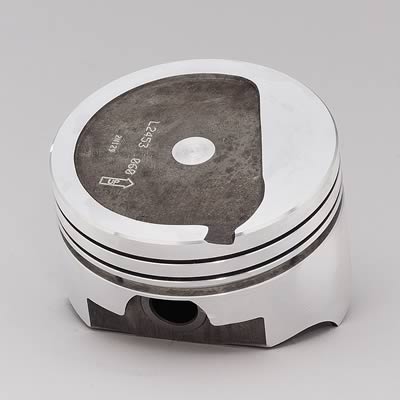
This chamber volume needs a piston with a dished area off the side of the Quench surface..... NOT A FULL Dished piston.
You'll want a piston with a deck profile that mirrors the quench surface, but also offers a dish volume to control static compression ratio.
Something similiar to this...... (example only).............


.............. if the chamber quench surface is similar to this.


You'll want a LCQ piston if the chambers are similar to this.


current deck clearance from piston to deck @ TDC: 0.19
I think you meant 0.019"... not 0.190".
Once this is known, this will determine the compressed head gasket thickness, which will determine the head gasket p/n.

The goal is to bring the Quench Dimension to approx .038" for a Marine SBC.


  1. I'm now finding out that some of the specs I was given by the person I bought this engine from differ then what I actually have. I do have some piece of mind now as to what I have from tearing the motor down.

  2. At this point I want to build the best motor I can and stay within a reasonable budget without breaking bank.

  3. My hull is a 26' Wilson, very light and fast hull. The boat wants to go fast, and it handles very well, especially surfing down swell. The previous motor was a 260-280 hp I'm guessing, cruised at 25 @ 2900 rpm. Would love to get something in 330-350 hp if possible, cruise at 30-35 and on pump gas,

  4. while using what parts I currently have, but replace what is necessary due to poor condition or just having the wrong parts.

I hope I'm being realistic.

I really appreciate all the time, feed back and help.

Best,
Jim

  1. Just chalk it up to a bad experience. Hopefully you did not pay much for it.

  2. I think that we can all appreciate that.

  3. All the more reason to do a Quench Build.
    Nothing else to the build must change, and if you do it correctly, it won't break the bank.

  4. Like said, run away from this piston profile. There are much better choices to be made.
    Look up the info on the intake runners and valve diameters. See if these are suitable for marine use.
 
Last edited:
Jim, just an FYI..... the quench build is not necessarily a Hot Rod or High Performance build.... although it certainly enhances performance.
The quench or squish is all about creating a reduction to Detonation potential, of which the Marine gasser can and will be prone to.

Static C/R can also be increased a point or two.... or it can left as per OEM.

Once the correct quench dimension is acheived, the ignition advance can be increased some with no greater risk of ignition induced Detonation.
An increased ignition spark lead also places the LPCP (location of peak cylinder pressure) closer to the desired crankshaft angle, giving the engine better low end torque.


.
 
Thanks you Ricardo for all the info you have provided. I ended up getting most of my money back for the motor, I'm keeping it all as I can use some of the other parts etc. I tore it down and found some pitting in two cylinders, and light cylinder and ball honing would not remove it all. Now I'm going a different route, like I wanted, 383 stroker.

I appreciate all the advice from everyone.

Jim
 
Back
Top