Logo

pin removal tool? for DP-A

quint

Contributing Member
Does anyone know exactly how the pin removal tool 885148 works. I can see u remove the pin lock bolts per the VP manual but how does the puller actually get the hinge pin out? Is it threaded in and then used like a slap hammer to back out the pin away from the steering helmet? (I dont think I can punch them out with my DP-A because of clearance with the helmet) just want to know how that puller grabs the pin? The VP manual does not elaborate or show a pic and from what pics I have seen of the puller it doesn't seem to threaded on the end. Has anyone converted a cheaper slap hammer or other device because the VP drift seems way over priced? Thanks in advance for any advice/help.
 
Quit, I assume that you are asking about the main suspension fork "hinge" pins.


The 290 hinge pins are internally threaded for a puller tool.
The tool threads into the puller threads, and you would use the tool to apply an outward force against the pins.

These pins can be corroded into the aluminum ears of the transom shield.
Heat on these ears is your friend... (it will slightly expand the aluminum!)

The tool is not necessary if you drive agaist the pins with either an aluminum or brass punch... or nothing harder than an Italian Bread Stick.
images


(these pins are rather soft, and we can easily expand them if driven against with a steel punch.)

But again, only after you have applied heat to the aluminum ears/bosses.
Drive inwards..... and drive outwards.... back and forth a few times if need be.
They will usually loosen up.

A small Mapp Gas torch works well for a heat supply.
Avoid Oxi/Acet...... especially a neutral flame...... too hot!


Tip:
When removing and re-installing this drive, remove the transmission first.
Watch for the shims.... keep these in order... they must go back in!

Now disconnect the shift cable and water neck hose.
Now remove the hinge pins and the remaining Intermediate and lower section of the drive as a unit.

When going back together..... do the reverse by re-installing the transmission last.
Much easier this way.

Replace OEM O-rings..... these are not intended to go second time around.


Side note:
When swapping any drive components.... transmission, Intermediate or Lower Unit from one Intermediate to another, Re-Shimming is required.
This is not an option..... it is a requirement!


.
 
Last edited:
Yes Ricardo main susp fork pins... by the way those bread sticks look delicious just need a little pesto sauce dipping...can you elaborate about "watch for the shims" I know little about them. Unless I can deterime I have a absolute trim/tilt leak...I just may remove the trans since I need to replace the bushings and seal in the steering helmet/fork anyway. What is the thread size of the hinge pins? I researched an old thread/post on this site and understand the pins are 5/16 x18 per a seloc repair manual? Can you confirm this Ricardo?
 
Yes, the bread sticks serve a double purpose..... after pin removal, with a little garlic butter, you'll have a snack right there! :D


Transmission shims:


Between the Transmission and the Intermediate housing, you'll find a set of shims.
These shims ensure that the lower driven gear bearing is "squeezed" or "compressed" so that when the Trans/Int are snugged up together, this bearing outer race and retainer cannot spin within the Intermediate housing bore.

The shims create a .003" to .004" squeeze, while allowing the two cases to come to "zero" clearance when fully tightened.
With the transmission just snugged up (no O-rings yet in place), you should see a feeler gauge reading of .003" or so.
When fully tightened, this reading should now be zero.

The two O-rings must be replaced!


Lower unit shims:

Just above the lower unit vertical shaft upper-most bearing, there will be an outer race that is press fit into the Intermediate housing.
You won't typically see this race when a lower unit is removed, since the race remains up in the Intermediate housing.
Above this race is another set of shims.
These shims control the downward force on the vertical shaft..... or to put it another way, this bearing/race "checks" the up-lift force against the vertical shaft (since the apposing gear action wants to seperate the gears).
IOW, these shims have final control over the drive gear/driven gear contact.

Again, all O-rings must be replaced.


Quint, I don't use hinge pin the puller tool.
All drives prior to the 290 used hinge pins that were not threaded, so with any drive prior to the "C" drive (hollow hinge pins), I just use Heat and a brass or aluminum punch.
Although some can be very stubborn, this has always worked well for me.


Watch out for Seloc and Clymers repair manual information.... there are some errors in these.
Your best manual will be the OEM work shop manual for your model drive.


.
 
Last edited:
Hi not sure if this approved method but it works for me and is relatively simple. Maybe my pins weren’t stuck fast but:-
I used a long bolt that matched the thread of the pins, I placed a large socket from my socket set (or steel tube) big enough to easily cover the pin. Then a large wide washer and nut on the bolt. Feed the socket, washer next, then nut, then the bolt. Tighten bolt into the pin. Tighten nut against the washer and socket whilst holding firm the bolt. The idea is that when you tighten the nut it will draw the pin out of the shield into the length of pipe or socket.
 
interesting method moresparks thanks...Ricardo when you say 'watch the shims/keep in order' do you have a pic of what the shims look like when u remove the trans..do the shims get moved misaligned when you remove the trans?
 
Shown here as SEQ #8 and there will usually be more than one.
Volvo Penta sometimes calls these adjusting washers.

Beware that shims may stick to the oil film on the lower driven gear bearing. As you remove the transmission, look at this bearing immediately for a shim or two.

(this is a 270/280/275/285 style.... but the shims and location are the same)


There are also shims above the lower unit vertical shaft tapered roller bearing race.
This race is press-fit into the Intermediate housing.
If a lower unit is changed, re-shimming is required.

.
 
Last edited:
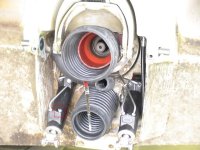
Not very pretty, and definitely not digestible: an 8mm-1.25 bolt welded to a 5/8 nut used with a rented slap hammer from AutoZone (they'll give all of your money back on return of the rented tool) and voila! Works with the hinge pins on our twin 1989 SP-C drives which cannot be driven inboard due to lack of clearance.

I recall reading somewhere that the threaded hole might be 1/4-20 but I snapped off a tap trying the SAE size. Can anyone confirm this?
 

Attachments

  • copy of 0205131521.jpg
    copy of 0205131521.jpg
    15.8 KB · Views: 333
  • copy of DSC00969.JPG
    copy of DSC00969.JPG
    50.5 KB · Views: 2,618
I've always been able to remove the hinge pins using my Italian Bread Stick and heat method. Some can be very stubborn, but they will come out.

Suggestion: rather than using slide hammer, I'd suggest using a threaded puller tool, and prevent the "impact" against the small threads. Perhaps a tool that is similar to a SBC harmonic balancer install tool.

The principle would be very similar, but instead of pulling the balancer over and onto the crankshaft, the tool would be pulling against the temporary tube support causing the hinge pin to move outwards.

For the C, C1 and later, a threaded fixture could be inserted at the inboard side of the hollow hinge pin.

I'm actually showing a SBC Balancer installation tool. Of course the small thread size would be different.
 

Attachments

  • Volvo Penta hinge pin extractor.jpg
    Volvo Penta hinge pin extractor.jpg
    37 KB · Views: 989
Back
Top