Logo

Observation of a common Question/problem about Timing

paw2000

Contributing Member
Hi all, Been awhile and was checking out different threads and solutions. It seems there is a fair amount of posts of RH (starboard) reverse rotation engines that are down on RPMs as compared to the other LH (port engine). Usually is goes like this, Engine starts and idles fine, no noise or misfire, just doesn't make the rpms. Sometimes they say timing when set to spec the motor barely runs, and they have to advance it 35degrees or more to run smooth.

I have this issue since the engines were installed. I had original crusaders 270's, bought boat knowing engines were bad, put 2 long block assemblies in. RH and LH engines. Run the boat, max rpms RH almost 3k, LH would turn up to 4k. First season over figure maybe a prop issue, had the 16x15 props scanned and trued, I actually lost about 400 rpm on the RH (starboard) engine. Well I ran it all season and just lived with it.

3rd season starts and I want this fixed! The port engine ran great, the slower Starboard engine was keeping the Port from its potential. So I make the decision to pull the Cam from the RH engine. I had have 2 marine techs inspect the engine, they compression checked, played with timing and said cam shaft, they couldn't explain the timing marks as compared to the other engine. They would advance the timing of the LH engine and get the starter fighting to start the engine. Like you see on a modified street car engine. The Starboard engine didn't care, just cranked over and started. So they say cam must be worn.

Well I pull the cam(big job while in boat) replace with Melling 22125 (stock reverse cam). Well the cam pulled out was the same one. Ok, maybe lobes worn?, nope perfectly good cam. I install new, with lifters, break in cam, no improvement. So I run the season as is, enjoy the boat. Put 60 hours on the engines.

So I'm reading up on cams and read that a gm reverse rotation engine uses a standard rotation cam blank(to turn the oil pump and dist correctly) but has a reverse grind (ground) lobe pattern. Is it possible ?? that timing a RH motor that using the balancer marks and standard timing plate is inaccurate? TDC is TDC, but since crank direction is CCW (from front) this would explain the supposedly radically timing to get the engine to run? Maybe time from flywheel? Does RH engines react differently to advanced timing? Maybe not the noticeable difference like LH engine does, but still necessary for longevity and performance?

I would like to see an RH motor that ran good, and put a timing light on it and see first hand. and to be able to advance and retard timing.
Some info of boat 32ft CC 315 props 16x15 trans 1.52-1 speed gps 22.1knots @ 2500 rpms.
 
Reverse rotation motors either run the cam backwards, then reverse the distributor and oil pump rotation (so it's 'normal'), or they use a gear drive (vs. timing chain) to reverse the cam rotation (so it's 'normal' along with the distributor and oil pump rotation). You have one or the other, for the motor will not run if the above methods are combined.

Hope that helps.

Jeff
 
All the factory gm assembled engines destined for marine use I've seen (so ~ 40 years) use the gear approach so the distributor and its rotation are the same for either RH or LH rotation...yes TDC is TDC but the "advance" direction on the timing tab reverses between the two...damn return key is inhibiting the paragraphs again....anyhow, the timing curve should be the same and you will have to measure it to see if it is correct...if they are different, you can get what you are describing....the other piece of info is the vacuum vs RPM data for each engine....it will show you the load seen by each engine...and finally, you need to make sure both engines are in similar mechanical shape if you want them to perform similar....BTW, if a mechanic tells you the cam is worn and needs to be changed without any evidence (measurements), its past time to find another mechanic.
 
Agreed with every point! (How about that?) A bad cam is easily determined since the motor will pop like crazy out the intake.

Jeff
 
Thanks for the reply. My RH is gear driven. Just seems from the many inquiries Ive read on this and other forums that RH engines seems to experience this. Do they react differently to timing changes because of the type of cam they have? Typical chevy small block will run at timing from 0 (even less) to 50 degrees advanced (not recommended) the more the advanced the rpms increase. Also the harder to start, a heavy advanced engine. To me it seems the RH engine doesn't react as expected. Its possible the engine is producing all the power it can, and its underpowered for the application.

It seems when marine trans that can reverse output came out, the usefulness of RH engines went away. The horsepower went up and rpms increased, guess due to availability of performance cams.
 
This is pretty much in step with Jeff and Mark.

.
............ and they have to advance it 35degrees or more to run smooth.
Not sure that I'm understanding this one.

35 degrees of advance (even if at the "full in" rpm), is a recipe for Detonation Damage for the average SBC Marine Engine build with the GM full dished pistons. It's even a bit excessive for a well buit Q/E SBC Marine Engine. Be careful!


I have this issue since the engines were installed. I had original crusaders 270's, bought boat knowing engines were bad, put 2 long block assemblies in. RH and LH engines. Run the boat, max rpms RH almost 3k, LH would turn up to 4k.
3k rpm as a WOT RPM is not up to spec. Unless related to ignition advance, you may over-burnden this engine.


So I make the decision to pull the Cam from the RH engine.

I had have 2 marine techs inspect the engine, they compression checked,
Was the cylinder pressure test done prior to removing the camshaft?

played with timing and said cam shaft,
How did they determine that the camshaft was bad? (Unless it's obviously visible...... there's only one true method)

they couldn't explain the timing marks as compared to the other engine.
Very simple as Mark explains.
As long as the TDC markings are true ..... you can't go wrong!
But... if the markings are not accurate, you can be chasing your tail for days.
(see my PPS suggestion below)


They would advance the timing of the LH engine and get the starter fighting to start the engine. Like you see on a modified street car engine.
You're talking about advancing BASE advance, and then experiencing "bucking".... correct?
If so, this would be expected of any engine.

The Starboard engine didn't care, just cranked over and started. So they say cam must be worn.
Even a badly worn camshaft maintains a certain degree of accurate valve operation and timing at cranking RPM.
I'd want to hear further explanation of this.

Well I pull the cam(big job while in boat) replace with Melling 22125 (stock reverse cam). Well the cam pulled out was the same one. Ok, maybe lobes worn?, nope perfectly good cam. I install new, with lifters, break in cam, no improvement. So I run the season as is, enjoy the boat. Put 60 hours on the engines.
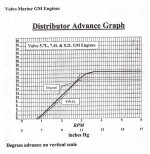
At any point have you verified the Progressive Ignition Advance on this REV RH rotation engine?
BASE advance, progressive advance and TA should be very similar to the STD LH rotation engine.
(see ignition advance curve image)

So I'm reading up on cams and read that a gm reverse rotation engine uses a standard rotation cam blank (to turn the oil pump and dist correctly) but has a reverse grind (ground) lobe pattern.
NO.... a REV RH rotation SBC camshaft profile is completely different, so the blank that they begin with would also be completely different.

Depending on how the camahaft is driven (chain and sprockets -vs- twin gears) the REV RH rotation engine chain driven camshaft's "drive" gear, and the REV RH distributor's "driven" gear cuts are reversed as to accommodate the CW distributor rotation and the standard oil pump rotation.
(no such thing as a SBC REV direction oil pump)

If the camshaft is twin gear driven, the camshaft's "drive" gear, and the REV RH distributor's "driven" gear cuts can remain the same as to accommodate
the CW distributor rotation and the standard oil pump rotation.


Is it possible ?? that timing a RH motor that using the balancer marks and standard timing plate is inaccurate?
The timing cover tab must extend the markings out in the oposite direction.
If not... you'll be rather limited in the amount of degrees that you can read when checking BASE advance..... and you cetainly won't be able to see anything much above BASE advance as you check the Progressive or TA!

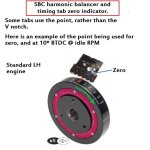
The easiest solution is to mark off the harmonice balancers up to approximately 35* (in incriments of 5*).
Then while checking timing.... you'd use the tab's TCD notch only against the new balancer markings.
(see image below)

TDC is TDC, but since crank direction is CCW (from front) this would explain the supposedly radically timing to get the engine to run?
Only if the TDC markings are not accurate to begin with.
If you want to verify TDC..... you'll need to perform a PPS procedure. (PPS = positive piston stop)

Maybe time from flywheel?
Yes, you certainly could.... but only if the flywheel also offers a TDC location that corresponds to another static marking.

Does RH engines react differently to advanced timing?
NO... each engine will react very similarly to a progressive ignition spark lead!

Maybe not the noticeable difference like LH engine does, but still necessary for longevity and performance?

I would like to see an RH motor that ran good, and put a timing light on it and see first hand. and to be able to advance and retard timing.
There is no reason for the REV RH rotation engine spark advance to be different from that of the Std LH rotation engine spark advance.
We need spark advance in order to place the LPCP where it needs to be.

Some info of boat 32ft CC 315 props 16x15 trans 1.52-1 speed gps 22.1knots @ 2500 rpms.
2.5K rpm, under that load, is an rpm that will be prone to detonation potential.
IMOO.... if this is a planing hull (and at 22.1 knots I'm sure that it is) I would avoid that RPM.

This is an example advance curve ONLY. See your OEM specs.
Your engine build will influence the progressive and TA some.


The degree markings shown below (Port side of the balancer TDC groove), are for a Std RH rotation engine.
The markings for a REV RH engine would simply be to the Starboard side of the TDC balancer grove.
The tab ZERO marking would be unchanged for either engine.
 

Attachments

  • Ignition advance line graph VP 5.7L .jpg
    Ignition advance line graph VP 5.7L .jpg
    81 KB · Views: 12,386
  • Timing tab ZERO and 10 degrees explained 1.jpg
    Timing tab ZERO and 10 degrees explained 1.jpg
    49.7 KB · Views: 381
  • Timing tab ZERO and 28 degrees explained 1.jpg
    Timing tab ZERO and 28 degrees explained 1.jpg
    46.9 KB · Views: 171
Thank you TeKeelA for the kind words. :D

Keep in mind that these are combined efforts here. We all play a role in helping each other!


.
 
Ricardo's reply makes me want to live in Oregon so i have a mechanic who knows their stuff!
......................................Based on the "wet coast" weather you may need him to fix the next boat you build and I would recommend an Ark !!!!:D
 
Come on, Don: the sun shines in Oregon at least five days a month in the summer. Well; maybe only four...

Jeff
 
Back
Top