Logo

NO spark AQ120b

78-9 volvo penta Aq120b
inherited,sat for a few yrs
cranking, fuel, but no spark


replaced coil after it tested bad
new plugs... still no spark


purchased elec ign. almost same price as condenser


i believe i have a wiring problem
i noticed a purple "resistor" wire running right to the back of the alt. but not connected
...read that it was power for coil but i already have 3 wires to coil, labled ign coil.
(1 pos. and 2 neg.) that is before elec ign system.


elec. ign. system requires only using 1 +, 1- of its wiring along with 1 + to power ign coil.
this is how i hooked it up but still no spark.
^^this set up leaves 2 ground wires that previously went to the coil disconnected and then i still have that "resistor" wire not connected.


no manual and cant find detailed enough wiring diagram


thanks for the help
 
The wire running to/from the alternator is for the field circuit. There will be a diode in this circuit to prevent this from back-feeding the ignition circuit.

If you are going with the Pertronix conversion kit, use the wiring diagram provided.

Note that the kit does nothing to correct for a worn flyweight system, rust compromised flyweight return springs, or for any shaft wobble that may create an erratic dwell.

After the installation, be sure to check the advance for/at the Full-In rpm.
See your OEM specs for this.

.
 
Last edited:
The alternator doesn't look stock... Would not having the "resistor" wire hooked up prevent the engine from running ie my no spark problem. Or would it just not charge my battery?
 
Wire won't keep it from running. Jump a wire from B+ to the positive side of the coil and see if it starts. If it does you have some wire tracking to do. If it starts, just pull the wire off the B+ and it will die.
 
Are you able to post a few photos of your engine for us?

The OEM ignition coil may use a "resistor" in the circuit, but I am not aware of this year range using a "resistor wire".
The type/style of ignition coil will determine whether or not the circuit is to be resisted or non-resisted.
And again.... let your Pertronix Kit instructions suggest how to wire the Ignitor unit.

As for the alternator field lead..... the VP schematic may call this a "resistor", but it is actually a "Diode".

If this alternator requires a field circuit to be active, then this diode must be working.
If not, often the engine will not shut down when the key switch is turned to the "Off" position.


Also, your ignition system may incorporate a "start-by-pass" circuit. This offers a full 12 volts to the ignition coil during cranking.
It then lets go once the starter motor is disengaged and returns the coil voltage to "resisted".
If so.... make certain that this circuit functions correctly.


.
 
Last edited:
Tried jumping a wire from B+ to coil. But same result.

Trying to upload pics but doesn't seem like it wants to load them.. I'll keep trying
 
Tried jumping a wire from B+ to coil. But same result.

Trying to upload pics but doesn't seem like it wants to load them.. I'll keep trying

Where are we?
Are you still set up with the points system?
Have you installed the Pertronix kit?

Understand that in order to create ignition spark, several things must be present.

Power to the + side of the coil, and of the correct voltage.
A means to take the - side of the coil to Negative.... I.E., contact points or electronic triggering.
A storage capacitor that holds this saturation charge.
A break in the saturation duration that causes the coil's field to collapse.
Field collapse causes secondary High Tension voltage... I.E., Ignition Spark.

If any one of these are not working... you will not get a good spark.

.
 
Elec. ign. is installed now. All hooked up to coil.
Ran a separate + wire to + side of coil to make sure I had 12V.

How do I know if I have an external or internal resistor for the coil.
 
................
Elec. ign. is installed now.
Install the Pertronix Hall Effect unit and sensor exactly as per the instructions.

All hooked up to coil.
The coil will determine which voltage. It may say "Internally Resisted" or it may not.

Ran a separate + wire to + side of coil to make sure I had 12V.
You should be testing for voltage with a VOM.

How do I know if I have an external or internal resistor for the coil.
Look at the circuit. Test the circuit.

Other than the ignition advance specs for Marine..... an automotive buddy can help you on this.


.
 
Update. Got spark at the plugs by running jumper wire to coil with elec. ign. Installed.
Must be a problem with the original + to coil from ign. Switch.
Still wont run. I believe it's a fuel problem now. The plugs are dry, not wet at all after trying to start.
 
Last edited:
That side draft Solex is only good for the trash can. Pull it off and rebuild it. I'm sure it's gummed up from sitting. Once you get it running and use the boat be on the look out for a AQ125 intake and carb, much, much better. Some will say go with a Webber but I've had real good luck with the down draft Solex carbs over the years.
 
Before you conclude that it's a fuel problem.... first verify your spark quality.
You should be seeing a white-ish/blue spark... not yellow-ish!
It should give you a nice audible "snap" as well.

Place a good spark plug wire directly into the coil's high tension socket.
Insert a good spark plug into that wire boot.
Give that spark plug a good engine block contact.

Watch out for any volatile fuel vapors.

Crank the engine over, and look for a good quality spark.
With the spark plug now into the coil, you'll see 4 spark events per two crankshaft revolutions, instead of only 1.

If you are getting good spark, now substitute the carburetor's fuel delivery with a small amount of gasoline directly into the carburetor throat.

Use Caution!


.
 
That side draft Solex is only good for the trash can. Pull it off and rebuild it. I'm sure it's gummed up from sitting. Once you get it running and use the boat be on the look out for a AQ125 intake and carb, much, much better. Some will say go with a Webber but I've had real good luck with the down draft Solex carbs over the years.

haha I believe it. Thanks I'll keep an eye out for one. Appreciate the tip.

Before you conclude that it's a fuel problem.... first verify your spark quality. You should be seeing a white-ish/blue spark... not yellow-ish!
It should give you a nice audible "snap" as well.


Place a good spark plug wire directly into the coil's high tension socket.
Insert a good spark plug into that wire boot.
Give that spark plug a good engine block contact.


Watch out for any volatile fuel vapors.


Crank the engine over, and look for a good quality spark.
With the spark plug now into the coil, you'll see 4 spark events per two crankshaft revolutions, instead of only 1.


If you are getting good spark, now substitute the carburetor's fuel delivery with a small amount of gasoline directly into the carburetor throat.


Use Caution!


.

i pulled the plug from one of the cyl. And tested it to the block and got from what I believe was a white spark, don't recall the snap. Tested another cylinder same result.
I will do what you say and test directly from the coil.

Once I got spark I put plugs back in and tried to start it, with starter fluid, gas directly into the carb both to ill effect.
Most I got was a little white smoke out of the carb where I put gas in.
 
Still can't get it running... Justs crank and cranks.
plugs are dry
have white spark
new coil
12v + jumper wire to coil
believe I'm getting enough fuel (starter fluid, pour gas directly into carb)
what am I missing????
did I buy the wrong starter and its cranking it the wrong direction?
 
Did I miss something at the beginning of this thread? Did you ever determine the engines compression? I've never seen a reverse rotation Bosch starter but that doesn't mean the didn't make them. Bounce the engine over and watch the timing mark on the crank gear. Does it come around from 30 degrees advanced or does it come around from 10 degrees after. Parts guy a long time ago gave me a starter for a SB Chevy that was reverse rotation, that made me scratch my head a little while, while shooting ducks out of the air.
 
Last edited:
I'm with Gary. Volvo Penta has not used a RH Reverse rotation engine. No need to with cone clutch engagement.

When looking at the engine from a perspective of the flywheel (rear)..... the engine will rotate counter-clockwise.
CCW is standard LH rotation for any engine.

If looking at the front of the engine, it would rotate CW for a standard LH rotation.


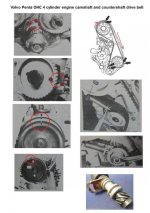
Have you verified that the timing belt is indexed correctly?
Have you verified that the distributor is indexed correctly?

When #1 cylinder is approaching TDC C/S, the distributor's rotor will be aiming towards the #1 spark plug wire tower.
If not...... the indexing is incorrect!
By indexing I mean..... either the distributor is installed incorrectly, or the plug wire firing order is off.


Under good and normal conditions...... cylinder pressure + fuel/air + ignition spark + correct spark timing = fire up.


.
 
Okay here is where I'm at:
blue spark at all cylinders
adequate fuel delivery

heres the bad news
compression is showing 60psi at all cylinders after initial testing
i held the throttle open, but obviously the engine doesn't run to I can run it to temp.
so either engine needs rebuilding or I did the test wrong.
 
When you pump the throttle do you get a squirt of gas into the throat of the carb? Did you clean the carb/carbs?
My side draft solex carbs do not have a choke, you have to pump the throttle to get the fuel mixture rich enough to get ignition.
My undestanding is that if the compression is even for all cylinders you are ok. That's more important that the actual readings. So don't give up.


Hope this helps,
Jon
 
When you pump the throttle do you get a squirt of gas into the throat of the carb? Did you clean the carb/carbs? My side draft solex carbs do not have a choke, you have to pump the throttle to get the fuel mixture rich enough to get ignition.
My undestanding is that if the compression is even for all cylinders you are ok. That's more important that the actual readings. So don't give up.


Hope this helps,
Jon

squirt of fuel every time I pump the throttle.
I don't have a choke either.. I pump it and used starter fluid. Hooked fuel line to remote tank with pump.
Started messing with the distributer(spinning it) and got it to backfire. Closest I've gotten to running.
Anyone have instructions for proper installation of distributer?
also timing belt alignment.
 
Trying to bring thread and boat back from the dead. Still need help.
Timing belt is not indexed correctly.
Cam pulley does not line up with notch on block when engine at TDC
I am having a hard time seeing any other timing marks on either of the other two pulleys.
Seems I need to start from scratch but don't have workshop manual.

Can I just release tension on belt and align cam pulley once engine is at TDC without messing with the crank and other pulleys assuming they are correct. Looks like cam pulley is off by 5-10 teeth.
I believe I have dizzy correct now. Just want to verify cylinder #1 is first cylinder looking at engine from now of boat to stern (pulley side) also verify firing order I've read two different ones 1-3-4-2 and 1-4-3-2

I have spark and adequate fuel. I got it to backfire so I believe that is a sign of spark, fuel, and some compression present..... So I want to try to get it timed correctly before tearing apart the engine.
Thanks
 
The crankshaft will need to be indexed so that #1 cylinder is at TDC.
Since you will be indexing the camshaft, this can not yet be TDC @ Compression stroke.
IOW, bring #1 to TDC only.

NOTE: the markings on the belt are only good if the belt is being installed in the correct rotation direction.
The marks will not repeat for several rotations once all has moved.


.
 
The crankshaft will need to be indexed so that #1 cylinder is at TDC. Since you will be indexing the camshaft, this can not yet be TDC @ Compression stroke.
IOW, bring #1 to TDC only.


NOTE: the markings on the belt are only good if the belt is being installed in the correct rotation direction.
The marks will not repeat for several rotations once all has moved.


.

im confused... Are you saying do not index cam. To match TDC cyl. #1 ?
i agree and do not believe marks on belt were put on correctly(matching marks) so I'm not going off the marks off the timing belt. Just asking if I can remove belt off pulleys to alight camshaft marks assuming the other 2 pulleys are aligned correctly when cyl #1 is at TDC. ....
or how else (procedure) to align all pulleys and marks and belt and distributer and rotor

Point a timing light at the damper and change spark plug wires until you can see the marks with the timing light. The note the tower on the distributor cap and put the #1 plug wire in that tower and set the firing order from there.

What is a damper? Is there not a distinct cyl. #1 I figure someone would kno and could verify. Still not sure which firing order is correct cause I read two different ones...


On my 151 the raw water pump seal was leaking water onto the cam sprocket and it was rusting so the rust bits were falling down into the grooves on the crank sprocket causing it to jump out of sync with the cam. If you get it running and the timing marks are jumping all around the belt needs replaced and the sprockets need cleaned or replaced.


Noted. Raw water pump doesn't leak. Engine is actually pretty clean inside and out for such an old engine. I'll keep an eye out for it if/when I get it running
 
When #1 cylinder is approaching TDC C/S, the distributor's rotor will be aiming towards the #1 spark plug wire tower. If not...... the indexing is incorrect!
By indexing I mean..... either the distributor is installed incorrectly, or the plug wire firing order is off.

from your older post I believe I understand how to do this properly.. I'm more concerned now how to align pulley marks with marks on the block with cyl. #1 @ TDC. I'm worried about bending valves but I heard a rumor these engines are non interference. Trying to verify info before I really mess something up.
 
They are non interference motors another thing to try is stick your finger in the #1 plug hole and turn the crank clockwise until you feel compression then line the timing marks up to TDC. Then look at the position of the rotor on the distributor cap. It should be pointing at the #1 tower on the cap.

i already mess around with the distributer, but in order for that to work wouldnt i have to know which one is #1 cyl already?
In the process of purchasing a workshop manual
 
Last edited:
.......................

RicardoMarine said:
The crankshaft will need to be indexed so that #1 cylinder is at TDC.
Since you will be indexing the camshaft, this can not yet be TDC @ Compression stroke.
IOW, bring #1 to TDC only.
im confused... Are you saying do not index cam. To match TDC cyl. #1 ?
No.... what I'm suggesting is..... since the camshaft is not yet indexed, the #1 piston only need be @ TDC.
Once the camshaft has been indexed, now #1 TDC C/S (compression stroke) will occur every other revolution.
IOW, this is unlike an engine whereby the camshaft is more permanently driven by either gear or chain.


i agree and do not believe marks on belt were put on correctly(matching marks) so I'm not going off the marks off the timing belt.
That's OK.
Just make sure that the three cogged pulley marks are indexed correctly prior to the belt tension being applied.


Just asking if I can remove belt off pulleys to alight camshaft marks assuming the other 2 pulleys are aligned correctly when cyl #1 is at TDC. ....
Yes!
You'll begin with the crankshaft pulley aligned as per OEM, then you'll varify the alignment of the counter-shaft and camshaft pulleys.

Up to this point (with no cam/counter shaft indexing) there is no TDC C/S (compression stroke ... so to speak).... there's only TDC every revolution.


or how else (procedure) to align all pulleys and marks and belt and distributer and rotor
Perhaps think of it like this:
The crankshaft is the main guy. He drives the camshaft and countershaft and sets the presidence for indexing.
Until the camshaft is indexed, the valve timing (relative to pistion location) is non-existant.
Once the camshaft is indexed, now the valve timing is correct relative to pistion location.


NOTE: the counter shaft doesn't care about indexing if it wasn't for one distinctive aspect.
And that is.... the counter-shaft drive gear and the distributor gear allow for only one idexing due to the limitations of the adjustment slot in the distributor housing (adjustment slot for timing adjustments).
Unlike a typical V engine whereby the distributor housing offers an unlimitted degree of rotation, this one does not.
IOW...... if BASE advance cannot be obtained within the number of degrees provided within length of this machined slot..........., then either the countershaft and/or distributor are NOT indexed correctly!

So....
the counter-shaft indexing is just as important as is the camshaft indexing
due to gear tooth count and the adjustment slot limitations.
the spark plug wire indexing to the distributor cap is also critical.

Years back, Ryan and myself put together some V/P information.
Ryan covered the OHC 4 engines/drives, and I covered the other engines/drives.
Take a look at Ryan's thread.

Or follow this link
http://www.threefattigers.com/Protocore/Volvo/TimingMarks.htm


Is there not a distinct cyl. #1
Yes, whether car, truck, industrial, aircraft or marine, #1 cylinder is typically the forward most cylinder (forward meaning opposite of flywheel end).

I figure someone would kno and could verify. Still not sure which firing order is correct cause I read two different ones...
Varify this.... but I believe that the AQ120 firing order is 1-3-4-2.

from your older post I believe I understand how to do this properly.. I'm more concerned now how to align pulley marks with marks on the block with cyl. #1 @ TDC. I'm worried about bending valves but I heard a rumor these engines are non interference. Trying to verify info before I really mess something up.
Yes, these are non-interference engines.


i already mess around with the distributer, but in order for that to work wouldnt i have to know which one is #1 cyl already?
See above.
In the process of purchasing a workshop manual
OEM is your best bet over that of the Seloc or Clymers !

BTW, here's another MarineEngines dot com thread that may be helpful.
http://www.marineengine.com/boat-forum/showthread.php?406051-Wandering-Ignition-Timing
 
Here's another image that may help you.
I included an image of the distributor adjustment slot.

BTW, the belt and belt tensioner unit are same as the automotive, and are less expensive.
 

Attachments

  • cogged pulley alignment.jpg
    cogged pulley alignment.jpg
    56.6 KB · Views: 225
Last edited:
Thats the info im looking for! Thank you RicardoMarine for spelling it all out for me
And thank you everyone else all great info
I'll get right on it and post back results
i am having the hardest time finding the mark on the crankshaft pulley it just all painted blue with some rust spots.
Also haven't found the mark on the counter-shaft pulley. I see what I believe to be is the metal flange that comes off the block with a notch in it to line up the mark on the pulley?

The only workshop book I found so far is Seloc, but I was mainly getting it for all the questions you just answered for me
 
Back
Top