Logo

Mariner 40hp Pull Start - Battery Charging

EvansSJ

New member
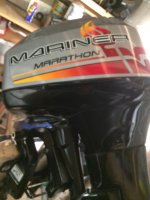
I wonder if anyone can give me some advice. I would like to use my current outboard Mariner Marathon 40hp (2003) pull start to charge a 12V battery.

I have plans to convert it to electric start next year (including second battery) but this is the first step for me.

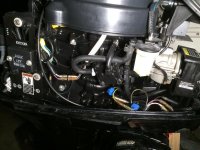
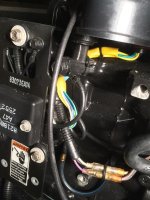
I have attached some pictures under the cover, do I need to install a battery charge kit (part number 62351A10) or can I run cables straight out to the battery?

Can anyone recommend a basic wiring book for a small fishing boat as I've got some re-wiring to do too.

Thank you


Attachments

  • IMG_0887.jpg
    IMG_0887.jpg
    44.8 KB · Views: 155
  • IMG_0888 (Medium).jpg
    IMG_0888 (Medium).jpg
    73.1 KB · Views: 214
  • IMG_0894 (Medium).JPG
    IMG_0894 (Medium).JPG
    76.5 KB · Views: 201
Where do your two yellow wires that come from the stator (down from under the flywheel) terminate at?

If they simply go to an isolation strip (kinda rectangle thingy with a couple of screw posts on the motor block somewhere) you can simply add a rectifier and feed the battery from that - or if they have bullet connectors you could add the voltage regulator that you would find on the electric start model.

The stators are different between the electric (2 types) and pull start models - they all have 3 coils used for ignition but the electric start model has more additional coils (compared to 3 on the manual start) for producing "auxiliary" power.

What that means is, the "charge coils" on the manual stator might be capable of keeping a full charged battery "topped up", they would probably not be able to provide "recovery" (in a reasonable amount of time) if you used your battery to power a electric trolling motor etc on a longer term outing.

There is/was three different (power) stators - 16 or 9 amps on the electric models and 7 amps for the rope start.

So if you run "continuously" above 3000 rpms you would have a recharge rate of about 7 amps.

Perspective - a group 27 deep cycle battery that holds about 90 amp hours of power would require you to run the motor for about 13 hours solid to recharge the battery.

If you plan on upgrading to electric start AND you want more than a "top up charge" capability, you best include the high powered stator as part of your plans. It's one thing to replace the charge (discharged) to start the motor, quite another if you plan on drawing power for the battery for anything more than a fish finder or nav lights.
 
Thank you Graham for the positive response.

Ill take a look on the weekend.

All I need is to be able to keep a 12V charged to run a VHF/Nav/Fishfinder, so the engine looks up to he job.

Thanks

Steve
 
Gentlemen
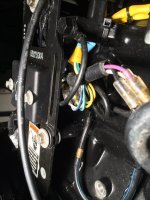
I have taken a good look at the engine and can see that I have the bullet connectors (that Graham alluded to earlier in the thread) so I'm going to get a voltage regulator to top up my battery. The job looks quite straightforward and I'm confident that I can do it. I've been trying to work out what gauge cable to run from the regulator to my battery but have got so confused, every book or website says something different, (the length I want to run the cables Pos & Neg is approx 4 linear metres, can anyone help). I have attached a picture showing the two yellow wires running down from the stator. What are they doing at the moment? Can I disconnect these and simply run them into the regulator or do I need to "tee off" from them. Any help is greatly appreciated. Thanks Steve
 

Attachments

  • IMG_0916 (Medium).JPG
    IMG_0916 (Medium).JPG
    79 KB · Views: 196
First off, I (suspect) that those bullet connectors are simply plugged into an isolation block.

The power being produced by the charge coils in the stator has to go "somewhere" or else it would cause the bobbins to overheat, possibly melt and damage the stator (happens and usually takes out the ignition portion as well). An isolation block uses the motor itself to "eat up" the power being produced.

When you install the regulator you simply "unplug" them from where they are now and plug the into the regulator - the regulator becomes the (new) termination point for those wires - tee'ing them off would result in little/no charge since electricity looks for the easiest path to ground, and going through circuitry and then into a battery is "the hard way". Jumping the gap on a sparkplug, in the ignition side, is the "really hard way" :)

Once you have the regulator installed, never (as in never ever) run the motor without a battery connected. No battery = nowhere for the power being generated to go = fried regulator which then causes a fried stator.

As far as "what gauge" wire.

You are looking at no more than 7 amps of power over a run of approximately 15 feet (4 meters is what 13'ish feet - we have used the metric system since I was in high school but I never really caught on :) ).

So based on that you "could" use an 12 gauge wire (based on the amps plus the distance, 12 gauge is recommended to prevent loss due to resistance - tables that do not consider voltage loss would say that 18 gauge "could handle" the 7 amps in a 15 foot run).

Since you want to hook it to your battery I would suggest that you go with a heavier wire just for the sake of durability (and what I mean is, the battery being somewhat remote from the charge source in your case, a heavier wire like say an 8 gauge, while "un-necessary", wouldn't easily snap off if was pulled, tugged, hooked by a piece of gear etc), and an 8 gauge (or 6 for that matter) wouldn't break the bank to get 15 feet of it. Using "more wire" than necessary, aside from cost, in this application, has no real downside.

 
Back
Top