Logo

Manifold Replacement Question

FastFred

Member
On my to-do list for this Winter is to remove the manifolds, elbows, and risers for inspection and/or replacement.

- 1988 Crusader 270HP (twins) with approx 1000hrs)-

I believe the engines are 'full' closed loop system (see picture, tell me if I'm wrong). The engines are from 1988, and I've had the boat for about a year and a half. Unfortunately, I have no maintenance records of the boat prior to my ownership. So, I have no idea how old the manifolds, elbows, and risers are.

I'm doing this as preventative maintenance only. I have no symptoms of any problems or issues that I know of, other than a slight difference in operation temperature (comparing the port and starboard engines). Temps are always between 150* and 180*.

My question is this: Does removal of the manifolds justify changing them? Or is there such a thing as reinstalling them if they appear to be in satisfactory condition?

Is one brand better than another when it comes to installing new manifolds, risers and elbows? Or is it the proverbial "Ford/Chevy argument"?

IMAG0498.jpg
 
It looks like the only part of your system that is exposed to the RAW or sea water side is your elbows. (see guy's I got it right this time) That being the case you should be able to replace just those and be good. Nice looking engine!
 
Ayuh,... I concur with missnancy,... Just the elbows/ risers see any raw water,....

Speakin' of Water,.... has this boat ever seen the Brine,..??

If not, I wouldn't worry 'bout Any of it,....

Rotten manifolds, 'n risers is a Saltwater boat thing,...
In Sweetwater, manifolds, 'n risers last til they're frozen without bein' drained,...
The 1s on my houseboat are over 40 years old, 'n in near perfect condition,...
 
Thank you for the responses, guys. And thanks for the nice compliment Miss Nancy. Last Fall & Winter, I took the time to wire-wheel the engines (in place), and spray them with DupliColor ceramic engine paint. DE 1601 Ford Blue is the color, if anyone is interested. It's a small shade darker than the original Crusader Blue. See attached image of a before and after. She looks even prettier now with all new hoses.

To answer your question Bondo, Yes, the boat has ONLY been in the brine her whole life. I currently slip in Cape May, NJ, and dry dock in my hometown of Northfield, 40nm North.

Port_Eng_Before_After.jpg
 
Last edited:
FastFred, on my Crusader risers, there's what I take to be a date cast into them. If yours are like mine, on the inboard side of risers you'll see the part number (97772) and nearby a manufacturing date.
Dan
 
How did you spray paint in place without making a total mess of the bilge area?

I am replacing my manifolds & risers in a few months once it gets warmer out here in Norcal, 1976 models though. Picked up two sets, original Crusaders, on eBay.
 
Fred, I agree with Missnancy.

In looking at your system, these are Full systems, in which case only the exhaust elbows will have seen raw water through them, and are very likely the only components that need attention.... although inspecting the manifolds is never a bad idea.

I'd be equally concerned with the sea water side of your two Heat Exchangers.
Have you been keeping up with pencil anode replacements?
Some times these pencil anodes require several changes per season.

Unsolicited tip:
Bring the engines up to temp prior to cracking any bolts loose. You can complete the job once things cool back down.


Fred... just an observation here.... and IMOO.

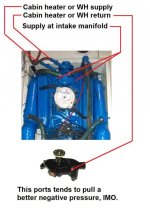
In order for a Cabin Heater or Water Heater to function to it's best potential, we want an unrestricted supply from upstream of the thermostat, and we also want an unrestricted return to the engine's circulating pump....... preferably the Starboard most port.
(see image below)

The mild pressure differential between these two sides of the closed cooling system, is what makes for a good cabin heater or water heater function.

My personal preference, would be only one shut-off valve at the supply side (none at the return side), and the coolant return being made at the starboard most port of the Circ Pump.
Your call.
 

Attachments

  • Freds CCS  +  CH WH plumbing.jpg
    Freds CCS + CH WH plumbing.jpg
    56.4 KB · Views: 163
Last edited:
Dan, Thanks for that info. I'll certainly take a look and see if I can see a date stamp on them next visit to the boat.

JD, I used lots of news paper under the engine, and along the sides to keep the over-spray from messing the bilge. I also used lots of blue tape. The engines sit half above deck, and half below. They are covered with an engine box that have chairs for the driver and passenger. (see attached pic) This helped give me a little better access to them as well. Under the engine is a fiberglass w/gel coat liner that cleaned up easily with acetone. The previous owner sprayed them too, but didn't use newspaper, and left a lot of over spray. That wiped right off with acetone, where I could reach it.

Rick,
Please correct me if I'm wrong...The elbows you refer to are the pieces that are bolted directly to the aft end of the manifold, yes?

This past Spring, I removed both heat exchangers and took them to a shop to be cleaned and checked. I was very disappointed in the end result from the shop, so I ended up doing it myself. When I got the back from the shop, there was still crud in them, as viewed from the end-cap removed. I ended up soaking them in white vinegar, and using a nylon .177cal cleaning brush to clean each tube individually. There was still sea weed in there! Anyway, they're clean now, as of Spring 2013. I also replaced the end caps that had hairline fractures, and gaskets too. I replaced the zincs at that time as well, but I haven't checked them since. I will this Winter, and evaluate whether a more frequent replacement is required.

Thanks for the tip on warming up the engines prior to cracking the bolts on the elbows. Will the work on spark plugs as well? I haven't changed them yet due to poor access to them.

As for the heater lines... I will take your advice if I ever decide to mess with it, or if I have to replace something there. The lines go to a small "school bus" heater that sits at the passengers' feet. It makes enough heat that even on a 30* day, you can't run it constantly without sweating your ass off. In Fall 2012, I removed it, made new stainless steel feet for it, and had it powder coated. (see before and after pic below)

You guys are the best! I always enjoy our conversations, and I appreciate all the help.

This pic was taken when I first found the boat, and began work on her. She had sat in the yard winterized for three years, and suffered from neglect. On this day, my wife Stacy came down to the boat to keep me company while I pulled the carb off. I'm posting this pic to show how the engines sit half above and half below deck. It make for a nice center-of-gravity, as well as easing the maintenance.
IMAG0325sm.jpg


The "school bus" heater (before & after) - just forward of the port engine, at the passenger's feet
Heater_Before_After.jpg
 
FastFred said:
Rick,
Please correct me if I'm wrong...The elbows you refer to are the pieces that are bolted directly to the aft end of the manifold, yes?
Fred, that is correct.
These are Elbows, and are sometimes (in a misnomer fashion) called "risers".

Risers are actually spacers or extensions that lift the elbows up from the manifolds, as to gain elevation against the Hull's water line.

With a raw water cooled system, the manifold and elbow "transfer" ports become an issue with regard to restrictive rust scale or corrosion.
With your Full Closed Cooling system, these transfer ports are blocked off and are not used.

IOW, if you were to see any corrosion or rust scale issues, it would most likely limited to your elbows only.


.
 
Last edited:
From your pictures you have both risers and elbows...and they are the only items that need periodic replacement; the main exhaust manifold should be good for a long time to come. In the mid atlantic, figure 3-7 years for a nominal life span.

If you opt to pull your risers and elbows, get the proper gaskets. Drain the coolant from the manifolds before removing the risers/elbows. Note the current positions of the "tabs" on the gaskets - the key to proper reinstallation the first time.

As far as brands, the OEM, OSCO, & Barr are on the same plane (your Ford vs Chevy debate)...most anything else is well below their quality and you don't want to go cheap here...
 
From your pictures you have both risers and elbows...and they are the only items that need periodic replacement; the main exhaust manifold should be good for a long time to come. In the mid atlantic, figure 3-7 years for a nominal life span.

Are you saying that the manifolds are likely to be OK, but the lifespan of the risers and elbows is 3-7 years? Just trying to clarify...

Are these the elbows? (see pic) If so, I had them off in the Spring of this year to replace the exhaust hoses from to back. While I had them off, I descaled them, and painted. They were in 'OK' condition. Not great, but OK enough to reinstall.

IMAG1078sm.jpg
 
in a nutshell, yes - the exhaust manifolds should be fine as long as the coolant is maintained and will last the life of the engine with no problem....

Your pic looks like part of an exhaust elbow....many different configurations of risers and elbows used over the years...as suggested earlier, getting the part numbers from the castings is a good way to verify what you have...most but not all of the OEM castings are still available...for the few that aren't, substitute configurations aren't that hard to build.

BTW, Crusader suggests checking the zinc pencils every thirty days...that will give you some insight to how chemically active your local waters are...
 
Looking good on the OUTSIDE doesn't mean the water passages INSIDE are still intact.

Jeff

PS: I pressure test mine to determine if they are still okay.
 
Looking good on the OUTSIDE doesn't mean the water passages INSIDE are still intact.

Jeff

PS: I pressure test mine to determine if they are still okay.

How do you pressure test them, and are talking about both the elbows and risers on log style manifolds or the center rise manifolds, or both types?

Thanks,
Erich
 
You can pressure test any of the exhaust pieces...For that matter, the same applies to any "jacketed" item.

As source of low pressure air, a pressure gauge, appropriate sized pipe fitting and adapters and block off plates or caps...
 
I just don't know how you would block off the inlet and outlet of say an elbow that has been removed from an engine to pressure test it. Where would you put the low pressure air and how would you tell if it was leaking into the other normally separated section?
 
The elbows are the hardest part to do cause of the water injection ports...the few I have seen just block off the water jacket, quite similar to the gaskets but w/o the water holes....

Some find it easier to just fill the liquid "jacket" and look for seepage into the exhaust port....

Over the years, I've found it is easier to just replace on a scheduled maintenance basis ...
 
Back
Top