Logo

Left and Right Hand Rotation Crusader 454's Mark IV's

drseth

New member
Hi,

I am confused as to the orientation of myself to the engine when refering to left and right handed rotation. Is it from the belts to the distributor(front to rear), or is it from the distributor to the belts (rear to front)? I know left hand rotation is CCW and right hand rotation is CW. Also, in these Mark IV BBC's, what is the rotation of the rotor button in these engines? Is it the same or different? From what I have surmised, the Gen V and VI's have a different distributor setup for reverse rotation engines, but in the Mark IV, the distributors are the same regardless of the rotation of the engine.

Finally, these Velvet drive trannies in forward turn opposite of the engine rotation, right?

Sometimes, I think I had rather pull teeth than deal with some of the nuances of engines, but mostly, I have had fun.
 
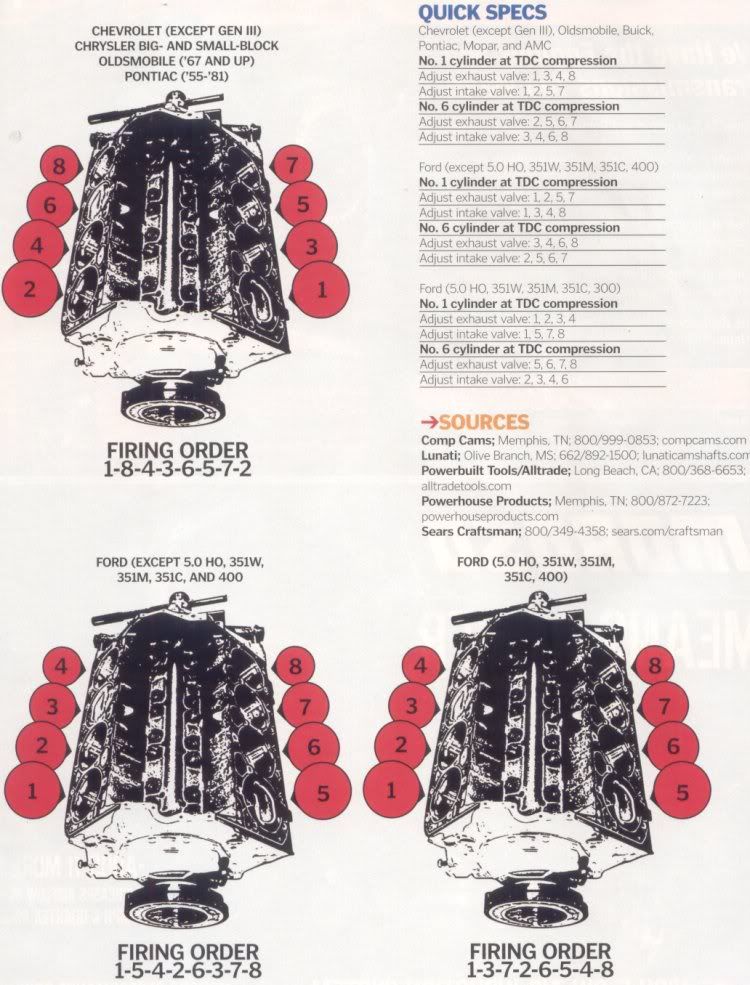
Rotation is determined by looking at the engine from behind the flywheel. Follow the second plug wire to fire after #1 cylinder. If the next is #8, that is the standard rotation engine (CCW - LH) If the next cylinder to fire after #1 is #2 cylinder, that is the counter rotation engine. Direction may be labeled on the engine somewhere or stamped on the block. What makes you think you have a counter rotator? What year is the application?
 
Rotation is determined by looking at the engine from behind the flywheel. Follow the second plug wire to fire after #1 cylinder. If the next is #8, that is the standard rotation engine (CCW - LH) If the next cylinder to fire after #1 is #2 cylinder, that is the counter rotation engine. Direction may be labeled on the engine somewhere or stamped on the block. What makes you think you have a counter rotator? What year is the application?
Ditto WoodieMan.
Marine Industry Standards dictate that we view the engine from the flywheel side.
Flywheel rotating CCW is LH or Standard Rotation.
CW is RH or Reverse Rotation.
What's done from there will be a result of engine orientation, transmissions, etc.

Yes, the firing order for the GM Reverse Roation is just oposite, beginning from #1 cylinder.
The crankshaft and camshaft dictate this.
Due to the oil pump, the distributor will rotate standard on both engines...... only the cam and distributor change (other than a thrust load bearing within RH engine the distributor)

This may be something that you'd want to keep on record.
(with exception to using the two-stop cam follower adjustment procedure :mad: , this is good info to have on hand.)
firingorder.jpg
 
The rotors spin CW, viewed from above. The GEN V's can be 'reversed' just as easily as the Mark IVs; the GEN VI's are a different story. No real 'need' to reverse the engines when the 'full power reverse' gears showed up. Economics (logistics) eliminated the need for the reverse rotation engines after that.

the inline Velvet Drives are a bit more flexible. Typically, the output rotation matches the input rotation when in FWD. Whether CW or CCW is determined by the pump's orientation when the gear is assembled. Certain ratios, in certain series, buck this trend and do things backwards. On top of that, BW had several "-CR" models that did things 'backwards', too. Best to have the specific model numbers in hand when asking specific questions.

BTW, the bulk of the info desired is available in the owner's manuals....
 
Check your starter motors as well, if you have recently had them over-hauled..... particularly if they are Bendix drive.
They may have gotten the motors themselves correct, but if the bendix drives were reveresed, you won't get them to turn the engines.
 
Thanks for the info. So, a typical rotation for a single engine useage or a modern twin installation is CCW, right? I am running 1978 model Crusader 454's, the starboard is CCW, the port engine is CW. In forward gear, the props are turning CW on the Starboard, CCW on the port side.

If I was to repower with new engines and trannies, which trannie would allow both engines to be normal CCW rotation, but have the props turning in a counterrotating manner?
 
The current engine offerings are LH and use "full power reverse" gears. for a twin install using them, both engines would be LH and the gears would be connected so shafts rotate CW on starboard and CCW on port, when viewed from the transom, looking forward. The typical gears put behind gasoline engines to due this are the 5000 series velvet drives or the ZF (Hurth), both with a 'down angled' output shaft.

Based on your description, you have the 1.91:1 or the 1.88:1 inline velvet drives.
 
Back
Top