Logo

Johnson 90 hp 1988

I have recently picked up a 1988 Johnson 90HP for my Lund Renegade. It looks as if a few items are left outstanding from the install. I am hoping someone can help. As I am sure I will have more questions/issues we will start with them a couple at a time.
The Trim Gauge does not work. How can I troubleshoot this? It flickers when the ignition is turned so I know it is getting power. What wires go to it and from where? How can I test it?*

There is no horn. I found where another forum member has had a problem with the horn but had a console. I have the stock white throttle body which I believe the horn is*integrated*into. How do I get to it and how can I test it? There is no tone when starting the motor, however I know this is also an over heat and warning horn to notify you of issues so I really want it working.*
 
Warning horn....... To obtain access to that horn, you will first need to remove the control box from its mounting which is either (usually) the interior side of the boat or the side of the console.

Have the throttle handle in neutral, remove the allen screw from the center of the handle, now temporarily install a long 1/4x20 threaded bolt into where the allen screw was and belt it with a hammer to dislodge the handle. Remove the rest of the philip screws as required to split the box.

Testing the horn..... Engine NOT running but with the key in the RUN position. Find the TAN wire(s) protruding from the cylinder heads and ground either one to the powerhead. The horn should sound unless it is either faulty or missing.

The PTT gauge.... Check the sender under the engine between the transom brackets to see if it's frozen in place etc.
 
Warning Horn:
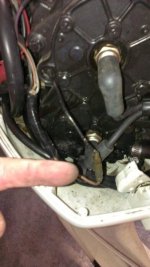
So here are the pics of two brown wires I found and grounded neither of which set a horn off after the key was turned. Also I included a pic of my throttle body to ensure we are talking about the same apples. I have not torn it apart yet.

The PPT gauge I moved the pictured switch with no results Is there a way to test the wires going to the gauge so I know if it is the gauge or the switch in the back?

Thanks for the help
IMAG0119.jpgIMAG0120.jpgIMAG0122.jpgIMAG0124.jpg
 
The first picture shows an orange wire it has to do with ignition and absolutely no voltage should be applied to it !!------------The second shows a tan wire from a heat sensor in the head.---Horn should sound if wire from harness is touched to ground.-------Check the horn in the control box as it may be faulty.
 
The first picture.... That's a orange primary coil wire.

The second picture is the TAN wireleading to one of the heat sensors in the head(s).... this is the TAN wire I spoke of. Now is the time to take that control box apart and get that warning horn back in operation.

NOTE: You did have the key turned to the RUN position (engine NOT running) when you grounded that TAN wire didn't you?

PTT gauge..... On the back of the gauge, simply grounding the "S" terminal of that gauge should make it peg to the top if the gauge itself is okay.... assuming the key is in the RUN position and 12v is being applied to the "I" or "B" terminal of the gauge (whichever voltage letter it may have).

The switch in picture 3..... Engine not running, key in RUN posiiton, trace the wires from that switch back to its connection point and while observing the gauge... with a small jumper of some kind quickly and momentarily connect those two wires together. The gauge needle should move.

With the PTT gauge switch disconnected, check the ohm reading of the switch as you move the lever up and down. The movement should be smooth from one extreme to the other. If no movement, or jerky, hesitation, etc, consider it faulty.
 
Last edited:
Horn: Yes the key was in the on position and the engine was not running.
Horn: is there a way to install a new horn on the outside that would be easier than pulling off the throttle? Just looking at my options, I do not have an issue with taking it apart unless it is springs gears and levers, I see opening a clock like in a cartoon here for some reason :)

PTT switch check: Do you know where the wires connect? they run into a bundle cable into the motor this may be hard to trace.

PPT Gauge Check: Do we know which wires go where on the gauge? the gauge was not working on the last boat so they may have had it messed up from that point. I have installed a new gauge and it still did not work so I think it is the wiring or switch. There looks to be a red coming from the throttle a white and a black (with some colored stripe) going into the umbilical to the engine.
 
Having the horn outside the box...............

The horn has a built in black ground wire which obviously must be connected to a ground.

There is a TAN wire within the wiring harness which connects to the slide on terminal closest to the black ground wire.

A wire leading from the "A" terminal of the ignition switch OR any terminal that has 12v applied to it ONLY when the key is in the RUN or START position connects to the remaining slide on terminal of the horn.

Sorry, I don't have the wiring diagram. Hopefully another member can supply that for you.
 
Hi.

I have the 81 90Hp with the same control box. It's really not a complicated device and if you are average mechanically you should be able to take it apart and put it back together pretty easily. The tricky part is not catching any of the wiring when putting the two halves back together and also getting the cams to line up, but with a little patience it happens in no time.

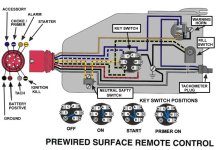
My warning horn had two wires, one to supply power in the on position (purple) and another to supply the signal from the overheat sensors (Tan) the internal buzzer is just above the key switch and should have a plastic shield around it to stop it touching the metal case, some newer ones also have a ground, so look our for that before taking the horn out.

Here is a picture of the wiring diagram for the remote (The Purple power wire I spoke about is blue in this one)


REMCONTBOX.jpg

I will post pictures of the inside of my control box on my profile as they are too large to post here, if you're interested.

Let me know how you go as I had to do mine quite a few times while trying to fit a proper kill switch and new switch to stop it starting while in gear.
 
All the above aside I have bigger issues now. I took the motor out for its first test run on water. I had previously tested it on rabbit ears.

We ran slow for the first 10 min to warm up and due to low water levels 4 feet or so. Then when in 8' of water we ran it up. 3-4 min into the run engine limited back. I am not sure why but it seems like the SLOW feature engaged. This is speculation.

Symptoms:
Turned off and restarted no prob
Throttle up starts RPMs up then limits down since first limiting event
checked Plugs/ wires and found one wire leaking voltage (that hurt)
Found bulb leaking some fuel (air in line?)
oil bulb is hard
Fuel bulb was hard tried squeezing no help
throttle up with prop not engaged revs all the way up.
the pisser seems to be throwing a very strong stream as well.

Current plan is to pull the fuel filter, plugs, wires and fuel line to the engine and replace.

If you have experience with the SLOW feature of this engine please report what would set it off and why as well as if the items above would make it engage.

I guess I know why I want the buzzer working now...
 
I feel your pain. I'm no expert and This is like reading my own posts from when I first got my 90. There are a lot of posts on this site listing the steps to be taken to get it working. I ran on Muffs no problem. took it on the water and got the overheat within minutes and the SLOW feature kicked in, took it out ran on muffs and no overheat. Always thought the tell tale stream was the be all and end all of cooling. Turns out there are a lot of other things to it. I wouldn't risk running it again without doing some trouble shooting.

Areas you will be pointed to are: Compression, Spark condition, Thermostats, Waterjackets, Deflectors, Sparkplug temps, Airfuel mixture, lean carbs, rich carbs, the list can go on.

If you read my first posts you will notice I got fantastic advice from Joe Reeves, Kimbrc and a range of other guys that got me back on the water without too much damage to my wallet.

I followed the advice one step at a time. In the end my problem was that the deflectors, which move water around the cylinder heads the proper path were actually blocking it. The thermostats were stuck and worked 100% after a good cleaning and there was "silt" in the cylinder head covers blocking effective water flow.

Spark tests and Compression tests are also always a good place to start. Also if you don't have one get a manual, they are fairly cheap by invaluable if you want to take this on yourself. I would suggest searching the site, look at my threads and start a new one listing your findings/questions.

Good luck, I'll help where I can.
 
Why does the slow feature effect the prop engaged but not the neutral run up? That was one thing that confused me. What could one expect to pay for a good tune up and resolution to a SLOW engagement?

I Would love to take this on myself however I am just not sure I have the background. Depending on the cost perhaps I go with trial by fire. I am terrified I will do more Damage than help though.

Keith How involved were your steps?
 
You should double check whether the 1988 ---90 HP was equipped with the " SLOW " feature.-------The 120 / 140 HP loopers were equipped with it.---------Perhaps start with a compression test.
 
Last edited:
From what I understand any motor under load is generating more heat. My deduction then is that in neutral although the revs are going up the components are not nearly as strained as they are when under load or in gear. The strain of a load generates a lot more heat and bingo....

My mechanical skills are average, so my learning curve was more on what do with with outboards/this motor in my instance. If I was starting out mechanically I wouldn't have taken it on.

As far as costs go it depends on the time, parts and your area. In my case no one down here except back yard mechanics would touch a motor as old as mine so I had little choice. I am not sure what area you are in, but I don't think it could hurt to take it to someone to have a look if they're willing to look for free and bill dependent on repairs, there may even be someone on the site willing to do it....
 
Compression Tests Show 124-125 per cylinder. I did check that before I purchased. The Manuel was tipped me off to the SLOW feature, It does not specifically state that the 88 Has the feature however upon further investigation it does show that the SLOW feature is discuss on the 1989 Ignition Trouble shooting. Either way the engine is still throttling back for some reason that I need to identify without making it worse. THANK YOU for the help guys. Please keep the ideas coming for the simple mechanic I am good enough to be dangerous but I do not want to get out of my realm and have a paperweight.
 
What type of fuel pump is installed on the motor -----original VRO unit ?---------Original VRO unit with oil section blocked off.-----Older style ( pre 84 ) fuel pump ??--------------Use a timing light to verify spark on all cylinders at full throttle, when it acts up.----------Shine a strong flashlight into carburetor bores to compare amount of fuel coming up the main jets when it acts up.----The " SLOW " feature was not offered on the 88 / 90 HP crossflow engines , not even listed as standard on them in 94 !
 
Last edited:
Double check compression. Inspect s/plugs for water, metal flakes, etc.

Check head bolt torque... should be between 18 to 20 foot pounds. Torque bolts in following sequence.

9....10
5.....6
1.....2
4.....3
8.....7

Correct warning horn problem... install new horn, whatever it takes.

Remove lower unit, dismantle water pump & inspect. Usually a good idea to replace the entire water pump assembly.

Now, with the compression factor known to be good, no water traces within the cylinders, all bolts known to be torqued properly, and the cooling supply component in perfect condition, it should be safe to run the engine in order to trouble shoot any remaining problems.

To be running that engine with no warning system and having the S.L.O.W. feature kick in while doing so could be compared with running a vehicle with a frayed fan belt and no heat gauge. Really not a good idea.
 
RacerOne:
Fuel Pump: How do I check what kind?
VRO: Not Bypassed, working (engine is oily and smoking) Is there a way to check? Not sure on the vintage.
Spark Check: I do not have a timing light and have never used one. I can check with a friend, is this complicated?
Carb Check: this would be very difficult, Do I pop the carb cover to do this and leave it off while running?

Joe:
Checked the compression again 124 125 on all cylinders
I replaced the plugs with new Champions the old ones were dirty but not horrible but spaced to .050 or more I can post pictures of them if it would help.
I do not have a torque wrench so I just snugged them all they were loose
Do I have to drop the lower unit to get to the water pump? or is it under the two 3x4 panels? Is there a procedure for this?

I did start it up and check the spark plugs and see how it sounded. seems about the same. I kept it in neutral after rev'ing a couple times I shut down and felt the heads. The right seem much hotter than right. I when and got my infrared temp gauge and did the same thing and check the heads. They are all 130-140 idol and 140-150 after 3-4 rev's

I talked to a marina and they told me NOT to run this motor in gear out of water. Not even to see if my throttle issues have cleared since it has cooled and been taken out of the water. This would only take about 30 seconds to a minute. is this really that dangerous?

They all want $100 to diagnose no one has turn me away for having an 1988 however.

The Horn is next on the to do list. I am going out now to take off the throttle.

Ok I have answered everything I think or asked another question. Looking forward to your responses. Thanks again guys.
 
A few Updates for you.

I forgot to mention I installed a new fuel line going to the engine with a new bulb and fuel connection. I have also uploaded pics of the plugs. I think these look much worse in the pic than in person.

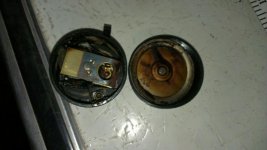
Here is the result of the Throttle operation. The horn is toast the way it looks burnt and melted. should I use an OEM horn or does anyone have a different suggestion. as a replacement?

melted Horn II.jpgMelted Horn.jpgSpark Plugs.jpg
 
As long as the supplied wires will carry the amperage needed, you can install any horn or other warning component you desire. The only drawback is that the other devices will not beep when you turn the key on.... no big deal as you can install a simply toggle switch to test the horn at any time you wish.

If the wires won't handle the amperage needed (gets hot, starts to melt), simply run heavier gauge wires.
 
That expensive horn is an electronic item, not a simple electric item. The other devices will not have that built in third wire but will rather be a two wire component, activated only when voltage is applied via one wire and grounded via the other wire.

The expensive horn is grounded very momentarily thru that third black built in ground wire via the electronic circuit within the horn.

Personally, I'd go the toggle switch route to test the horn (any horn) before I'd put out $65.00 for that plastic thing.
 
Awesome Thanks for the info Joe.

I answered some questions for you and asked some others above in my post above, do you have some answers on the water pump? What else can I check before submitting to the marina? Is removing the head cover and checking the water cooling path a major undertaking? how do I check the thermostats?

Thanks for all your help.
 
The Horn / Siren / Buzzer/ Warning Horn :

I replaced the Horn with a Radio Shack 273-068 This is a water proof horn that is 4-28V DC with either pulsing or consistent tone. The key engaged does not work as expected but the horn works great. It comes with a mounting Ring for a 1 1/4 in hole.

Purple to the positive and Tan to the negative.

This was the second one I tried, I also tried a different 2 wire model that worked as well and was $5 cheaper but was not water proof. I thought it was incompatible because it was going off constantly but upon further investigation there is a problem with the VRO.
 
The lower unit must be removed in order to see/inspect/replace the water pump.

The engine can be run on a flushette, in gear as long as the water is turned on full force, HOWEVER do not increase the rpms beyond 1500 rpm. Advancing the throttle to a high rpm is risking a runaway engine... something you do not want to experience.

It's really impossible to check the waters cooling path. Removing the cylinder heads allows one to check the water passages surrounding the cylinders for salt deposits, and also reveals the condition of the water deflectors.

Checking thermostats.... It's necessary to remove them and watch their function when placed in hot water which would need to exceed 150 degrees.

Spark Check: The spark is not checked with a timing light. It is checked with a spark tester with a gap set to 7/16" for that model engine. The spark must jump that gap with a strong blue lightning like flame... a real SNAP! Testers are available at most automotive part stores... or build the following.

(Spark Tester - Home Made)
(J. Reeves)

You can use a medium size philips screwdriver inserted into the spark plug boot spring connector, then hold the screwdriver shank approximately 7/16" away from the block to check the spark or build the following:

A spark tester can be made with a piece of 1x4 or 1x6, drive a few finishing nails through it, then bend the pointed ends at a right angle. You can then adjust the gap by simply twisting the nail(s). Solder a spark plug wire to one which you can connect to the spark plug boots, and a ground wire of some kind to the other to connect to the powerhead somewhere. Use small alligator clips on the other end of the wires to connect to ground and to the spark plug connector that exists inside of the rubber plug boot.

Using the above, one could easily build a spark tester whereas they could connect 2, 4, 6, or 8 cylinders all at one time.

The ground nail being straight up, the others being bent, aimed at the ground nail. A typical 4 cylinder tester follows:
 
..........X1..........X2
.................X..(grd)
..........X3..........X4

Thousands of parts in my remaining stock. Not able to list them all. Let me know what you need and I'll look it up for you. Visit my eBay auction at
:

http://shop.ebay.com/Joe_OMC32/m.html?_dmd=1&_ipg=50&_sop=12&_rdc=1


You ask about a Carb Check: Check for what?
 
I am concerned if I pop the head to get to the thermostats I will have to replace the head gasket. is this a difficult task. It seems very straight forward but would like some opinions.

My Manual does not have a procedure in removing the lower unit. Usually when this is the case it is straight forward and no big deal is that the case? I did watch the Sticky on this however this is not very descriptive on the removal of the unit.

Do we know how to tell if this unit has SLOW?

I cannot find an issue with the VRO Should I replace the pump or bypass IYP?

what are the water defectors?

Take a look at the plug in the above picture far left. Is that one too clean? could I be getting water in the cylinder? is there another way to check this?

I found a tune up kit on e-bay for 150 with gaskets, water pump and thermostats as well as a couple other items. These items all seem straight forward and things I would not want to but would be required to pay to have completed at the dealer. If I do these before I go to the dealer I am guessing I will have to pay for less and they can focus on the tune up/ identification of the core issue of the RPM / SLOW Restriction.
 
The thermostats are not in the cylinder heads. There are hoses attached to the cylinder heads that leaad to a smaller housing located directly below the large exhaust baffle plate assembly. That smaller housing is where the two thermostats and water bypass valves are located. Quite difficult for the inexperienced to remove/replace but has been done many times with patience.

If the overheat sensor in the port cylinder head has two wires instead of one, the engine has the S.L.O.W. feature.

Water deflectors are actually 3/8" OD rubber fuel tubing that is located in various areas of the water passages in the block/crankcase to divert the water flow properly. THey have been known to swell sideways at times and restrict the water flow.

The water on the s/plug question.... I looked but can't tell. Normally if water is present, water will still exist on the electrodes of the plug.

I suspect that your manual is not specificly for your engine due to the lack of info pertaining to removing the lower unit, and apparently no mention of water deflectors. It would be best to obtain a factory manual specific for that model.
 
Is there a procedure available to remove and replace the Thermostats?

Can you confirm the VRO is to go to the negative lead on the battery lead on the engine and the tan wire?

How do you access the deflectors? by removing the head cover? Is anything gained by removing the head cover?

When I ran the last time there are two black tubes that I am told are exhaust tubes going to a white box. Around this white box there is water that accumulates is this a potential leak in the looking system that could be the source of my issues? It sounds as if this is where you are talking the thermostats are located as well. If this is one in the same perhaps I will drop the lower cowling and check it out. thoughts?
 
Back
Top