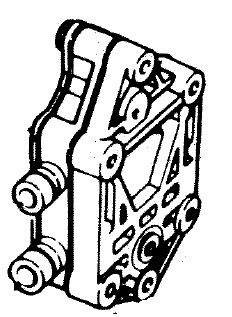
LDL10 = 1965 5hp Johnson.
Yes, you need to pull the flywheel in order to get at the points, etc. You can use a steering wheel puller or a harmonic balance puller. NOTE: Be sure to tighten the flywheel nut to the proper specifications (40-45 Foot Pounds) when re-installing the flywheel. To do otherwise will result in a sheared flywheel key and damaged crankshaft and flywheel tapers.
The noise you hear at the tank indicates that the fuel pump is drawing air. Either install a new "O" Ring in that fuel line fitting or install a new complete fitting. As it stands, the engine is using the fuel in the carburetor to run for a short time, then as the air manages to gain access to the carburetor... your problem occurs.
(Magneto & Driver Coil Alignment)
(J. Reeves)
To align the coils properly, have the metal vertical portion of the coil yokes aligned with the inside edge of the bevel that exists on the top portion of the aluminum seat upon which the coils sit. This creates the proper distance between the coils and the flywheel magnets. Faulty alignment creates friction and the yokes of the coils heat up, turn blue and expand.
********************
(Point Setting Of Magneto Models)
(J. Reeves)
Set the points as follows. Have the flywheel key aligned with the fiber rubbing portion of the ignition points. Adjust the gap so that a .020 gauge will pass thru but a .022 will not. Should there be any question of the points being dirty (touching the contact with your finger would cause them to be dirty), clean them with a small brush and acetone or lacquer thinner.
NOTE 1: Should the operating cam have a small portion on it with the word "SET" imprinted, align this portion with the fiber rubbing portion instead of the flywheel key.
NOTE 2: Should the cam have the word TOP embossed on the top of it, that is a cam that could be installed upside down and this is simply telling you which side is up. It is not a position where one would set the points.
Thousands of parts in my remaining stock. Not able to list them all. Let me know what you need and I'll look it up for you. Visit my eBay auction at:
http://shop.ebay.com/Joe_OMC32/m.html?_dmd=1&_ipg=50&_sop=12&_rdc=1
********************
(Now.... Whichever carburetor your engine may have, adjust as follows

(Carburetor Adjustment - Single S/S Adjustable Needle Valve)
(J. Reeves)
Initial setting is: Slow speed = seat gently, then open 1-1/2 turns.
Start engine and set the rpms to where it just stays running. In segments of 1/8 turns, start to turn the S/S needle valve in. Wait a few seconds for the engine to respond. As you turn the valve in, the rpms will increase. Lower the rpms again to where the engine will just stay running.
Eventually you'll hit the point where the engine wants to die out or it will spit back (sounds like a mild backfire). At that point, back out the valve 1/4 turn. Within that 1/4 turn, you'll find the smoothest slow speed setting.
When you have finished the above adjustment, you will have no reason to move them again unless the carburetor fouls/gums up from sitting, in which case you would be required to remove, clean, and rebuild the carburetor anyway.
--------------------------------------------------
(Carburetor Adjustments - Two Adjustable N/Vs)
(J. Reeves)
Initial settings are: Bottom high speed = seat gently, then open 1 turn out. Top slow speed = seat gently, then open 1-1/2 turns.
Setting the high and low needle valves properly:
NOTE: For engines that DO NOT have a shift selection, obviously there is no NEUTRAL position. Simply lower the rpms to the lowest setting to obtain the low speed needle valve adjustment.
(High Speed) Start engine (it will run pretty rough), shift into forward gear, take up to full throttle. In segments of 1/8 turn, waiting for the engine to respond between turns, start turning in the bottom high speed needle valve. You'll reach a point whereas the engine will either start to die out or spit back (sounds like a mild backfire). At that point, back out the needle valve 1/4 turn. Within that 1/4 turn, you'll find the smoothest setting.
(Low Speed) Slow the engine down to where it just stays running. Shift into neutral. Again in segments of 1/8 turns, start to turn the top needle valve in. Wait a few seconds for the engine to respond. As you turn the valve in, the rpms will increase. Lower the rpms again to where the engine will just stay running. Eventually you'll hit the point where the engine wants to die out or it will spit back. Again, at that point, back out the valve 1/4 turn. Within that 1/4 turn, you'll find the smoothest slow speed setting.
When you have finished the above adjustments, you will have no reason to move them again unless the carburetor fouls/gums up from sitting, in which case you would be required to remove, clean, and rebuild the carburetor anyway.
Thousands of parts in my remaining stock. Not able to list them all. Let me know what you need and I'll look it up for you. Visit my eBay auction at:
http://shop.ebay.com/Joe_OMC32/m.html?_dmd=1&_ipg=50&_sop=12&_rdc=1
********************
And that's what I think!